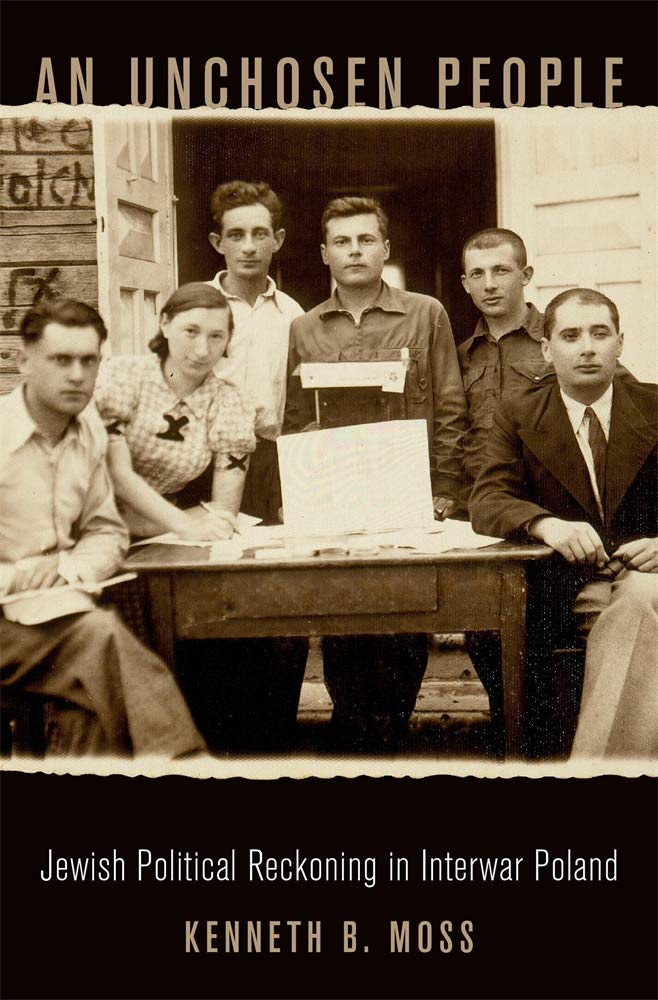
An Unchosen People: Jewish Political Reckoning in Interwar Poland
$46.00
by Kenneth B. Moss



A revisionist account of interwar Europe’s largest Jewish community that upends histories of Jewish agency to rediscover reckonings with nationalism’s pathologies, diaspora’s fragility, Zionism’s promises, and the necessity of choice. What did the future hold for interwar Europe’s largest Jewish community, the font of global Jewish hopes? When intrepid analysts asked these questions on the cusp of the 1930s, they discovered a Polish Jewry reckoning with “no tomorrow.” Assailed by antisemitism and witnessing liberalism’s collapse, some Polish Jews looked past progressive hopes or religious certainties to investigate what the nation-state was becoming, what powers minority communities really possessed, and where a future might be found―and for whom. The story of modern Jewry is often told as one of creativity and contestation. Kenneth B. Moss traces instead a late Jewish reckoning with diasporic vulnerability, nationalism’s terrible potencies, Zionism’s promises, and the necessity of choice. Moss examines the works of Polish Jewry’s most searching thinkers as they confronted political irrationality, state crisis, and the limits of resistance. He reconstructs the desperate creativity of activists seeking to counter despair where they could not redress its causes. And he recovers a lost grassroots history of critical thought and political searching among ordinary Jews, young and powerless, as they struggled to find a viable future for themselves―in Palestine if not in Poland, individually if not communally. Focusing not on ideals but on a search for realism, Moss recasts the history of modern Jewish political thought. Where much scholarship seeks Jewish agency over a collective future, An Unchosen People recovers a darker tradition characterized by painful tradeoffs amid a harrowing political reality, making Polish Jewry a paradigmatic example of the minority experience endemic to the nation-state. “Scholars of Jewish history have devoted a great deal of attention to interwar Poland as the site of a cultural efflorescence that emerged out of the devastation of World War I…Now Kenneth B. Moss…has come to complicate the story, in ways at once surprising and intuitive, in his new book An Unchosen People …The reluctant recourse to Zionism tells us a good deal about the limited agency and sense of futurelessness found among Polish Jews in this age of cultural pessimism. It is a story exceptionally well told…a brilliant affective history of Jewish political culture in interwar Poland…It is one of the merits of Moss’s fine book to show that, for Polish Jews even before the German invasion of 1939, immigration to Palestine was nothing more or less than a path of escape from a hellish abyss, the full depths of which they could not yet imagine.” ― David N. Myers , Los Angeles Review of Books “An insightful, incisive, thoroughly documented study of how interwar Polish Jews understood their situation in real time…In a tour de force of investigation and erudition, [Moss] has uncovered troves of unpublished private correspondence, journals, notes, and memoranda that, taken together with a substantial body of published works, constitute an ongoing conversation in Yiddish, Polish, and Hebrew among some two dozen guiding figures who tried to predict where the increasingly treacherous currents might lead and what Jews might do in response.” ― David Engel , Jewish Review of Books “A substantial contribution to interwar Polish Jewish history, a significant argument in the ongoing conversation about conditions for Jews in prewar Poland…[the author’s] scholarship is prodigious… broadens the dialogue that scholars of the field have engaged in for decades.” ― Sean Martin , H-Net Reviews “An original, provocative, inspiring, challenging, and even haunting book.” ― Piotr J. Wróbel , Journal of Modern History “Unsettling and important…The poignancy of this carefully researched and thoughtful volume lies not only in the story it recounts but in the way it surreptitiously causes the reader to reflect on the fragility of democracy and the rise of extrusionary nationalism in our day.” ― Robert Brym , Canadian Jewish Studies “One of the most important studies of Polish Jewry to appear in years, An Unchosen People is a deeply original exploration of how Jewish political thought in interwar Poland grappled with rising antisemitism and a growing sense of Jewish vulnerability.” ― Samuel D. Kassow, author of Who Will Write Our History?: Rediscovering a Hidden Archive from the Warsaw Ghetto “With stunning erudition and deep compassion for its subjects, An Unchosen People portrays an interwar Polish-Jewish community shaped and sustained by a sense of desperation in the face of a bleak future. Moss’s book bristles with insights about the relationship between global economic crisis, political extremism, and Jewish national identifications in the twentieth century.” ― Derek Penslar, author of Theodor Herzl: The Charismatic