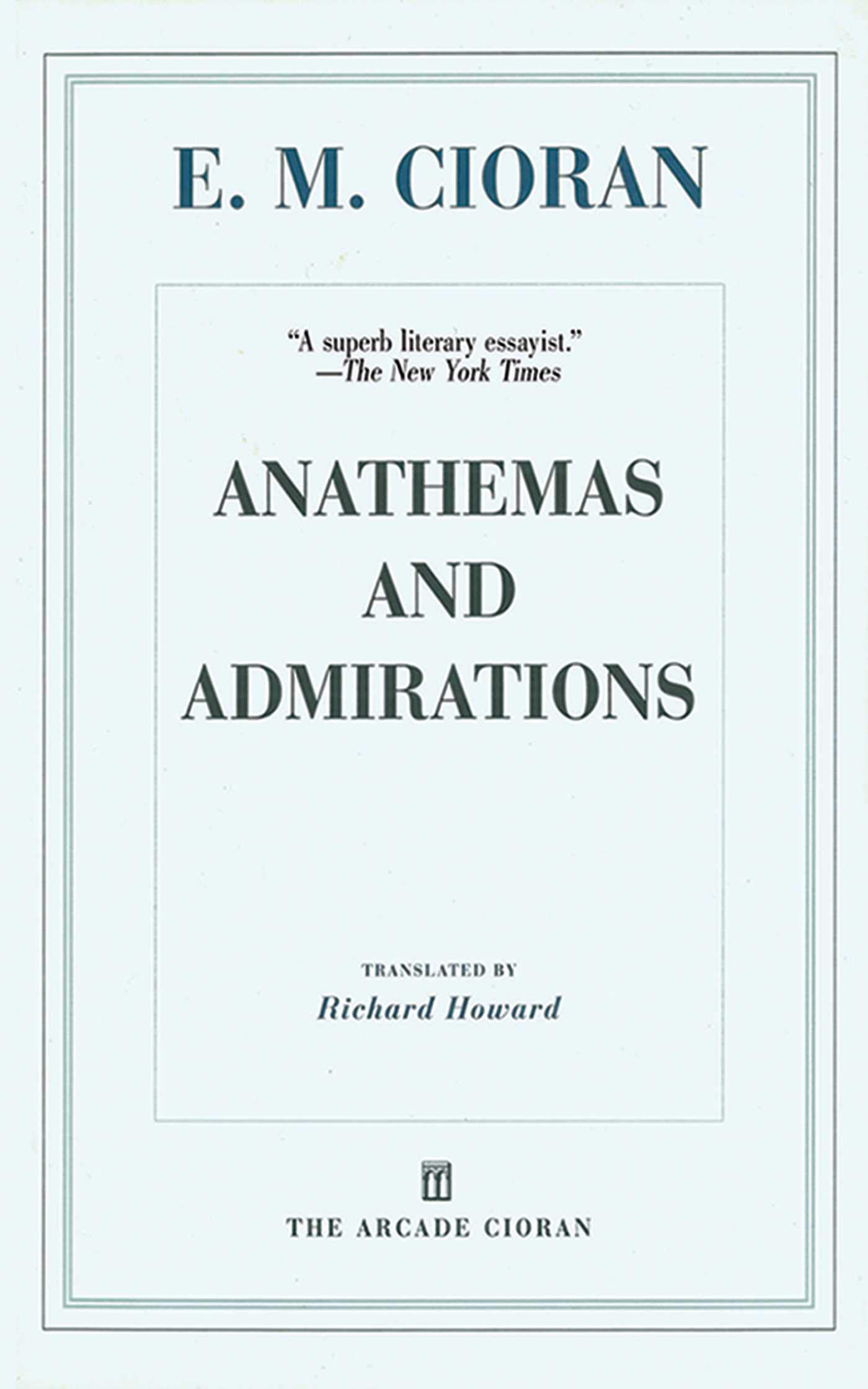



In this collection of essays and epigrams, E.M. Cioran gives us portraits and evaluations—which he calls "admirations"—of Samuel Beckett, Jorge Luis Borges, F. Scott Fitzgerald, the poet Paul Valery, and Mircea Eliade, among others. In alternating sections of aphorisms—his "anathemas"—he delivers insights on such topics as solitude, flattery, vanity, friendship, insomnia, music, mortality, God, and the lure of disillusion. E. M. Cioran left his native land of Romania for Paris in the late 1930s, where he lived and wrote until his death in 1995. His many books include Anathemas and Admirations , A Short History of Decay , and The Trouble with Being Born . Richard Howard is the author of eleven books of poetry, including Untitled Subjects , which won the Pulitzer Prize in 1970. He is the translator for more than 150 works from the French language. He received the American Book Award for his translation of Charles Baudelaire’s Les Fleurs du Mal. Eugene Thacker is the author of several books, including After Life and Horror of Philosophy . He teaches at The New School in New York. Anathemas and Admirations By E. M. Cioran, Richard Howard Skyhorse Publishing Copyright © 1987 Editions Gallimard All rights reserved. ISBN: 978-1-61145-688-2 Contents Foreword, 1 On the Verge of Existence, 2 Joseph de Maistre, 3 Fractures, 4 Valéry Facing His Idols, 5 The Lure of Disillusion, 6 Beckett, 7 Meeting the Moments, 8 Saint-John Perse, 9 Exasperations, 10 Mircea Eliade, 11 That Fatal Perspicacity, 12 Caillois, 13 Michaux, 14 Benjamin Fondane, 15 Borges, 16 Maria Zambrano, 17 Weininger, 18 Fitzgerald, 19 Guido Ceronetti, 20 She Was Not of Their World, 21 Foreshortened Confession, 22 Rereading ..., CHAPTER 1 On the Verge of Existence * * * WHEN CHRIST HARROWED HELL, the Just under the old law — Abel, Enoch, Noah — mistrusted his teaching and made no answer to his call They took him for an emissary of the Tempter whose schemes they feared. Only Cain and those of his race adhered to such doctrine, or professed to, and followed him out of hell. Such was the doctrine of Mareion. "The wicked prosper," that old objection to the notion of a merciful or at least honorable Creator — who consolidated it better than this heresiarch? Who else so acutely perceived its invincibility? * * * Amateur paleontologist, I have spent several months pondering the skeleton. Result: no more than a few pages. ... The subject, it is true, scarcely warrants prolixity. * * * Applying the same treatment to a poet and a thinker strikes me as a lapse in taste. There are realms from which philosophers ought to abstain. To dissect a poem as if it were a system is a crime, even a sacrilege. Oddly enough, the poets exult when they do not understand the pronouncements made upon them. The jargon flatters them, gives them the illusion of preferment. Such weakness demeans them to the level of their glossators. * * * To Buddhism (indeed, to the Orient in general), Nothingness does not have the rather grim signification we attribute to it. It is identified with a limit-experience of light or, if you like, with a state of luminous absence, an everlasting radiant void: Being that has triumphed over all its properties, or rather non-Being supremely positive in that it dispenses bliss without substance, without substratum, without support in any world at all. * * * Solitude: so fulfilling that the merest rendezvous is a crucifixion . * * * Hindu philosophy pursues deliverance; Greek — with the exception of Pyrrho, Epicurus, and a few unclassifiable figures — is a disappointment: it seeks only ... truth. * * * Nirvana has been compared to a mirror that no longer reflects any object. To a mirror, then, forever pure, forever unemployed. * * * Christ having named Satan "Prince of this world," Saint Paul, to go one better, struck home: "God of this world." When such authorities designate our ruler by name, who is entitled to disinherited status? * * * Man is free, save for his depths. On the surface, he does as he likes; down there, will is a meaningless syllable. * * * To disarm the envious, we should take to the streets on crutches. Only the spectacle of our collapse can humanize, to some extent, our friends and our enemies. * * * Rightly, in every age it is assumed we are witnessing the disappearance of the last traces of the earthly paradise. * * * Christ again: according to one Gnostic source, he ascended — in abhorrence of fatum — to trouble celestial arrangements and to prevent any questioning of the heavenly bodies. In such confusion, what can have happened to my poor star? * * * Kant waited until the last days of his old age to perceive the dark side of existence and to indicate "the failure of any rational theodicy." ... Others have been luckier: to them this occurred even before they began to philosophize. * * * Apparently matter, jealous of life, seeks to discover its weak points and to punish