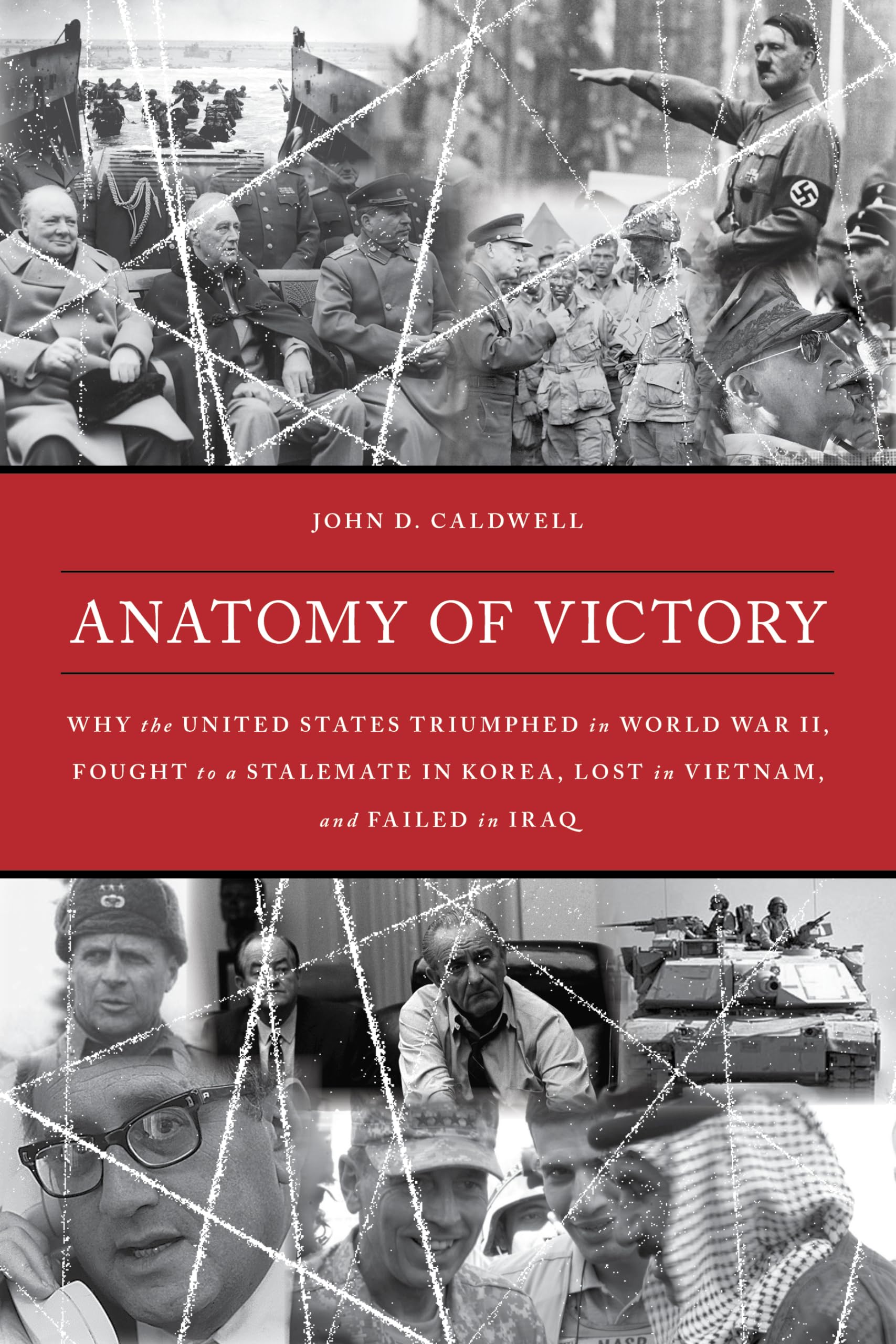
Anatomy of Victory: Why the United States Triumphed in World War II, Fought to a Stalemate in Korea, Lost in Vietnam, and Failed in Iraq
$26.35
by John D. Caldwell



This groundbreaking book provides the first systematic comparison of America’s modern wars and why they were won or lost. John D. Caldwell uses the World War II victory as the historical benchmark for evaluating the success and failure of later conflicts. Unlike WWII, the Korean, Vietnam, and Iraqi Wars were limited, but they required enormous national commitments, produced no lasting victories, and generated bitter political controversies. Caldwell comprehensively examines these four wars through the lens of a strategic architecture to explain how and why their outcomes were so dramatically different. He defines a strategic architecture as an interlinked set of continually evolving policies, strategies, and operations by which combatant states work toward a desired end. Policy defines the high-level goals a nation seeks to achieve once it initiates a conflict or finds itself drawn into one. Policy makers direct a broad course of action and strive to control the initiative. When they make decisions, they have to respond to unforeseen conditions to guide and determine future decisions. Effective leaders are skilled at organizing constituencies they need to succeed and communicating to them convincingly. Strategy means employing whatever resources are available to achieve policy goals in situations that are dynamic as conflicts change quickly over time. Operations are the actions that occur when politicians, soldiers, and diplomats execute plans. A strategic architecture, Caldwell argues, is thus not a static blueprint but a dynamic vision of how a state can succeed or fail in a conflict. “Caldwell, a defense analyst, offers up a strategic survey of America’s major wars since 1941 to determine why the U.S. was victorious in WWII but has not meet its objectives in the major wars since. . . . [For] those who are interested in but have not read deeply on military strategy, this will be illuminating.” ― Publishers Weekly “Caldwell’s book is a reflection of a lifetime spent studying and analyzing U.S wars at several defense think tanks for more than 50 years. . . . As he walks readers though history, Caldwell provides both civilian and military strategists at all levels―including the Presidents―with the necessary information to understand how strategies evolved or disintegrated, succeeded brilliantly or fell short, or simply muddled along, wasting lives and national treasure in the process. . . . For civilian policymakers and military officers alike, Anatomy of Victory will yield lessons not only for strategy, but also for fostering and maintaining healthy relations. . . . Having lived athwart the wars and leaders he profiles, Caldwell has given readers a readable and important work that will help civilian and military leaders refine their abilities to develop and understand grand strategy. As we enter an era of renewed great power competition, these abilities have become vital.” ― Proceedings Magazine, the flagship publication of the U.S. Naval Institute “Excellent! Fills an important void in our understanding about policy, strategy, and operations.” ―H. R. McMaster “Readers can learn from and enjoy every page of this book, which displays the rare ability to seize immediately upon the essence of military questions. Unfortunately, not many of our generals―and far fewer of our elected leaders―have Caldwell’s talent for prescribing the necessities of victory and proscribing the causes of defeat. In masterful summaries that are equal parts history and analysis, he takes us on a truly professional tour of our wars since 1941, allowing us to share his great gift for strategic clarity.” ―Mark Helprin “As interesting a book as it gets. . . . The central problem the author addresses is the unsatisfying outcome to the conflicts after 1945. This is something few of us who witnessed the World War think about. Why has the good Uncle become such a patsy? . . . Caldwell offers a set of guidelines about how to think about involvement in any continuing or future conflict. They make a lot of sense. First and foremost is to align an overseas mission goal with America’s core interests and how to achieve that goal. If alignment fails, however, the mission risks failure beyond America’s control.” ― Takimag “Anatomy of Victory puts four wars side-by-side in a scientific analysis of what went right and what went wrong to produce the differing outcomes in World War II, Korea, Vietnam, and Iraq. . . . Why the wars after 1945 turned out badly is easy to understand―it's in a paragraph on page 431. . . . Caldwell succinctly tells us what went wrong and what you must do if you don't want a failed war. . . . His cogent conclusions define the criteria by which staff leaders must evaluate staff proposals, by which the president must evaluate cabinet proposals, by which Congress must evaluate the work of the executive, and by which the public must judge the performance of its political leaders. . . . None of this has been done for more