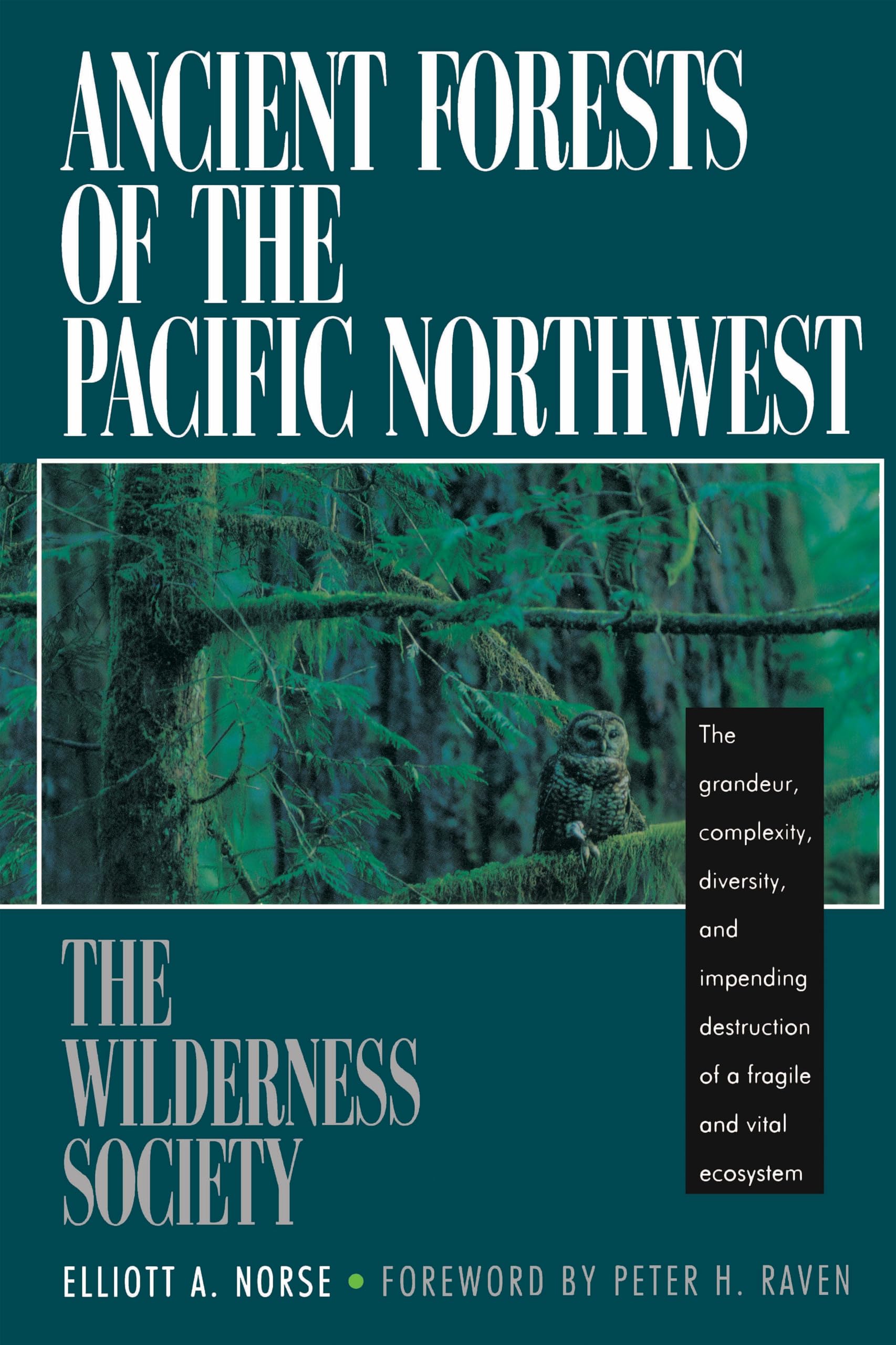



Ancient Forests of the Pacific Northwest provides a global context for what is happening in the Pacific Northwest, analyzing the remaining ancient forest and the threats to it from atmospheric changes and logging. It shows how human tampering affects an ecosystem, and how the Pacific Northwest could become a model for sustainable forestry worldwide. YA-- South America is not the only contintent destroying its forests, as this book accurately points out. Beginning with a brief examination of virgin forests as a global issue, Norse then focuses on the last remaining U. S. ancient forests. He examines in depth the complexity of the forest biome from the largest, oldest Douglas fir to the tiniest microbe, including man's impact on this irreplacable resource. With balance and objectivity, he explains the effects of the timber industry on the ecosystem and urges that we study carefully the interdependency of all life affected by the forest, not with the intention of eliminating the logging interests, but of preserving and restoring the forest so that all its uses may be perpetuated. Students will find a wealth of factual information here. The only drawback is that the book is most effective if read cover to cover, so for researchers who are dabbling, it won't be as useful. Ellen Ramsay, Amphitheater High School, Tucson, AZ Copyright 1991 Cahners Business Information, Inc. Elliot A. Norse is a marine and forest conservation biologist. His Ph.D. and postdoctoral research in the 1970s examined the ecology of blue crabs (Callinectes spp.) in Jamaica, Curacao, Mexico, Panama, and Columbia. Since then, he has devoted his career to incorporating conservation biology into environmental decision making as a staff member or consultant for US federal agencies, international governmental organizations, scientific professional societies, conservation organizations, and foundations. His writings include more than 50 publications on environmental policy, conservation biology, marine ecology, forest ecology, and human-caused climatic change. In 1986, as Public Policy Director of the Ecological Society of America, Elliot Norse worked with The Wilderness Society to write Conserving Biological Diversity in Our National Forests . He is also the author of Ancient Forests of the Pacific Northwest (Island Press, 1989), Global Marine Biological Diversity: A Strategy For Building Conservation Into Decision Making (Island Press, 1993), and Marine Conservation Biology: The Science of Maintaining the Sea's Biodiversity (Island Press, 2005). Ancient Forests of the Pacific Northwest By Elliott A. Norse ISLAND PRESS Copyright © 1990 The Wilderness Society All rights reserved. ISBN: 978-1-55963-016-0 Contents About Island Press, About The Wilderness Society, ELLIOTT A. NORSE, Title Page, Copyright Page, Table of Figures, Preface, Foreword, I - Ancient Forests: Global Resource Global Concern, II - The Forests of the Pacific Northwest, III - The Keys to Understanding, IV - The Biological values of Ancient Forests, Part 1, V - The Biological Values of Ancient Forests, Part 2, VI - Effects of Timber Operations, VII - External Threats to Ancient Forests, VIII - Sustainable Forestry for the Pacific Northwest, IX - Conclusions and Recommendations, Glossary, Suggested Readings, Index, About the Author, Also Available from Island Press, Island Press Board of Directors, CHAPTER 1 Ancient Forests: Global Resource Global Concern The Problem Rio de Janeiro, March 8—Brazil and seven other South American nations that form the Amazon Pact today denounced "foreign meddling" on the issue of preserving the rain forest they share. The pact nations ... threw their full support behind Brazil, which has been accused by environmentalists and industrialized countries of failing to protect the world's largest rain forest.... ... the general secretary of Brazil's Foreign Ministry, Paulo Tarso Flecha de Lima, described the environmentalist accusations as part of "a campaign to impede exploitation of natural resources in order to block [Brazil] from becoming a world power." "The developed countries are not the most prodigious examples when it comes to the environment," he added. (Mac Margolis, "Amazon Nations Back Brazil on Rain Forest," Washington Post, March 9, 1989) Picture the following: At the edge of the Asian, African, or Latin American rainforest, the birds have stopped singing, the mammals have fled as men armed with chainsaws fell the giant trees. Then they burn the land and plant intensively managed crops that cannot support sensitive forest species. In short order, a highly complex ecosystem, whose interacting parts had survived and evolved through eons of change, is gone. Americans have heard a lot about tropical deforestation. We have learned that forest ecosystems moderate climate, create soils, protect water supplies, break down pollutants, generate new medicines, and provide homes