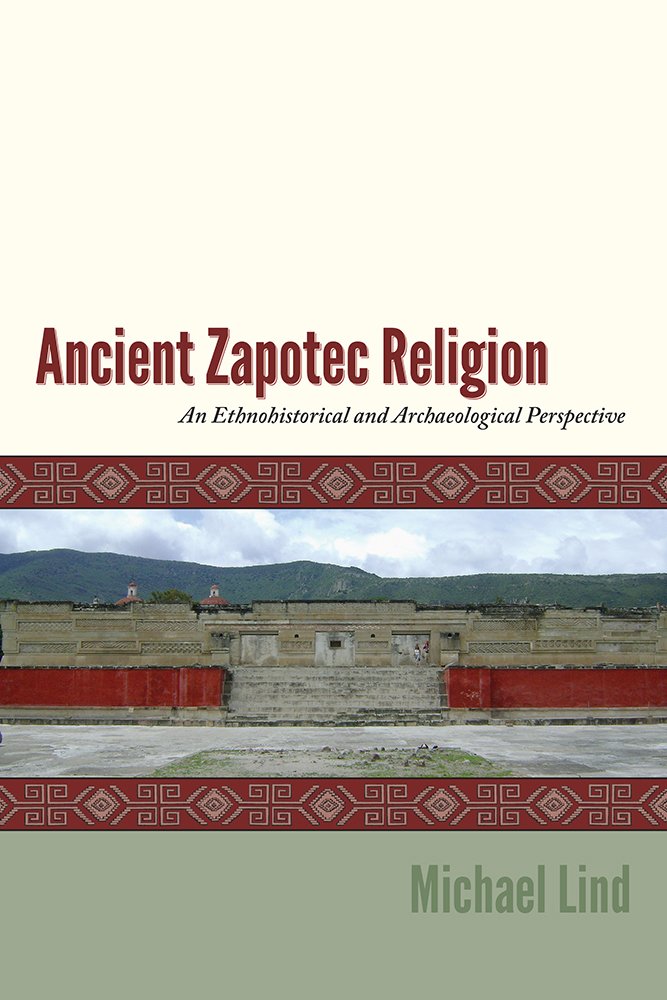
Ancient Zapotec Religion: An Ethnohistorical and Archaeological Perspective
$74.00
by Michael Lind



Ancient Zapotec Religion is the first comprehensive study of Zapotec religion as it existed in the southern Mexican state of Oaxaca on the eve of the Spanish Conquest. Author Michael Lind brings a new perspective, focusing not on underlying theological principles but on the material and spatial expressions of religious practice. Using sixteenth- and seventeenth-century Spanish colonial documents and archaeological findings related to the time period leading up to the Spanish Conquest, he presents new information on deities, ancestor worship and sacred bundles, the Zapotec cosmos, the priesthood, religious ceremonies and rituals, the nature of temples, the distinctive features of the sacred and solar calendars, and the religious significance of the murals of Mitla—the most sacred and holy center. He also shows how Zapotec religion served to integrate Zapotec city-state structure throughout the valley of Oaxaca, neighboring mountain regions, and the Isthmus of Tehuantepec. Ancient Zapotec Religion is the first in-depth and interdisciplinary book on the Zapotecs and their religious practices and will be of great interest to archaeologists, epigraphers, historians, and specialists in Native American, Latin American, and religious studies. “An excellent, impressive piece of scholarship . . . a valuable resource for scholars and students alike.” —Sarah B. Barber, University of Central Florida "As many scholars of Oaxaca and of ancient Mesoamerican religion in general know, there is a paucity of literature on Zapotec religion when compared to what is known about the Maya and Nahua belief systems. Lind’s project is thus timely and offers new insights into this little known area of ancient Zapotec society." —Hilary M. Leathem, Anthropology News " Ancient Zapotec Religion is an authoritatively researched study and provides a very useful synthesis of a complex subject. . . . Scholars of Mesoamerican religions will find [it] a valuable addition to the scholarly literature." — Sixteenth Century Journal "Lind provocatively points to the still understudied, complex and multi-locational realities of religious organization, structure and infrastructural elements of the ancient Zapotec world. Indeed, as the book progresses, the complexity inherent to the world of Zapotec deities is increasingly made known." —Naomi Calnitsky, Anthropology News Michael Lind was an anthropology professor at Santa Ana College in the 1970s and at the Universidad de las Américas in Mexico in the early 1980s. In 1984 he became a bilingual science teacher in the Santa Ana Unified School District, where he remained until his retirement in 2004. He is coauthor of The Lords of Lambityeco . Ancient Zapotec Religion An Ethnohistorical and Archaeological Perspective By Michael Lind University Press of Colorado Copyright © 2015 University Press of Colorado All rights reserved. ISBN: 978-1-60732-373-0 Contents List of Figures, List of Tables, Preface, 1. Introduction, 2. Zapotec Deities in Sixteenth-Century Documents, 3. Zapotec Deities in Seventeenth-Century Documents, 4. Zapotec Temple Priests, 5. Zapotec Temples: Mitla, 6. Zapotec Temples: Yagul, 7. Colaní: Zapotec Community Priests and Their Rituals, 8. Zapotec Ritual Books and Sacred Calendars, 9. The Mitla Murals, 10. Religion in Ancient Zapotec Society, References, Index, CHAPTER 1 Introduction * * * This study is about Zapotec religion as it existed around the time of the Spanish Conquest. Our knowledge of ancient Zapotec religion, like ancient Mesoamerican religions in general, comes principally from Spanish colonial documents ( Nicholson 1971 :396–97). From an analysis of sixteenth- and seventeenth-century documents, the nature of ancient Zapotec religion will be described and interpreted. This description and interpretation includes an identification of Zapotec deities, the role of ancestor worship, the nature of the Zapotec cosmos, the composition of the Zapotec priesthood, the rituals and ceremonies performed, and the use of the Zapotec sacred and solar calendars in religious activities. This study also relies on the archaeological record from the Postclassic, the time period leading up to the Spanish Conquest. Archaeological evidence of the nature of Postclassic Zapotec temples, tombs, ritual areas of palaces, and representations of deities in murals and artifacts also will be discussed. The role of religion in ancient Zapotec society will be examined in the conclusion to this study. SOCIETY, CULTURE, AND RELIGION To place religion within the context of society and culture requires some definitions. A society is a group of people who have a history of interacting with one another behaviorally, such as the ancient Zapotecs, and a culture is the behavior patterns that characterize their interactions. Together, a society and culture form a sociocultural system. From an analytical perspective, a sociocultural system c