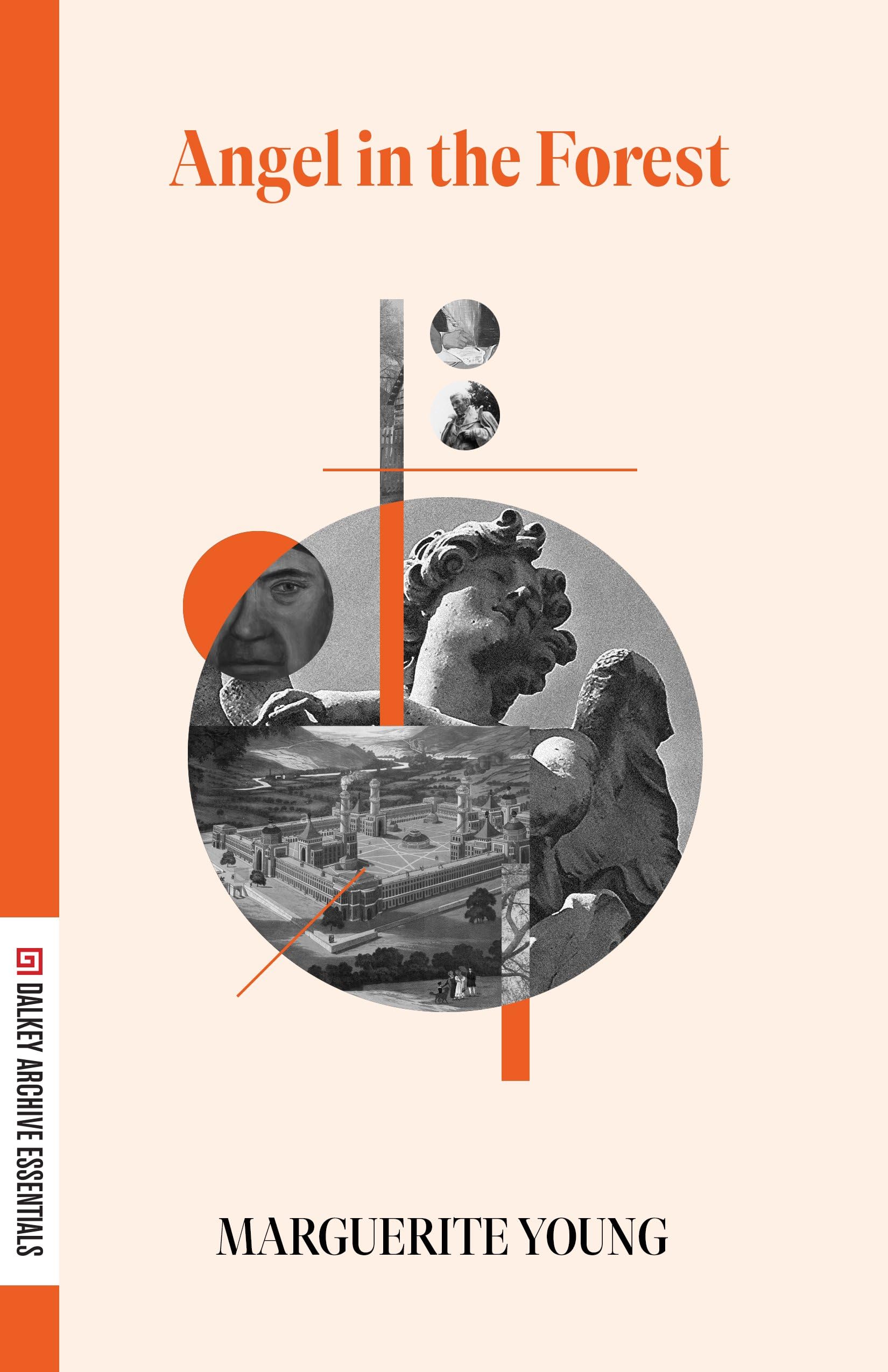
Angel in the Forest: A Fairy Tale of Two Utopias (Dalkey Archive Essentials)
$12.69
by Marguerite Young



Angel in the Forest is Marguerite Young's fascinating chronicle of two attempts to establish utopian communities in nineteenth-century America. In it, she recounts the strange tale of New Harmony, Indiana, a community originally founded in 1814 by the German mystic Father George Rapp, who wanted to apply Scriptural communism to daily life in order to bring about the New Jerusalem. It was sold in 1825 to Robert Owen, the father of British socialism who, with a group of English immigrants, implemented his own theories for a perfect community, this time based on rationalism. Both experiments failed, but Young finds in both a distinctively American yearning for utopia, which continues to characterize the American spirit to this day: a tradition of faith and folly can be traced from Owen's New Moral World to George Bush's New World Order. Written with the same elegance, wit, and lyric beauty that distinguishes her fiction, Angel in the Forest was widely praised upon its first publication in 1945. This edition includes Mark Van Doren's introduction to Scribner's 1966 reprint. A Los Angeles Times Best Book of 2024 “Young’s fables of communal enchantment and disenchantment rhyme with the struggles of the contemporary left to articulate a sufficiently ambitious program of transformation. This is especially true of her most elegant tragicomedy of political imagination, Angel in the Forest , a history of the rise and fall of the two dreaming collectives of New Harmony.” — Bookforum “When a poet chooses to write history facts gain in power and in dimension. Young is a meticulous scholar, but she illumines every description and every character with her laser light of significance. Her facts radiate wit and irony and are incarnated in human beings.” —Anaïs Nin, Los Angeles Times ”One of my very treasured books . . . the best book I know on the subject of the early primitive religious cults. I hope it will get the attention it deserves.” —Katherine Anne Porter “Religious or secular, Young convincingly, brilliantly, and beautifully shows that the only winners in utopia-building are those selling the goods.” — Heavy Feather Review Marguerite Young (1908-1995), born and reared in Indiana, moved to New York City in the 1940s, where she lived for the rest of her life. She is the author of two books of poetry, a collection of essays entitled Inviting the Muses , and two novels, Miss MacIntosh, My Darling (also a Dalkey Archive Essential) and Harp Song for a Radical. “New Harmony Today― A Glimpse in Summer, 1940” You come to old New Harmony by a creaking ferry. It has been operating for fifty years, according to the sign on the iron bell at the Wabash shore. This is a land of rolling hills on either side of the river. Sandpipers are continual migrants between two shores―primitive, they build no nests but holes in mudbanks, so that the hills seem coated with golden birds. Likely enough, there are two blind mules as other passengers on the ferry, and, tied to them like a cart behind them, translucent logs of the fallen birch. Likely enough, the ferryman will never speak a word. Far down the river, a barge turns toward the bend of the hills, the bargeman standing with his legs spread wide against a cloudless sky. Time passes, as the ferry creaks beneath a superfluous toll bridge, the government’s extravagance, for few cross it. Ascending a path that seems to lead nowhere, you come at last to New Harmony, a disappointment. The past is an intangible in Indiana, you find, as in other parts of these abstract United States―a filling station where there were two Utopias, Mr. Babbitt where there was an angel. Surely, a Mexican town would be more flagrant in its tragic beauty, but this is a grayness, and the people are not picturesquely blind, standing outside golden-domed cathedrals or kneeling before a Christ with Indian hair. Our ancestors, always hurried, left little evidence of their existence, if one discounts intangibles, a sundial, an apple a day, an angel in the forest. New Harmony, once so supernatural, has subsided into easy naturalism, like that suggested by James Whitcomb Riley’s poetry. This is, after all, the pocket country, hemmed in by two mighty rivers, the Wabash and Ohio, and some twenty miles, as the crow flies, from that large metropolis, Evansville, a pottery center and wharf for lazy steamboats, mostly imaginary. It is difficult to visualize this secluded area as once the scene of two Utopias, like the Cartesian split between body and soul―the Rappite, a Scriptural communism, founded by Father George Rapp, a German peasant, who believed his people to be future angels―the Owenite, founded by Robert Owen, an English cotton lord, who believed all men to be machines. The end result of Father Rapp’s community, a celibate order, was heaven―and the end result of Robert Owen’s, while also incalculable, was the British labor movement. New Harmony has a charm escaping these and other categories. In 1940, it se