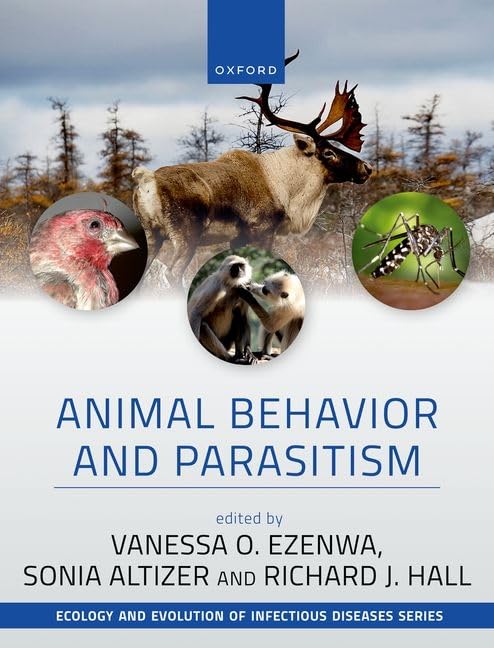
Animal Behavior and Parasitism (Ecology and Evolution of Infectious Diseases)
$130.00
by Vanessa Ezenwa



We live in a world teeming with parasites. Many animal behaviors, including social interactions, mating displays, and decisions about where to move, nest, and forage are shaped by interactions with parasites. The same is true for humans, where our attraction to mates, hygienic behaviors, food choices, and decisions about when and where to gather in groups often depend on current and perceived infection risk. In turn, behaviors like social distancing and self-medication can alter the trajectories of parasite transmission and evolution, as vividly illustrated by the ongoing COVID-19 pandemic. The myriad connections between animal behavior and parasitism have been the subject of growing research interest since the 1970s and 80s, when fundamental theories linking the two fields of study emerged. Since then, a combination of conceptual and technological advances, and increased integration of ideas across disciplines, have helped to uncover fascinating new connections between animal behavior and the ecology and evolution of infectious diseases. This accessible text surveys emerging research in this vibrant field. Chapters focus on fundamental topics at the interface of animal behavior and parasitism, and authors have been selected to provide a diverse and international perspective. Animal Behavior and Parasitism is an upper-level text suitable for senior undergraduate and graduate level students as well as professional researchers in animal behavior/behavioral ecology, disease ecology, parasitology, and evolutionary biology. "Given the myriad effects parasites exert on various facets of host biology and behavior, this scholarly, well-researched text will appeal to a broad range of biologists with widely varying interests." -- Choice "This book gives a timely overview over the many aspects of how parasites can influence animal behaviour and vice versa." -- ISBE Newsletter Vol 36 "The layout is generally pleasing and the text easy to read. Boxes and figure lighten up the text... everyone remotely interested in animal behaviour will be able to learn something from this book." -- Arne Hegemann, ISBE Newsletter Vol 36 Edited by Vanessa Ezenwa , Professor of Ecology and Evolutionary Biology, Department of Ecology and Evolutionary Biology, Yale University, USA, Sonia M. Altizer , Interim Dean and UGA Athletic Association Professor of Ecology, Odum School of Ecology and College of Veterinary Medicine, University of Georgia, USA, Richard Hall , Assistant Professor, Odum School of Ecology and College of Veterinary Medicine, University of Georgia, USA Vanessa Ezenwa is a Professor in the Department of Ecology and Evolutionary Biology at Yale University. She studies interactions between hosts and their parasites from physiological, behavioral, ecological perspectives. She is a senior editor at Ecology letters and President-Elect of the Animal Behavior Society. Sonia Altizer is a Professor in the Odum School of Ecology at the University of Georgia. She studies infectious disease ecology and its interface with animal behavior, anthropogenic change, and evolution. Much of her empirical work focuses on monarch butterflies and a protozoan parasite to better understand the consequences of host movement for animal-pathogen interactions. Richard Hall is an Associate Professor at the Odum School of Ecology and Department of Infectious Diseases at the University of Georgia. He uses mathematical models to study host-parasite interactions and their response to global environmental change, with particular application to migratory animals and behavioral changes associated with urbanization and resource subsidy. He is also an avid birder and wildlife gardener.