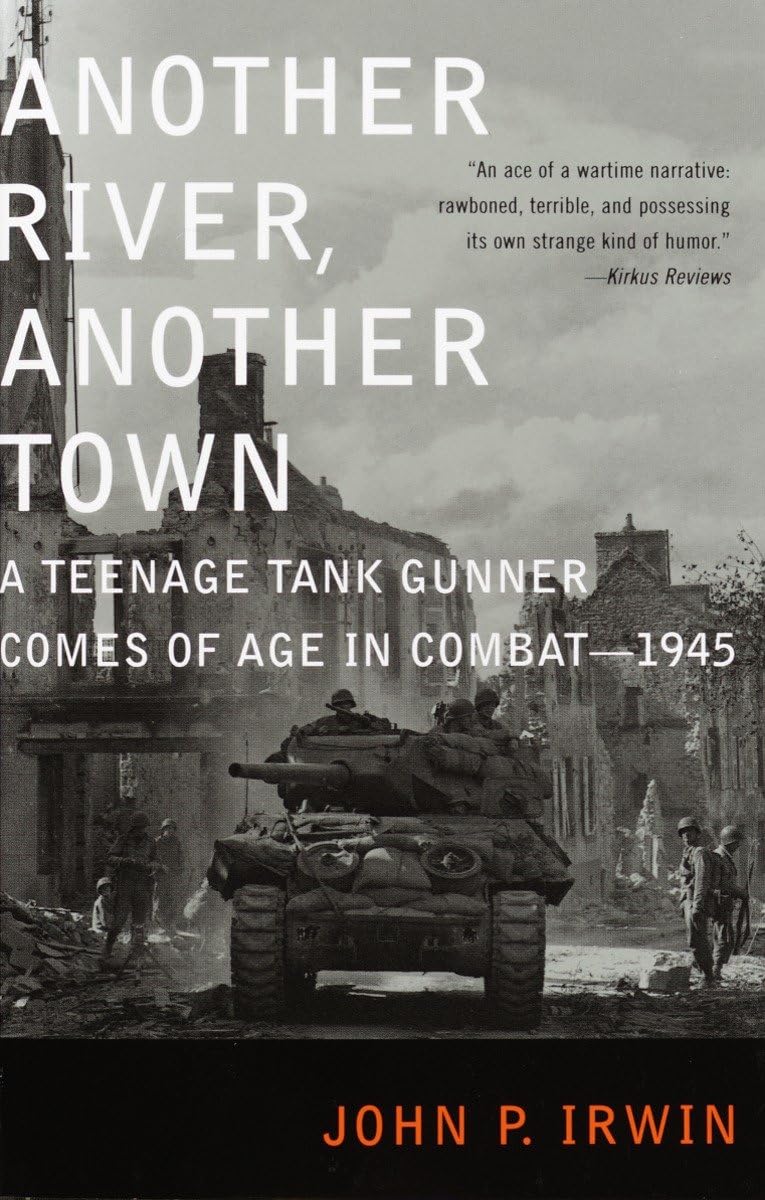
Another River, Another Town: A Teenage Tank Gunner Comes of Age in Combat--1945
$10.99
by John P. P. Irwin



Many narrative accounts of men in combat during World War II have conveyed the horrors and emotions of warfare. However, not many reveal in such an intimate way the struggle of innocent youth to adapt to the primitive code of “kill or be killed,” to transform from lads into combat soldiers. Another River, Another Town is the story of John P. Irwin, a teenage tank gunner whose idealistic desire to achieve heroism is shattered by the incredibly different view of life the world of combat demands. He comes to the realization that the realm of warfare has almost nothing in common with the civilian life from which he has come. The interminable fighting, dirt, fatigue, and hunger make the war seem endless. In addition to the killing and destruction on the battlefield, Irwin and his crew are caught up in the unbelievable depravity they encounter at Nordhausen Camp, where slave laborers are compelled to work themselves to death manufacturing the infamous V-rockets that have been causing so much destruction in London, and that are expected one day to devastate Washington, D.C. At the end of the war, the sense of victory is, for these men, overshadowed by the intense joy and relief they experience in knowing that the fighting is at last over. “In the intensity of the action that followed, I completely forgot about who was doing what. For the moment I forgot how immediate death could be and how vulnerable we all were. I focused on the range marks in my telescopic sight, the machine-gun trigger on the power traverse I was gripping, and the targets I was searching for. The turret smelled like wet diapers, and time once more stopped.”—from Another River, Another Town ve accounts of men in combat during World War II have conveyed the horrors and emotions of warfare. However, not many reveal in such an intimate way the struggle of innocent youth to adapt to the primitive code of kill or be killed, to transform from lads into combat soldiers. Another River, Another Town is the story of John P. Irwin, a teenage tank gunner whose idealistic desire to achieve heroism is shattered by the incredibly different view of life the world of combat demands. He comes to the realization that the realm of warfare has almost nothing in common with the civilian life from which he has come. The interminable fighting, dirt, fatigue, and hunger make the war seem endless. In addition to the killing and destruction on the battlefield, Irwin and his crew are caught up in the unbelievable depravity they encounter at Nordhausen Camp, where slave laborers are compelled to work themselves to death manufacturing the infamous V ve accounts of men in combat during World War II have conveyed the horrors and emotions of warfare. However, not many reveal in such an intimate way the struggle of innocent youth to adapt to the primitive code of “kill or be killed,” to transform from lads into combat soldiers. Another River, Another Town is the story of John P. Irwin, a teenage tank gunner whose idealistic desire to achieve heroism is shattered by the incredibly different view of life the world of combat demands. He comes to the realization that the realm of warfare has almost nothing in common with the civilian life from which he has come. The interminable fighting, dirt, fatigue, and hunger make the war seem endless. In addition to the killing and destruction on the battlefield, Irwin and his crew are caught up in the unbelievable depravity they encounter at Nordhausen Camp, where slave laborers are compelled to work themselves to death manufacturing the infamous V John P. Irwin was born in Norristown, Pennsylvania, in 1926, and enlisted in the army in August 1944. He was honorably discharged in July 1946 and went on to Ursinus College in 1952, eventually earning his Ph.D. in philosophy from Syracuse University. He taught philosophy at Lock Haven University from 1964 until his retirement in 1990. He lives in Lock Haven, Pennsylvania. CHAPTER 1 THE EDUCATION OF A HERO The German breakthrough in the Ardennes forest in France in December of 1944 and January of 1945 created a “bulge” extending into Allied positions. In the ensuing battle, one of the most horrendous and costly conflicts in the European theater in World War II—the Battle of the Bulge—the Allies lost enormous quantities of equipment, men, and supplies. The need to pursue the now retreating Germans required massive replacements of equipment and, especially, men. There was no way the war could continue without them. At that very moment, I was being prepared—along with tens of thousands of other GIs—to help supply the need. I had found my heroic destiny in armored warfare, and my training at Fort Knox, Kentucky, resulted in my qualifying best as a “medium tank gunner.” I was a normal teenager, just eighteen, naïve, ignorant, fully absorbed in myself, and quite certain that I knew all I needed to know about the world—in fact, next to nothing—and was invulnerable to such su