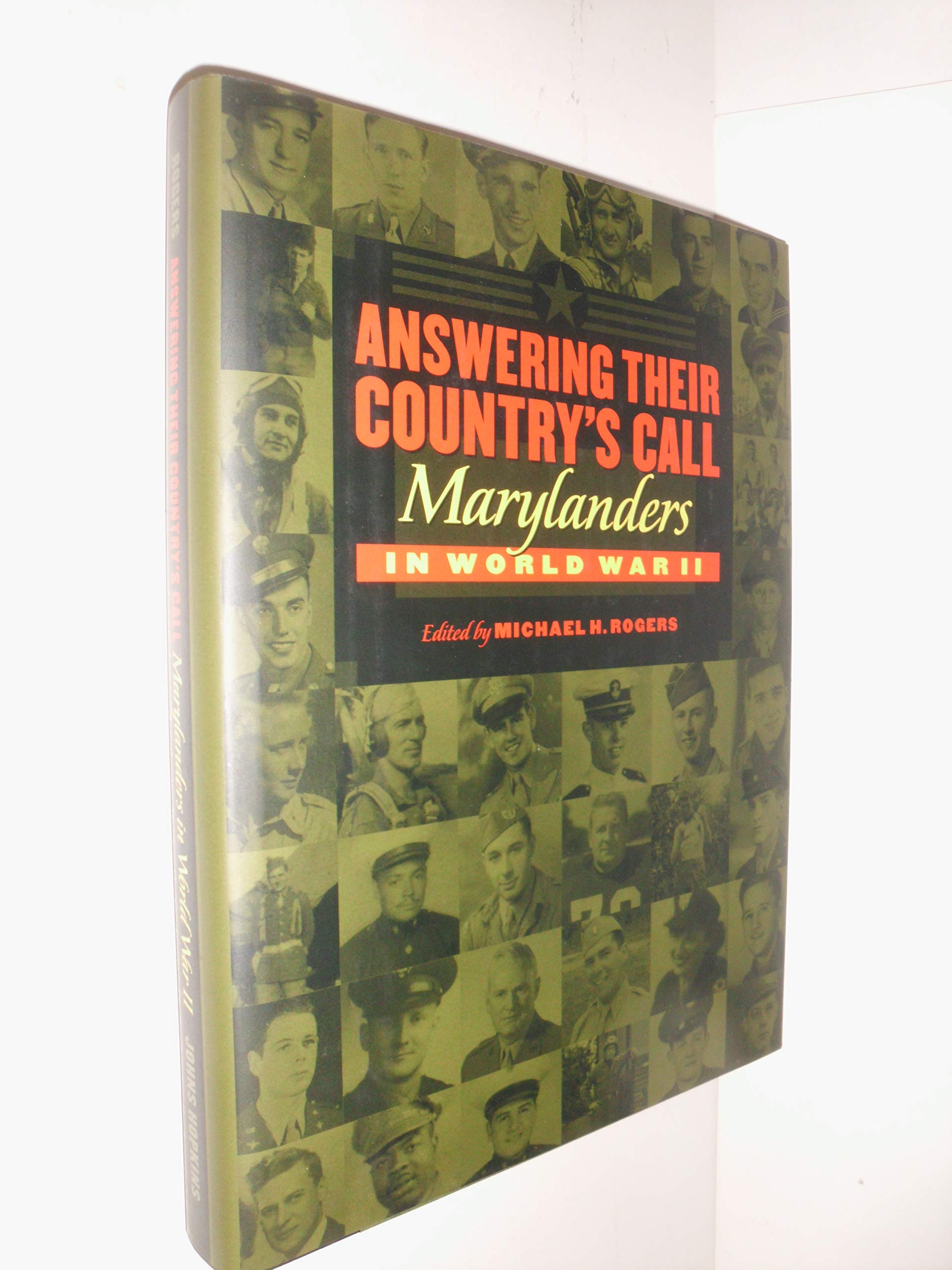



"Time will not dim the glory of their deeds." The inscription on Baltimore's recently razed Memorial Stadium reflects the gratitude we all feel toward the 288,000 Maryland men and women who served their country during the Second World War, especially the 6,454 Marylanders who didn't come home. But while their collective contribution to the cause of world freedom will always be remembered, their individual experiences are being forgotten, their tales of wartime still untold. In Answering Their Country's Call , Michael H. Rogers presents the stories of 31 Marylanders, told in their own words, each shedding new light on the large role played by a small state in the great struggle against tyranny. Among the ordinary citizens thrust into extraordinary circumstances featured in this book are Ensign Calvin S. George, Jr., a Naval Academy graduate who was captured by the Japanese in Manila in 1942 and survived four years of brutal conditions in POW camps and aboard the infamous Japanese "Hell Ships"; Pfc. James A. Kane, a medic in the 92nd Division―the famous "Buffalo Division"―who lost his right leg trying to reach a wounded soldier in Italy and was awarded the Purple Heart and Bronze Star; Dorothy E. Steinbas Davis, R.N., who served with the 57th Field Hospital in Europe, which treated wounded soldiers during the Battle of the Bulge; and Baltimore Colts legend Art Donovan, who served in the Marines as an anti-aircraft gunner on the carrier San Jacinto before being transferred to a machine gun crew on Okinawa. Each of these autobiographical pieces describes remarkable feats of courage; some offer harrowing accounts of combat, while others focus on vital duties carried out just behind the front lines. All provide personal views of World War II that reveal the mundane, unusual, and sometimes bizarre details of life during wartime. This riveting and often moving book pays tribute to all those who answered their country's call. I had survived four years in Japanese prison camps, during which time I had been reduced from 155 pounds to 80 pounds. But I was alive. The single most important thing that kept me alive was hope. Hope is the most powerful thing in the world. During my imprisonment, all I could think of was returning home to see Margaret. Although thousands of miles away, she saved my life every day. ( Calvin S. George Jr., USS Peary, U.S. Navy ) I have read the book and found it most remarkable... Mr. Rogers skillfully tells about the people he interviews, how they grew up and, what they made of themselves after they came back from war, so that you already know them before you come to the interesting training part and finally going to war. (Kalevi Olkio Harbor Lights Newsletter ) We nurses were not very glamorous during the war. We wore the same uniforms as the combat soldiers. We washed our clothes in our helmets, and during the Battle of the Bulge we went a month without shower facilities and used our all-purpose helmet for sponge baths. We usually wore some lipstick, mostly for our own morale... I think there is a problem with the way we write history about the war, and many sources do not realize that nurses and the American Red Cross women were right up there on the front lines with the men. (Dorothy E. Steinbis Davis, R.N. 57th Field Hospital, U.S. Army Medical Corps) I think we knocked out tanks with pure nerve. You get the nerve up because it's a case of do or die. If a tank was coming at you, you knew you had to get it even if it meant climbing on top of it to find a way to stop it. It was natural to be afraid in war, and a tank is a particularly scary thing. But I didn't really think about being scared at the time. I just reacted to the task at hand and made sure I and my men got the job done. (Joseph A. Farinholt, 29th Infantry Division, U.S. Army) The 366th was the first and last all-black outfit in the Army, and today people just wouldn't believe how we were treated... Leon Duncan, one of my friends killed in the ambush in Italy, once asked me if I thought we would be allowed to sit on the bench on Main Street when we got back to Berlin. He'll never know that answer was still no for many years after the war. (Joseph W. Purnell Sr., 366th Infantry Regiment, U.S. Army) Michael H. Rogers attended Rutgers University and has worked in ballpark operations for the Baltimore Orioles and the minor-league Bridgeport Bluefish. He currently works for the Maryland State Lottery Agency.