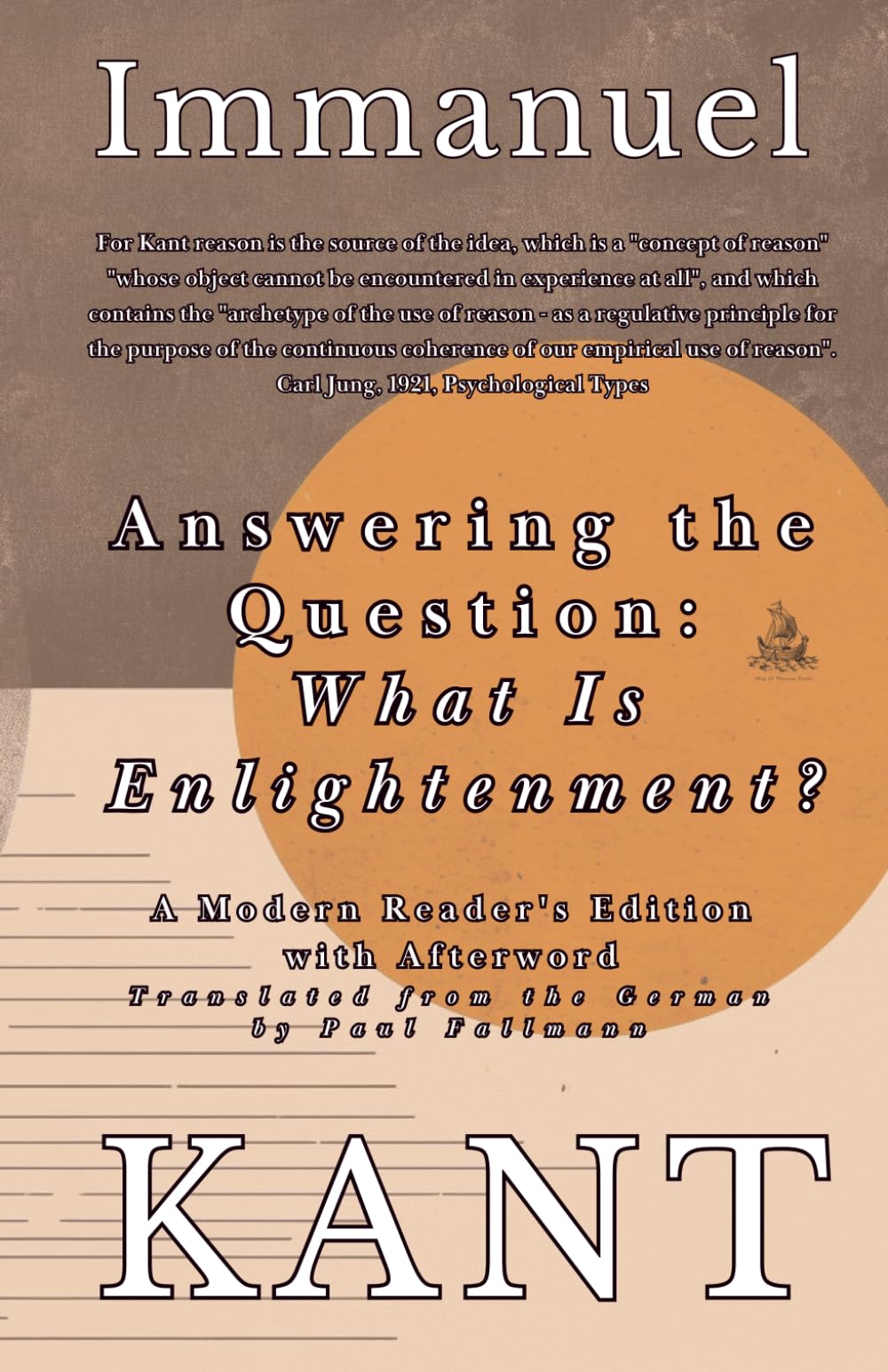



Published in 1784 in the Berlinische Monatsschrift, Immanuel Kant’s Answering the Question: What Is Enlightenment? (Beantwortung der Frage: Was ist Aufklärung?) emerged as a direct philosophical response to contemporary debates sparked by Voltaire and the broader European Enlightenment. Prompted by the journal’s invitation to intellectuals to define the meaning of enlightenment itself, Kant takes a position distinct from Voltaire’s sharp skepticism, emphasizing instead the individual's liberation from self-imposed intellectual immaturity. His memorable declaration—“Sapere aude!” (“Dare to know!”)—positions the text as both an explicit reply to Voltaire’s satirical critique of authority and tradition and a foundational call to intellectual independence grounded in moral responsibility. This Reader's Editon edition contains an Afterword by the translator, a timeline of Kant's life and works, and a helpful index of Kant's key concepts and intellectual rivals. This translation is designed for readability, rendering Kant's enigmatic German into the simplest equivalent possible, and removing the academic footnotes to make this critically important historical text as accessible as possible to the modern reader. Kant defines enlightenment as the process of freeing oneself from self-imposed immaturity, caused primarily by a lack of courage to use one's intellect without the guidance of others. The essay emphasizes the role of individual reason and the importance of independent thought, criticizes the tendency of people to rely on others for understanding and moral guidance, and advocates the public use of reason as a pathway to enlightenment, distinguishing between the public and private use of reason and emphasizing the social implications of enlightenment and the limitations on individual freedom. This work is significant for its exploration of the concepts of freedom, reason, and autonomy in the context of the Enlightenment. This defined enlightenment as "humanity's emergence from its self-incurred immaturity," the inability to use one's understanding without guidance from another, proclaiming "Sapere aude!"—"Have courage to use your own understanding!"—as the motto of enlightenment. Kant argued that laziness and cowardice keep people in perpetual tutelage long after nature has freed them from external direction, making it easy for self-appointed guardians to maintain control by offering books to understand for them, pastors to provide conscience, and physicians to dictate diet. The essay distinguished between the public use of reason (discourse in the public sphere through writings, which must remain free) and the private use of reason (arguments made while fulfilling official duties, which may be restricted), famously praising Frederick II of Prussia with the maxim "Argue as much as you will, and about what you will, but obey!" Kant insisted that no age can bind future generations through unalterable doctrines or perpetual guardianship, declaring such contracts crimes against human nature whose destiny lies in progress toward enlightenment. Written as one of fifteen articles for the *Berlinische Monatsschrift* responding to the journal's question about the nature of enlightenment, the essay became a foundational document of German liberalism while acknowledging that his was "an age of enlightenment" where emancipation had become possible but not yet "an enlightened age," since revolution can overthrow despotism but "never a true reform in ways of thinking," which can only occur slowly through the gradual spread of independent thinkers disseminating the spirit of rational self-valuation once they cast off the yoke of minority.