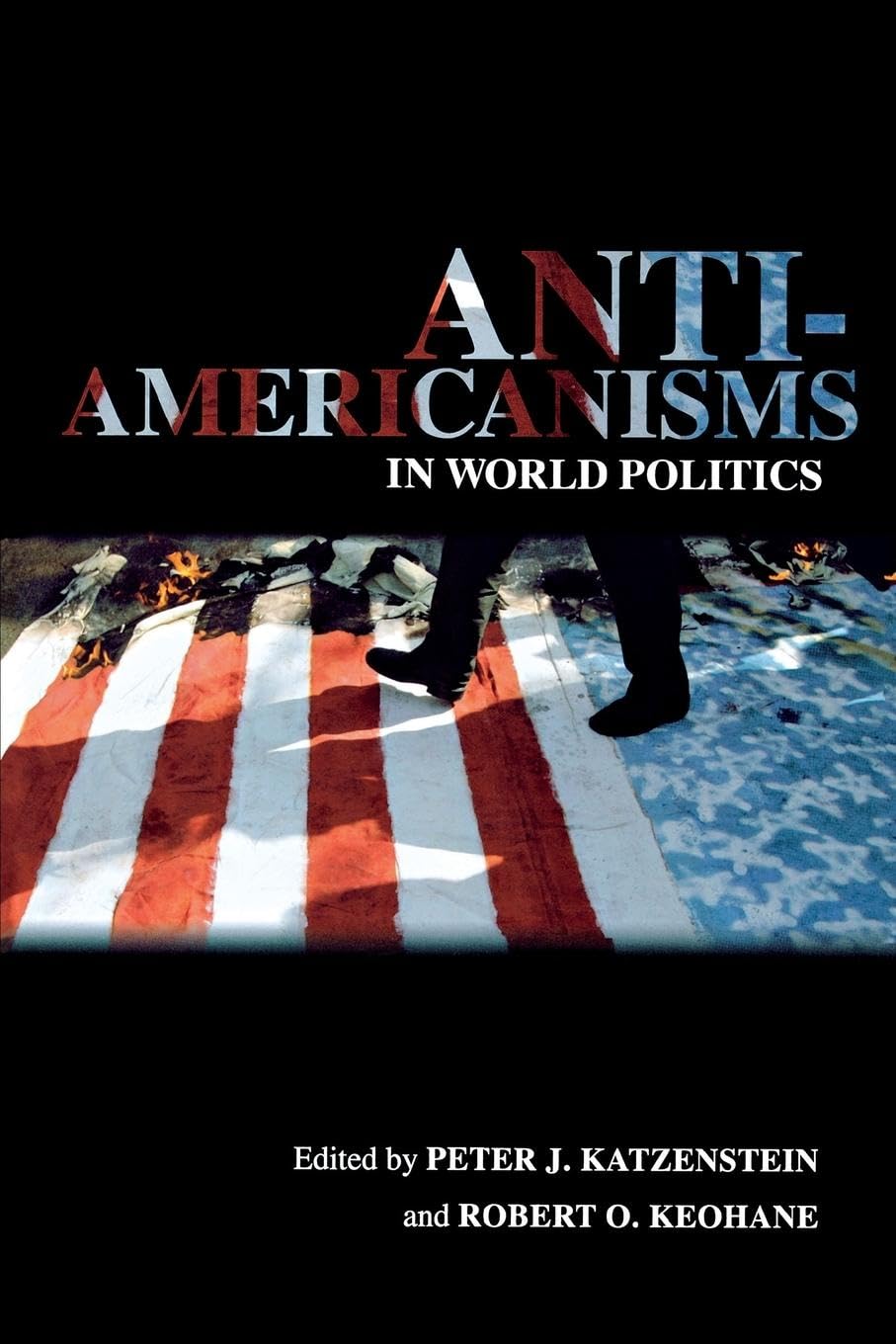
Anti-Americanisms in World Politics (Cornell Studies in Political Economy)
$14.50
by Peter J. Katzenstein



Anti-Americanism has been the subject of much commentary but little serious research. In response, Peter J. Katzenstein and Robert O. Keohane have assembled a distinguished group of experts, including historians, polling-data analysts, political scientists, anthropologists, and sociologists, to explore anti-Americanism in depth, using both qualitative and quantitative methods. The result is a book that probes deeply a central aspect of world politics that is frequently noted yet rarely understood. Katzenstein and Keohane identify several quite different anti-Americanisms-liberal, social, sovereign-nationalist, and radical. Some forms of anti-Americanism respond merely to what the United States does, and could change when U.S. policies change. Other forms are reactions to what the United States is, and involve greater bias and distrust. The complexity of anti-Americanism, they argue, reflects the cultural and political complexities of American society. The analysis in this book leads to a surprising discovery: there are as many ways to be anti-American as there are ways to be American. Is anti-American sentiment as rampant as it seems' In their new edited volume, Anti-Americanisms in World Politics, international relations scholars Peter Katzenstein and Robert Keohane bring together a distinguished group of social scientists to consider how much anti-Americanism there is, and whether, in fact, anti-Americanism is any one thing at all. The plural 'anti-Americanisms' in the book's title reveals its core insight: Anti-Americanism is not a single, unitary phenomenon.... Too often commentators who have written on anti-Americanism make do with anecdotal evidence: The burning of an American flag, or a chilly electoral climate for politicians who are seen as kowtowing to United States interests, are taken as signs that anti-Americanism is on the rise. By contrast, most contributors to the Katzenstein and Keohane volume rely on quantitative evidence from large-scale social surveys. Two especially noteworthy findings emerge. First, fewer people around the globe hate the United States than might be imagined.... Second, in most countries, anti-Americanism involves more distrust than outright bias. The distinction is crucial. Where there is distrust, people may be skeptical of US motives and claims, but are open to considering the American point of view. -- Neil Gross ― Boston Globe Whereas most other books on the topic either focus on anti-Americanism in one country or analyze it as a single worldwide phenomenon, this book makes a significant contribution by explicitly comparing the intensity of anti-American views across countries and regions and by emphasizing the variety of attitudes toward America even within one society. -- Ido Oren, University of Florida "Whereas most other books on the topic either focus on anti-Americanism in one country or analyze it as a single worldwide phenomenon, this book makes a signfiicant contribution by explicitly comparing the intensity of anti-American views across countries and regions and by emphasizing the variety of attitudes toward America even within one society."-Ido Oren, University of Florida Peter J. Katzenstein is Walter S. Carpenter, Jr. Professor of International Studies at Cornell University. His books include A World of Regions, Beyond Japan, Cultural Norms and National Security , and Small States in World Markets , all from Cornell. Robert O. Keohane is Professor of International Affairs, Woodrow Wilson School of Public and International Affairs, Princeton University. His books include After Hegemony: Cooperation and Discord in the World Political Economy, Power and Governance in a Partially Globalized World , and, with Joseph S. Nye, Jr., Power and Interdependence .