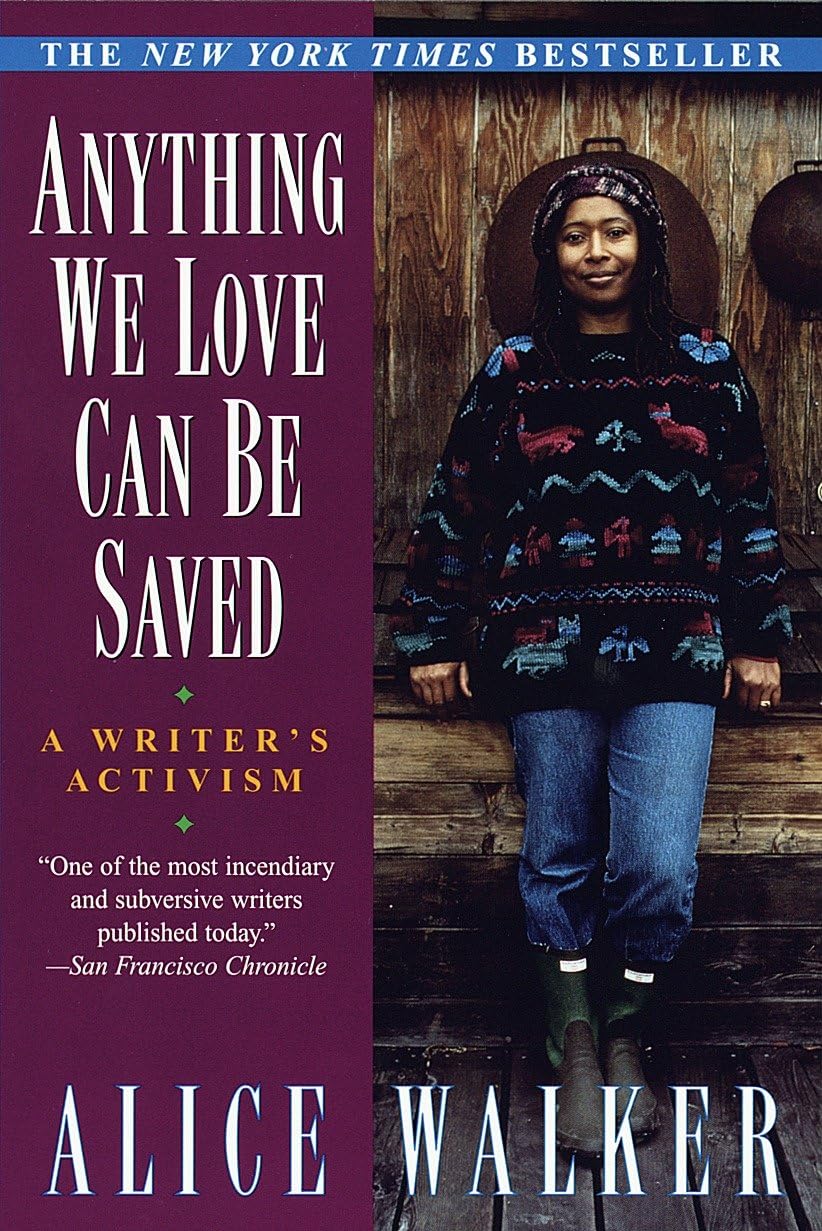



In Anything We Love Can Be Saved , Alice Walker writes about her life as an activist, in a book rich in the belief that the world is saveable, if only we will act. Speaking from her heart on a wide range of topics--religion and the spirit, feminism and race, families and identity, politics and social change--Walker begins with a moving autobiographical essay in which she describes her own spiritual growth and roots in activism. She goes on to explore many important private and public issues: being a daughter and raising one, dreadlocks, banned books, civil rights, and gender communication. She writes about Zora Neale Hurston and Salman Rushdie and offers advice to Bill Clinton. Here is a wise woman's thoughts as she interacts with the world today, and an important portrait of an activist writer's life. I was so taken with this book. Reading about the various important points in Alice's life was so fascinating. It helped see the shape and formation and the inner spirit and life of the author of one of my all time favorite books, The Color Purple. thing We Love Can Be Saved, Alice Walker writes about her life as an activist, in a book rich in the belief that the world is saveable, if only we will act. Speaking from her heart on a wide range of topics--religion and the spirit, feminism and race, families and identity, politics and social change--Walker begins with a moving autobiographical essay in which she describes her own spiritual growth and roots in activism. She goes on to explore many important private and public issues: being a daughter and raising one, dreadlocks, banned books, civil rights, and gender communication. She writes about Zora Neale Hurston and Salman Rushdie and offers advice to Bill Clinton. Here is a wise woman's thoughts as she interacts with the world today, and an important portrait of an activist writer's life. In Anything We Love Can Be Saved, Alice Walker writes about her life as an activist, in a book rich in the belief that the world is saveable, if only we will act. Speaking from her heart on a wide range of topics--religion and the spirit, feminism and race, families and identity, politics and social change--Walker begins with a moving autobiographical essay in which she describes her own spiritual growth and roots in activism. She goes on to explore many important private and public issues: being a daughter and raising one, dreadlocks, banned books, civil rights, and gender communication. She writes about Zora Neale Hurston and Salman Rushdie and offers advice to Bill Clinton. Here is a wise woman's thoughts as she interacts with the world today, and an important portrait of an activist writer's life. Alice Walker won the Pulitzer Prize and the National Book Award for her novel The Color Purple. Her other novels include By the Light of My Father’s Smile and Possessing the Secret of Joy. She is also the author of three collections of short stories, three collections of essays, seven volumes of poetry, and several children’s books. Born in Eatonton, Georgia, Walker now lives in Northern California. Introduction: Belief in the Love of the World This book begins with the essay “The Only Reason You Want to Go to Heaven Is That You Have Been Driven Out of Your Mind (Off Your Land and Out of Your Lover’s Arms): Clear Seeing Inherited Religion and Reclaiming the Pagan Self.” In it I explore my awareness, beginning in childhood, of the limitations of the patriarchal Christianity into which I was born; as well as my realization, over time, that my most cherished instinctual, natural self, the pagan self, was in danger of dying from its oppression by an ideology that had been forced on my ancestors, under threat of punishment or death, and was, for the most part, alien to me. That essay, which was delivered in a seminary in April of 1995, is followed by one about a meeting with people working toward the abolition of female genital mutilation in Bolgatanga, Northern Ghana, that occurred in April of 1996. The book ends with an essay entitled “My Mother’s Blue Bowl,” which grew out of my grieving for my mother after her death, in 1993, and the eventual solace I have taken in memories of all the ways in which she sacrificed to give me life, and fullness of life. Preceding that essay, there is a letter to President Clinton protesting the recent tightening of the thirty-seven-year-old U.S. blockade of Cuba, which threatens everyone in that island country with starvation. There are pieces on the resurrection of Zora Neale Hurston, the trials of Winnie Mandela, the experience of being both praised and banned as a writer, and the joy of discovering the Goddess in places we’ve been ashamed to look. There is also an essay on the sustaining miracle of Sweet Honey in the Rock, another on the beauty of dreadlocks, and another on how the life of an activist can be hard on her cat. I also write about our timid acceptance, as women, of language that “disappears” us, of the strength