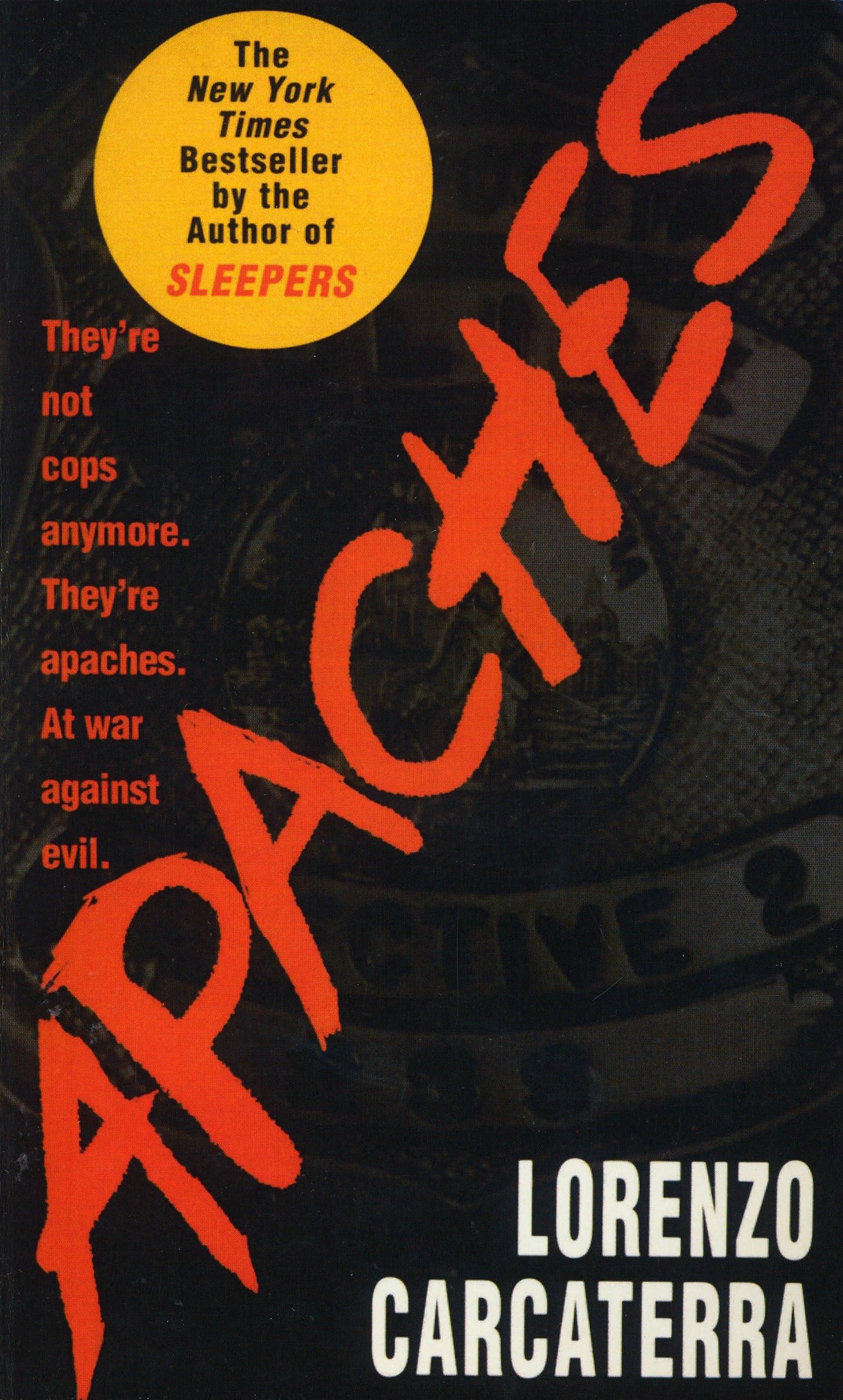



They're not cops anymore. They're apaches. At war against evil. “Pulp noir . . . Apaches showcases [Lorenzo] Carcaterra's ability to create chillingly evil characters and a world horrifying in its depravity.”— The Washington Post Book World Boomer. Dead-eye. Pins. Geronimo. Reverend Jim. Mrs. Columbo. Legends of the NYPD, they were great cops. The best cops. But they are cops no more. Now they are apaches, a renegade unit working on their own—reunited to bring down the most vicious criminal working in New York City today. . . . Praise for Apaches “One of the most intriguing writers around . . . Readers will no doubt die for this stuff.” — Newsweek “A compellingly readable novel . . . Think of it as The Magnificent Seven Does New York. ” — The Dallas Morning News “[Carcaterra] writes with the passion of Styron, the guts of Mailer, and the sting of James M. Cain.” —William Diehl “Pulp noir . . . Apaches showcases [Lorenzo] Carcaterra's ability to create chillingly evil characters and a world horrifying in its depravity.” — The Washington Post Book World “One of the most intriguing writers around . . . Readers will no doubt die for this stuff.” — Newsweek “A compellingly readable novel . . . Think of it as The Magnificent Seven Does New York. ” — The Dallas Morning News “[Carcaterra] writes with the passion of Styron, the guts of Mailer, and the sting of James M. Cain.” —William Diehl It was incredibly exciting to work on Lorenzo's first work of fiction. The pages came in batches at first, then all at once. But each early batch of pages was like going to the old movie serials, never knowing what would happen to our hero in the next episode. A. Scheibe -Eye. Pins. Geronimo. Reverend Jim. Mrs. Columbo. Legends of the NYPD, they were great cops. The best cops. But they are cops no more. Now they are apaches, a renegade unit working on their own.--reunited to bring down the most vicious criminal working New York City today. . . . Boomer. Dead-Eye. Pins. Geronimo. Reverend Jim. Mrs. Columbo. Legends of the NYPD, they were great cops. The best cops. But they are cops no more. Now they are apaches, a renegade unit working on their own -- reunited to bring down the most vicious criminal working New York City today.... Lorenzo Carcaterra is the #1 New York Times bestselling author of Sleepers, A Safe Place, Apaches, Gangster, Street Boys, Paradise City, Chasers, Midnight Angels, and The Wolf . He is a former writer/producer for Law & Order and has written for National Geographic Traveler, The New York Times Magazine, Details, and Maxim. He lives in New York City with Gus, his Olde English Bulldogge, and is at work on his next novel. Boomer GIOVANNI “BOOMER” FRONTIERI never wanted to be a cop. He was a three-letter athlete during his school years at St. Bernard’s Academy, a private high school in downtown Manhattan his parents insisted he attend. He would leave their cold-water railroad apartment each morning before sunup and return each evening after dark, eating dinner and doing homework at the kitchen table facing the fire escape. He was a model student, never complained about his packed schedule, and kept the friends he trusted to a minimum. He had two younger sisters, Angela and Maria, whom he would either dote on or ignore, depending on his mood. His older brother, Carmine, had already dropped out of school and followed their father, John, into the heavy-lifting, well-paying labor of the meat market. Their relationship was reserved, at best. John Frontieri was a stern man who commanded respect and demanded his family’s full attention. His upper body, conditioned by years of lugging 250-pound hindquarters off the backs of refrigerated trucks, was a weight lifter’s dream. He was quick to give a slap of the hand to one of the children if he felt they were out of line, but never hit or screamed at his wife, Theresa, a homely, chunky woman whose face displayed a weariness far greater than her years. On spring and summer Sunday mornings, after the nine o’clock mass, Johnny Frontieri would change quickly out of his blue dress suit and into work pants, construction shoes, and a sweatshirt. He and little Giovanni would then take their fishing poles and tackle down from the living room closet and rush out of the apartment for a twenty-minute subway ride downtown. There, after a brisk walk, the two would spend the day, feet brushing the sand on the edges of the East River, their backs to the Manhattan Bridge, fishing for whatever could survive the currents. It was their time together. “If I catch a shark, can I stay home from school tomorrow?” Giovanni, then nine, asked his father. “You catch a shark,” John said, “and you can stay home from school for a month.” “What about if I catch an eel?” “You reel an eel and I’ll make you go to school on weekends,” John said. The two looked at one another and laughed, the morning sun creeping past the e