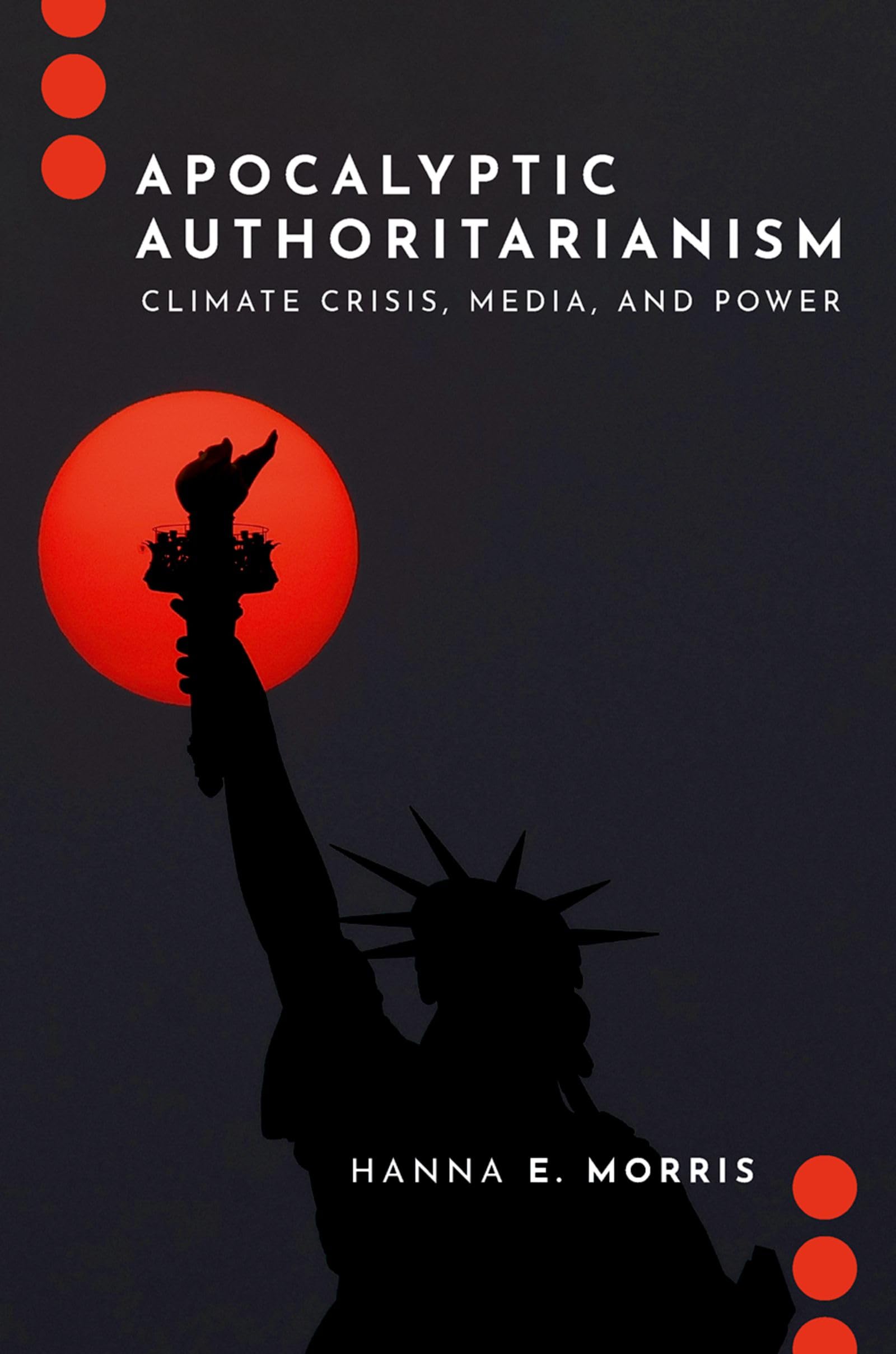
Apocalyptic Authoritarianism: Climate Crisis, Media, and Power (Journalism and Political Communication Unbound)
$23.14
by Hanna E. Morris



As climate change brings devastation to all areas of the world, and U.S. journalists cover these threats more extensively, climate reporting needs to be evaluated. Media representations of the climate crisis are critical because they influence what responses are taken and policies enacted. In Apocalyptic Authoritarianism , media scholar Hanna E. Morris reveals how national anxieties following the 2016 presidential election have shaped American news coverage of climate change in ways that severely limit how it has come to be known, imagined, and contended with. Looking at climate change reporting across prominent and ideologically diverse U.S. newspapers and magazines over the past decade, the book traces how news media create an illusion of control in the present through nostalgic and heroic stories of the past. Morris identifies a new mode of reactionary politics called "apocalyptic authoritarianism" to describe the post-2016 alignment of historically privileged figures united by a common enemy of the "new" New Left and a shared appeal to fears of "total crisis." Their antidemocratic paradigm portends national and planetary disarray if progressive social and climate justice "warriors" are not controlled at home and if "unruly masses" of climate migrants are not contained abroad. Ultimately, Morris calls for a robust and inclusive form of climate journalism and politics to facilitate--and not impede--democratic and equitable responses to climate change. "By illustrating how the obsession with "fixing" the Earth can be, at best, unhelpful and, at worst, paralyzing, Apocalyptic Authoritarianism makes a significant contribution to the ongoing conversation about how the press and policymakers can more effectively foster inclusive, nuanced, and meaningful discussions around the necessary measures for addressing climate change." -- Yaroslava Kutsai, Mass Communication and Society "In my view, one of the book's most significant contributions could be applicable across diverse national contexts, it is in fact its critique of the 'simplistic binary of right and wrong' that plagues American climate discourse, leaving 'little room for context and nuance.' This insight invites scholars and practitioners to rethink how climate communication can foster inclusivity, complexity, and democratic engagement rather than fear-driven authoritarianism." -- Marianna Poberezhskaya, Environmental Politics "Morris (Univ. of Toronto, Canada) suggests that journalism about climate change frequently adopts the frame that climate change is an inevitable environmental and socioeconomic catastrophe unless the recommendations of historically privileged experts are heeded and followed. ...Recommended for doctoral mass communication program collections in higher education and environmental studies. Comprehensive notes." -- R. A. Logan, CHOICE Hanna E. Morris is an Assistant Professor at the School of the Environment at the University of Toronto and co-chair of the Critical Studies of Climate Media, Discourse, and Power Working Group a part of Brown University's Climate Social Science Network. Her research concentrates on the climate-media-democracy nexus and explores critical questions of power and meaning-making around climate change. She co-edited the book entitled Climate Change and Journalism: Negotiating Rifts of Time (Routledge, 2021) and has published numerous papers in peer-reviewed journals including Environmental Communication , Journal of Language and Politics , Journal of Environmental Media , Media Theory , and Politique Américaine .