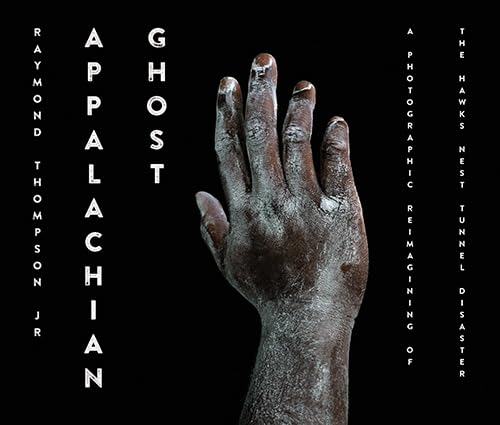
Appalachian Ghost: A Photographic Reimagining of the Hawk's Nest Tunnel Disaster (Appalachian Futures Black Native & Queer Voices)
$39.69
by Raymond Thompson Jr



In the early days of the Great Depression, the search for steady work drove thousands of migrant laborers―many of whom were African American―from all over Appalachia to a rural area near Fayetteville, West Virginia. Union Carbide Corporation had begun construction on a three-mile tunnel to divert the New River, and many hands were needed. Toiling for five years in confined spaces with poor ventilation, no means of dust control, and limited use of personal breathing protection, the workers were repeatedly exposed to pure silica dust. Many developed silicosis, an incurable and debilitating lung disease that is estimated to have caused the deaths of nearly eight hundred workers, two-thirds of whom were Black. Soon after, the US House of Representatives Committee on Labor classified silicosis as an occupational hazard. Despite the disaster's impact, information about its severity was largely suppressed―a decision that ensured the event faded quickly from public memory. Aside from a small plaque at Hawk's Nest State Park, which inaccurately admits to only 109 victims, there is little to mark the site of the worst industrial accident to date in the United States. In Appalachian Ghost: A Photographic Reimagining of the Hawk's Nest Tunnel Disaster , author Raymond Thompson Jr. explores the possibilities of that tragedy by reviving the faces and spaces of Hawk's Nest. Using primary source materials to re-create the workers' experiences in photographs, Thompson recontextualizes archival images to present a counter-archive that positions the Black experience at Hawk's Nest within the larger story of the American labor landscape. His photographs and poetry give voice to the silenced, resisting revisionist narratives that often ignore the sacrifices of African Americans and erase their instrumental role in the development of America's infrastructure. "This is an affecting, evocative, and visually stimulating homage to the forgotten laborers, at least two-thirds of them African American, who died because of their involvement in the construction of the three-mile Hawk's Nest Tunnel between 1930 and 1935. Ably assisted by poetry, photographs, and an engaging narrative, this book calls to me, and I suggest it will do so to anyone who is conversant with the history―even in a general sense―of the unprotected Black industrial worker in southern West Virginia."―Cicero M. Fain III, author of Black Huntington: An Appalachian Story "A very powerful intersection of archival materials, visual response to the historical events, literary invocation, and a scholarly context for the events at the Hawk's Nest Tunnel and surrounding communities. Thompson's photographs are expertly executed to create images that are powerful indictments of the harm that befell these workers, and yet, they are also hauntingly beautiful. The contradictions (painful and beautiful) are stark reminders of the invisible lives that were sacrificed. Appalachian Ghost is a séance for lives lost and a forgotten narrative in the building of modern America."―Wendel A. White, author of Schools for the Colored "A gut-wrenching account of the Hawk's Nest Tunnel disaster, one of the United States' worst industrial accidents. Thompson explores this largely unknown subject through a visual history that repeoples the story of Hawk's Nest, carefully sifting an archive to expose the human suffering buried in a West Virginia valley. . . . Appalachian Ghost reminds readers of the depth and folds present in all narratives. What we think we know is at the mercy of an archive's construction or sometimes deliberate masking and erasure. There is no clean story, no single dimension event. Triumphs and tragedies both come at the expense of people. Good history makes the forgotten or hidden dimensions of a historic episode visible. Appalachian Ghost is that type of history."― Change Seven "Thompson strives to highlight, in particular, the Black men who worked on the Hawk's Tunnel who are all too often left out of the history of the tunnel's construction. While thousands of Black men worked on the tunnel, there is little visual documentation that they were ever there. . . . . In some of the images, we see archival photos of the work camp, the gravesite, and the tunnel itself. In some, Thompson has edited in enlarged images of Black workers, as if putting them back in the recorded history where they belong. . . . Thompson's reimagining these images of Black men in work gear covered in dust brings history to life in such a stark and completely arresting way."― Book Riot "When it comes to documenting the past, focusing on people and events that have been systematically obscured or even erased in the official story, a pro like Raymond Thompson Jr. applied creative techniques to resurrect Appalachian ghosts from the 1930s. His powerful testimony illuminates one of the worst industrial disasters in U.S. history, the Hawk's Nest Tunnel and Dam. . . . Thompson's book, Appala