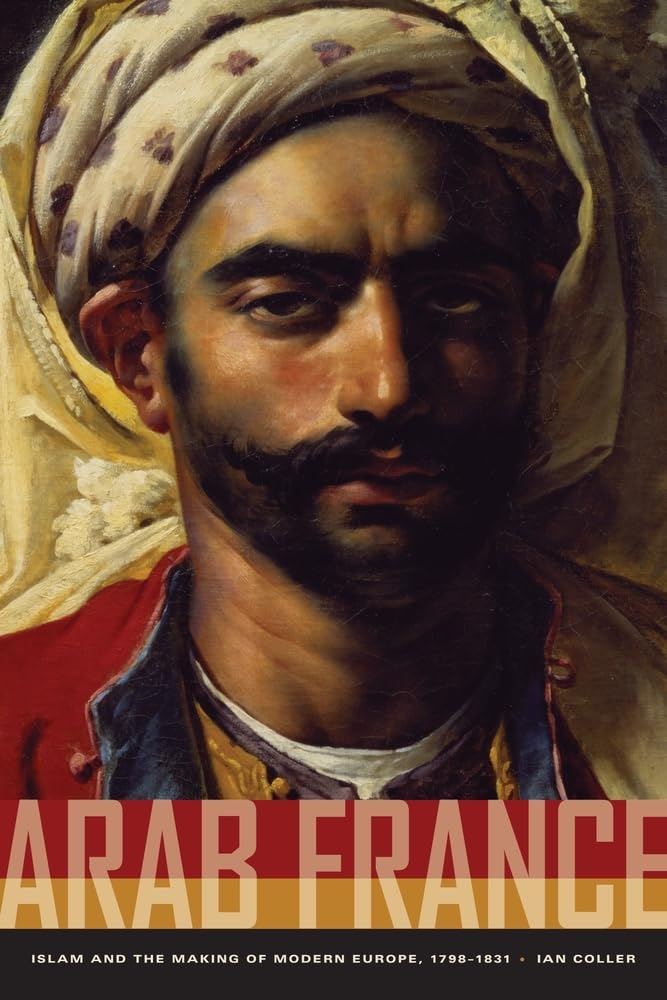



Many think of Muslims in Europe as a twentieth century phenomenon, but this book brings to life a lost community of Arabs who lived through war, revolution, and empire in early nineteenth century France. Ian Coller uncovers the surprising story of the several hundred men, women, and children―Egyptians, Syrians, Greeks, and others―who followed the French army back home after Napoleon’s occupation of Egypt. Based on research in neglected archives, on the rediscovery of forgotten Franco-Arab authors, and on a diverse collection of visual materials, the book builds a rich picture of the first Arab France―its birth, rise, and sudden decline in the age of colonial expansion. As he excavates a community that was nearly erased from the historical record, Coller offers a new account of France itself in this pivotal period, one that transcends the binary framework through which we too often view history by revealing the deep roots of exchange between Europe and the Muslim world, and showing how Arab France was in fact integral to the dawn of modernity. “Recommended.” -- D. A. Harvey ― Choice Published On: 2011-06-29 “An important and original book that will be of interest to scholars as well as to curious, nonspecialist readers.” -- Nadia Kiwan ― French Studies Published On: 2012-04-01 “An ambitious book. . . . Engaging and important.” -- Naomi Davidson ― Journal Of Modern History Published On: 2012-06-01 "Ian Coller's fascinating book explores the making of modern France during the Napoleonic period and under the Restoration 'from the outside inward'. He examines the life of Arab migrants in France: their role as outsiders, and victims, but also as participants in the creation of the modern nation and its empire. In the process he also throws much light on the history of the contemporary Arab Middle East and North Africa."C.A. Bayly, University of Cambridge "Ian Coller's fascinating book explores the making of modern France during the Napoleonic period and under the Restoration 'from the outside inward'. He examines the life of Arab migrants in France: their role as outsiders, and victims, but also as participants in the creation of the modern nation and its empire. In the process he also throws much light on the history of the contemporary Arab Middle East and North Africa."―C.A. Bayly, University of Cambridge Ian Coller is a postdoctoral fellow at the School of Historical Studies at the University of Melbourne. Arab France Islam and the Making of Modern Europe, 1798–1831 By Ian Coller UNIVERSITY OF CALIFORNIA PRESS Copyright © 2011 The Regents of the University of California All rights reserved. ISBN: 978-0-520-26065-8 Contents Preface, vii, Introduction, 1, 1. A Rough Crossing, 21, 2. Ports of Call, 47, 3. The Making of Arab Paris, 75, 4. Policing Orientalism, 99, 5. Massacre and Restoration, 121, 6. Cosmopolitanism and Confusion, 140, 7. Remaking Arab France, 167, 8. The Cathedral and the Mosque, 187, Conclusion, 211, Notes, 219, Selected Bibliography, 257, Index, 283, CHAPTER 1 A Rough Crossing In late August 1801, a fleet of British frigates set out from the port of Aboukir in Egypt. They were carrying the tattered remnants of the French Grande Armée, abandoned two years earlier by their commander, Napoleon Bonaparte, to fight on without much hope in Egypt, and at last given passage back to France by the treaty concluded with England and the Ottoman Porte. One night, just a few days into the crossing, a tragic scene unfolded on board one of these ships, a frigate named the Pallas. According to a letter conserved among the papers of the Commission d'Égypte, Ya'qub Hanna, an Egyptian Copt and the first non-French general in the French army, lay dying among the women of his family, watched by a grief-stricken crowd of men, women, and children. Although they had boarded the Pallas in Alexandria, they drew their origins from all over the Middle East, from Egypt, Syria, and even farther afield. They came from Georgia and the Caucasus, from Greece and Asia Minor, from southern Egypt and the Sudan, from Palestine and Mount Lebanon, from the Mediterranean cities of North Africa and from the great metropolis of Cairo. Their social origins were just as disparate: merchants and customs officials jumbled together with priests and artisans, soldiers and domestic servants. Most shared little beyond the Arabic language and an origin in the Islamicate society of the Ottoman lands. Their only other commonality was their decision to join the emigration to France led by General Ya'qub, now mortally ill. "No scene could been more striking for an artist than this tragic tableau," wrote Nemir Effendi, the author of the letter. A painter, he continued, would want to capture at once the group as a whole, and the details of the different moral sentiments that animated the onlookers. The variety of feelings can only be imagined—those of the English, the French, the Turks, the Cop