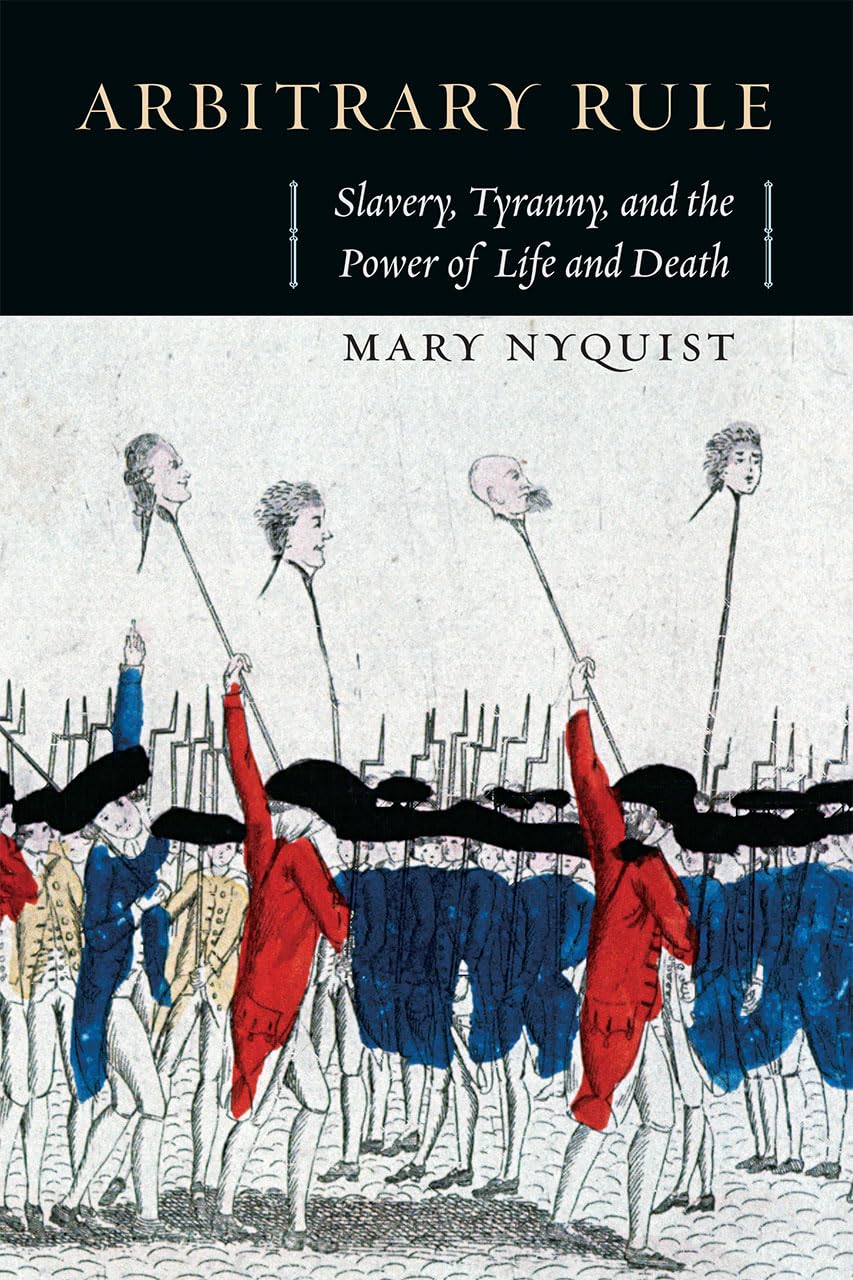



Slavery appears as a figurative construct during the English revolution of the mid-seventeenth century, and again in the American and French revolutions, when radicals represent their treatment as a form of political slavery. What, if anything, does figurative, political slavery have to do with transatlantic slavery? In Arbitrary Rule , Mary Nyquist explores connections between political and chattel slavery by excavating the tradition of Western political thought that justifies actively opposing tyranny. She argues that as powerful rhetorical and conceptual constructs, Greco-Roman political liberty and slavery reemerge at the time of early modern Eurocolonial expansion; they help to create racialized “free” national identities and their “unfree” counterparts in non-European nations represented as inhabiting an earlier, privative age. Arbitrary Rule is the first book to tackle political slavery’s discursive complexity, engaging Eurocolonialism, political philosophy, and literary studies, areas of study too often kept apart. Nyquist proceeds through analyses not only of texts that are canonical in political thought—by Aristotle, Cicero, Hobbes, and Locke—but also of literary works by Euripides, Buchanan, Vondel, Montaigne, and Milton, together with a variety of colonialist and political writings, with special emphasis on tracts written during the English revolution. She illustrates how “antityranny discourse,” which originated in democratic Athens, was adopted by republican Rome, and revived in early modern Western Europe, provided members of a “free” community with a means of protesting a threatened reduction of privileges or of consolidating a collective, political identity. Its semantic complexity, however, also enabled it to legitimize racialized enslavement and imperial expansion. Throughout, Nyquist demonstrates how principles relating to political slavery and tyranny are bound up with a Roman jurisprudential doctrine that sanctions the power of life and death held by the slaveholder over slaves and, by extension, the state, its representatives, or its laws over its citizenry. "In the rank of those literary studies that aspire to be taken seriously by intellectual historians of political theory, this book is easily one of the most brilliant and transformative volumes that I have encountered in years. . . . In a wide-ranging but intensely focused and powerfully cumulative study, Nyquist uncovers both the utter unpredictability of the interrelations between political and legal slavery but also their tenacious and intense discursive interlockings in the theories of sovereignty and in arguments against tyranny from Aristotle to Locke." ― Renaissance Quarterly “Nyquist’s book is impressively researched, persuasively argued, and clearly written. Anyone who is concerned with freedom, tyranny, and servitude in the modern or ancient world would do well to read Arbitrary Rule . For classicists, Nyquist records the influence and development of antiquity’s fundamental beliefs on these matters. For those interested in contemporary politics, Nyquist has clarified the origins of many of the political ideas that have shaped our modern world. Most significantly, Nyquist clarifies with great care and subtlety the intricacies of sixteenth and seventeenth century political thought with regard to freedom, servitude, and antityrannicism.” -- Thomas E. Strunk, Xavier University ― Bryn Mawr Classical Review “Nyquist’s Arbitrary Rule: Slavery, Tyranny, and the Power of Life and Death begins ambitiously with a broad survey of classical debates and culminates in careful close readings of Hobbes and Locke. . . . The groundwork that Nyquist provides in her earlier chapters (many of which glance forward to Hobbes or Milton) will be important and fascinating to a wide variety of readers of literature, history, philosophy, and the arts.” ― Restoration “ Arbitrary Rule is a remarkable book. It displays an impressive command of early modern literature and political thought, and throughout operates at a very high level of engagement and originality. It abounds in new perceptions and genuinely transforms the landscape of the period. I have no doubt that it will become a central focus of discussion for many years to come.” -- David Norbrook, University of Oxford “This daring interdisciplinary study effectively blends literary interpretation with historical and philosophical analysis. Through laying bare the nuances of antityrannical ideology, both ancient and modern, Arbitrary Rule arrestingly reveals the interconnections between liberalism, transatlantic slavery, and discourses on political servitude. Mary Nyquist’s imagination and sparkling intelligence shine through on every page.” -- Ryan K. Balot, author of Greek Political Thought “Mary Nyquist’s elegant study, Arbitrary Rule , joins distinguished works by Page duBois, Orlando Patterson, and Susan Buck-Morss in situating the