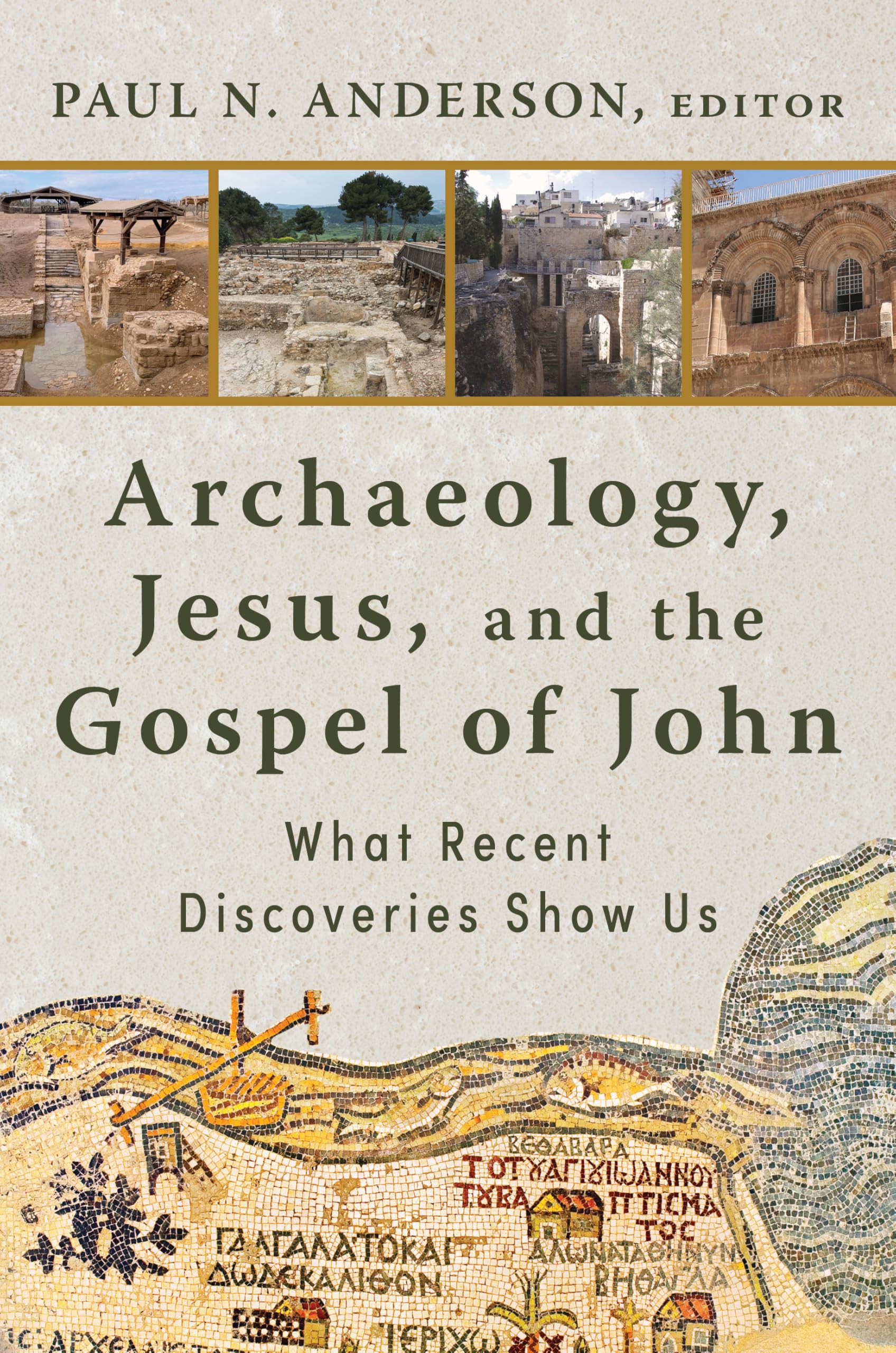
Archaeology, Jesus, and the Gospel of John: What Recent Discoveries Show Us
$99.99
by Paul N. Anderson



Discover the Fourth Gospel’s significance for historical Jesus studies. For years, the Gospel of John has been excluded from historical Jesus studies because of its distinctive theological and literary features. Yet, while John’s Gospel is often characterized as “the spiritual gospel,” it actually contains more archaeologically attested content and topographical details than all the other gospels combined. In this groundbreaking volume, renowned archaeologists discuss the Fourth Gospel’s material features and show how those features enrich our understanding of the historical Jesus. More than two dozen contributors present evidence of the Fourth Gospel’s historical reliability. Some of the contributors focus on Johannine descriptions of Jesus’s ministry, using archaeological expertise to illuminate narrative details ranging from the stone jars in Cana to the fishing industry in Galilee. Other contributors focus on Johannine discussions of places and customs, bringing archaeological research to bear on narrative references to worship sites on Mt. Gerazim, the second pool of Siloam, crucifixion practices of imperial Rome, and more. Throughout the volume, research findings are documented with compelling images. Following discussions of specific archaeological data, the book concludes with a broad overview of the implications for historical Jesus studies. By challenging the longstanding critical bias against the Fourth Gospel’s historical content, Archaeology, Jesus, and the Gospel of John lays the groundwork for a new quest for the historical Jesus―an inclusive quest that fully engages the Johannine account. Contributors: Paul N. Anderson, Rami Arav, Mordechai (Motti) Aviam, Robert J. Bull, Gary M. Burge, Wally V. Cirafesi, R. Alan Culpepper, Roland Deines, Craig A. Evans, Jane DeRose Evans, Shimon Gibson, K. C. Hanson, Brian D. Johnson, Craig R. Koester, Jodi Magness, C. Thomas McCollough, Rivka Nir, R. Steven Notley, Jordan J. Ryan, James Riley Strange, Scott Stripling, Joan E. Taylor, Urban C. von Wahlde, Jürgen K. Zangenberg “This welcome contribution to the John, Jesus, and History Project explores the numerous details of the Fourth Gospel mirroring first-century realities on the ground in Galilee, Samaria, and Judea and offers stimulating insights into how the Johannine ‘theologian’ relates to the rich historical data.” ―Harold Attridge , Yale Divinity School “This groundbreaking volume represents nearly two decades of scholarly conversations about the wealth of topographical references in the Fourth Gospel and the archaeological research that illuminates them. This book is a first of its kind both in its focus and in its scope. Boasting a stellar cast of contributors and comprehensive coverage of the subject, this volume has much to offer students of history, archaeology, and the Fourth Gospel.” ― Christopher W. Skinner , Loyola University Chicago “A landmark publication that shows how archaeology sheds light on the Gospel of John and how John in turn sheds light on the historical Jesus! John’s Jesus is not a figure of pious imagination, but one who walks the roads and valleys of first-century Galilee, Samaria, and Judea.” ― Michael F. Bird , Ridley College “The informative essays in this book, most of them from archaeologists and other experts in the primary sources, contribute significantly to our knowledge of relevant sites and customs in John’s Gospel. Likewise, while most of these authors offer appropriate scholarly cautions, they also provide concrete evidence concerning many first-century places and events featured in the Fourth Gospel. While John may preach about Jesus in a manner different from the Synoptics, his message, like theirs, rests on core information firmly rooted in history.” ― Craig S. Keener , Asbury Theological Seminary “ Archaeology, Jesus, and the Gospel of John: What Recent Discoveries Show Us is a fascinating and informative collection of essays challenging the idea that the Fourth Gospel’s theological interests per se render it unsuitable as a source of literal history. A welcome feature is that contributors were encouraged to make their best arguments while sometimes disagreeing with one another. The essays delve deeply into archaeological details while taking various views on both archaeological conclusions and historical interpretations.” ― Lydia McGrew , author of The Eye of the Beholder: The Gospel of John as Historical Reportage “In the last half century, scholars have come to recognize the value of archaeology for understanding the social and historical framework for the historical Jesus and the realization that the Fourth Gospel is an important source in historical Jesus research. This volume brings these two areas together in a collection of rich essays by an international group of archaeologists and specialists on the Fourth Gospel. It is an important work for scholars of the historical Jesus and for specialists working on the Fourth Gospel.” ― Gregory