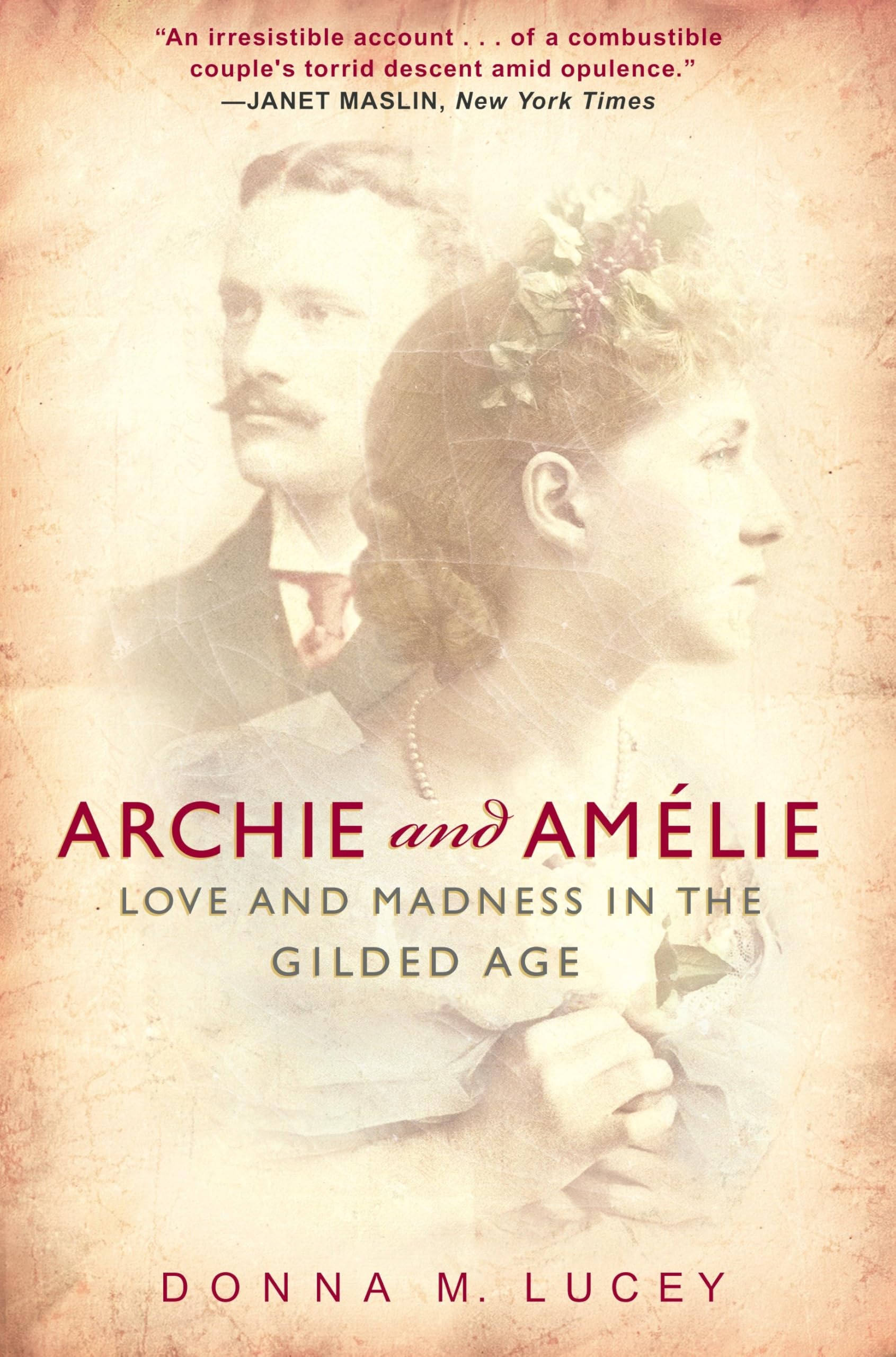



Filled with glamour, mystery, and madness, Archie and Amélie is the true story chronicling a tumultuous love affair in the Gilded Age. John Armstrong "Archie" Chanler was an heir to the Astor fortune, an eccentric, dashing, and handsome millionaire. Amélie Rives, Southern belle and the goddaughter of Robert E. Lee, was a daring author, a stunning temptress, and a woman ahead of her time. Archie and Amélie seemed made for each other—both were passionate, intense, and driven by emotion—but the very things that brought them together would soon tear them apart. Their marriage began with a “secret” wedding that found its way onto the front page of the New York Times , to the dismay of Archie’s relatives and Amélie’s many gentleman friends. To the world, the couple appeared charmed, rich, and famous; they moved in social circles that included Oscar Wilde, Teddy Roosevelt, and Stanford White. But although their love was undeniable, they tormented each other, and their private life was troubled from the start. They were the F. Scott and Zelda Fitzgerald of their day—a celebrated couple too dramatic and unconventional to last—but their tumultuous story has largely been forgotten. Now, Donna M. Lucey vividly brings to life these extraordinary lovers and their sweeping, tragic romance. “In the Virginia hunt country just outside of Charlottesville, where I live, the older people still tell stories of a strange couple who died some two generations ago. The stories involve ghosts, the mysterious burning of a church, a murder at a millionaire’s house, a sensational lunacy trial, and a beautiful, scantily clad young woman prowling her gardens at night as if she were searching for something or someone—or trying to walk off the effects of the morphine that was deranging her. I was inclined to dismiss all of this as tall tales Virginians love to spin out; but when I looked into these yarns I found proof that they were true. . . .” —Donna M. Lucey on Archie and Am é lie “Enchanting . . . An engrossing story told vividly and accurately. Lucey has given us an artistically composed and exhaustively researched story of the tragic marriage of two brilliant and spirited denizens of the Gilded Age whose lives, despite every gift the gods could shower upon them in fortune and talent, were reduced to ashes by drugs and madness.” —Louis Auchincloss Donna M. Lucey is an award-winning writer and photo editor whose previous books include Photographing Montana 1894–1928: The Life and Work of Evelyn Cameron and I Dwell in Possibility: Women Build a Nation 1600–1920 . She lives with her husband and son in Charlottesville, Virginia, where the story of Archie and Amélie is part of local lore. Chapter One The Education of an Astor, or A Name That Rings Like Bullion The irony of Archie–man on the run, hiding his face as he crossed the familiar Manhattan precincts of his youth–was not lost on the Astor heir himself. He had been, and still considered himself, one of the princes of the city. In fact, much of the real estate he traversed during that hansom cab ride in 1900 was owned by his family. The story of the Astor wealth was legend, and Archie could recite it chapter and verse. He had been schooled in the family history and in the expectations that it created. Archie understood only too well the burden involved. As the eldest son in his huge family (he had seven surviving brothers and sisters), he carried a particularly heavy load. All of the Chanler siblings prided themselves on their individuality, on their strong-willed and often eccentric ways. They all professed an indifference to money. Why not? They had plenty of it. Piles of it had been amassed by their forebears, and none of the current generation–least of all Archie–wanted to spend their lives the way their great-grandfather William Backhouse Astor had. Nicknamed “Landlord of New York,”William Backhouse Astor was both reviled and envied in his lifetime. Hewas a “hard dreary looking old man and the richest in the world,” in the estimation of Lord Rosebery, the future prime minister of England. Six feet tall but stoopshouldered, William B. Astor spent his life hunched over his contracts and leases. He had inherited from his father, John Jacob Astor, vast stretches of Manhattan real estate, and as the population boomed in nineteenth-century New York, the value of the land rose exponentially. By 1860 tenement slums with a population density of 290,000 per square mile became William B. Astor’s specialty. The arithmetic was simple: one block filled with tenements could generate at least twice the revenue of a similar block with more-spacious middle-class housing. As immigrants poured into the city, the Astor name became synonymous with misery. When one newcomer proudly announced to a Board of Health inspector that his house was owned by Astor, the official shot back, “More’s the pity.” William B. was the caretaker for the vast empire his father had acquired; he