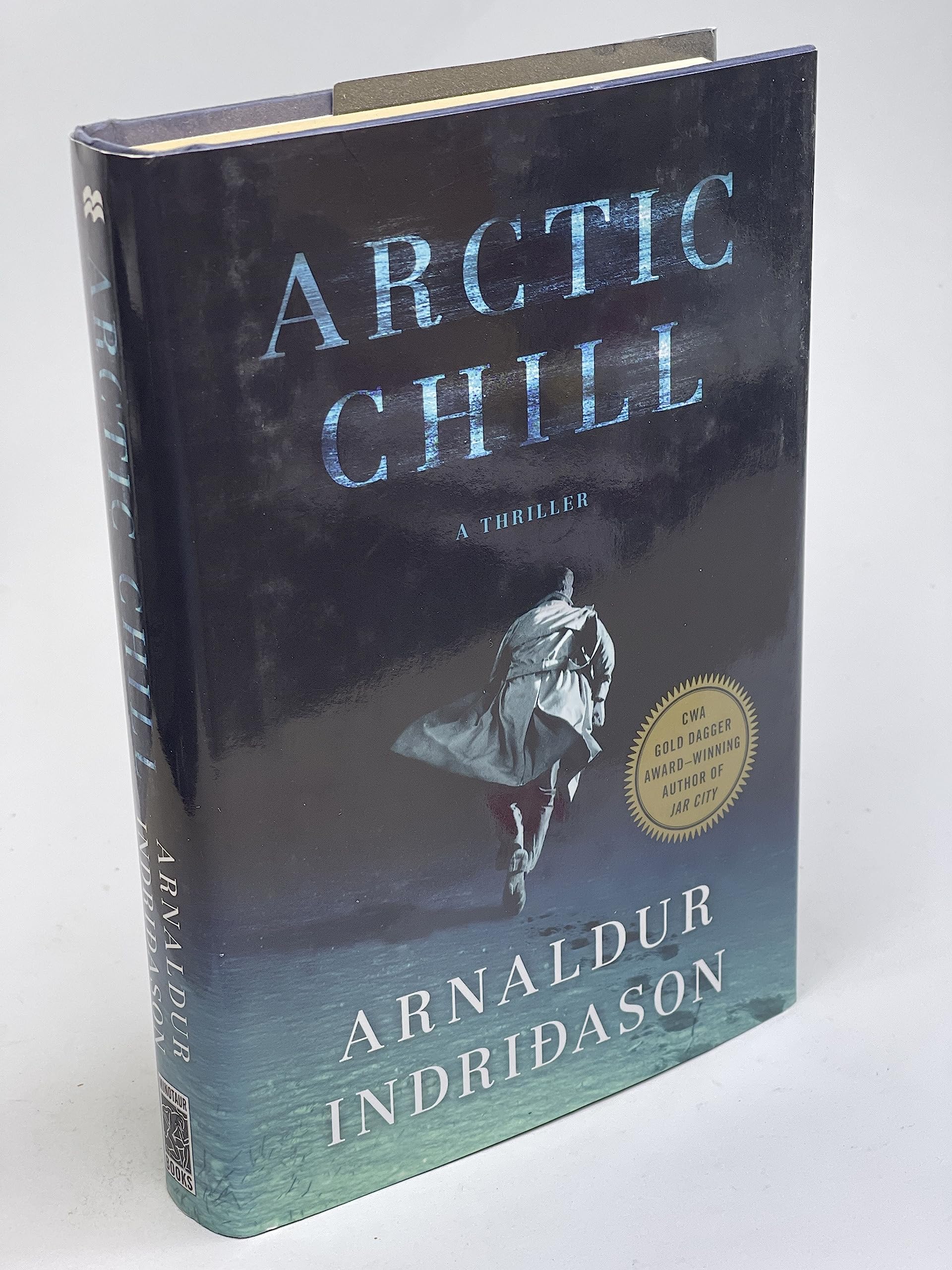



In this new extraordinary thriller from Gold Dagger Award winner Arnaldur Indridason, the Reykjavik police are called on an icy January day to a garden where a body has been found: a young, dark-skinned boy is frozen to the ground in a pool of his own blood. Erlendur and his team embark on their investigation and soon unearth tensions simmering beneath the surface of Iceland’s outwardly liberal, multicultural society. Meanwhile, the boy’s murder forces Erlendur to confront the tragedy in his own past. Soon, facts are emerging from the snow-filled darkness that are more chilling even than the Arctic night. Arnaldur Indridason, author of the Reykjavík Thrillers, was born in 1961. He worked at an Icelandic newspaper, first as a journalist and then for many years as a film reviewer. He won the Glass Key Award for Best Nordic Crime Novel for both Jar City and Silence of the Grave , and in 2005 Silence of the Grave also won the Crime Writers Gold Dagger Award for best crime novel of the year. The film of Jar City (available on DVD) was Iceland’s entry for the 2008 Academy Award for Best Foreign Film. Indridason lives in Reykjavík with his family. From The Washington Post's Book World/washingtonpost.com Reviewed by Patrick Anderson The modern American crime novel was launched in 1930 when Dashiell Hammett introduced the private investigator Sam Spade in "The Maltese Falcon." Other notable private eyes followed as the two-fisted, hard-drinking, incorruptible private eye replaced the lone cowboy as the iconic American hero. The problem with this new mythology was that private detectives, in real life, mostly spend their time on mundane matters -- shadowing errant spouses and the like -- and rarely venture near the scene of a major crime. As Ed McBain, author of the 87th Precinct series, had police detective Steve Carella observe, "The last time he had met a private detective investigating a murder was never." Because police officers have the authority and the resources to investigate major crimes, it was inevitable that more and more crime fiction would focus on them. Today there are hundreds of other fictional cops -- male and female, black and white, gay and straight, urban and rural -- solving crimes all over the world. Collectively, these so-called police procedurals follow a pattern -- crime, investigation, solution -- but within that formula there is room for endless variations. John Sandford's "prey" novels featuring Lucas Davenport, for example, are often quite funny. At the other extreme we have "Arctic Chill," by the Icelandic novelist Arnaldur Indridason, which is both a solid police procedural and one of the bleakest novels you'll ever come across. The novel is set in January in Reykjavik, Iceland, not a terribly festive time and place. One early evening, 10-year-old Elias is found dead, stabbed and "already frozen to the ice" outside the housing project where he lived with his mother and half brother. The mother, Sunee, is a Thai who married an Icelander. The couple had Elias, and she brought her other son over from Thailand. Then the husband abandoned the family, and Sunee works in a chocolate factory to support her two sons. The older son is devastated by his half brother's death, and his mother soon spirits him off to an unknown hiding place. Detectives Erlendur and Sigurdur Oli (male) and Elinborg (female) investigate. The detectives have no shortage of suspects. The author makes clear that many Icelanders resent foreigners who move to their country, and the police must determine if the murder was racially motivated. Elias was killed on his way home from school, and the detectives question a number of schoolyard bullies, as well as a teacher who is outspoken in his disdain for Asian immigrants. ("They shouldn't let those people into the country. It only causes conflict.") The detectives question a drug dealer who hangs around the schoolyard and a pedophile who lives in the neighborhood. The missing brother is under suspicion, too, along with the deadbeat father and the mother's new gentleman friend. The investigation is presented in great detail. We reach Page 92 before the first day's police work, covering perhaps six hours, comes to an end. Of course, not all of that involves the questioning of witnesses. We're also learning about the three detectives and particularly about Erlendur, who is a strikingly unhappy policeman. As a boy, he and his brother were caught in a blizzard; he survived but his brother was never found. He is haunted by guilt for not having saved his brother, and the death of Elias brings back those painful memories. His favorite pastime is reading books about how "people had frozen to death outdoors in Iceland in the old days, and others about death and destruction caused by avalanches." He lives in a "rat hole," drives a 30-year-old Ford Falcon and endures agonizing visits from his son and daughter, who've both suffered from drug and alcohol addiction. He has a rather leth