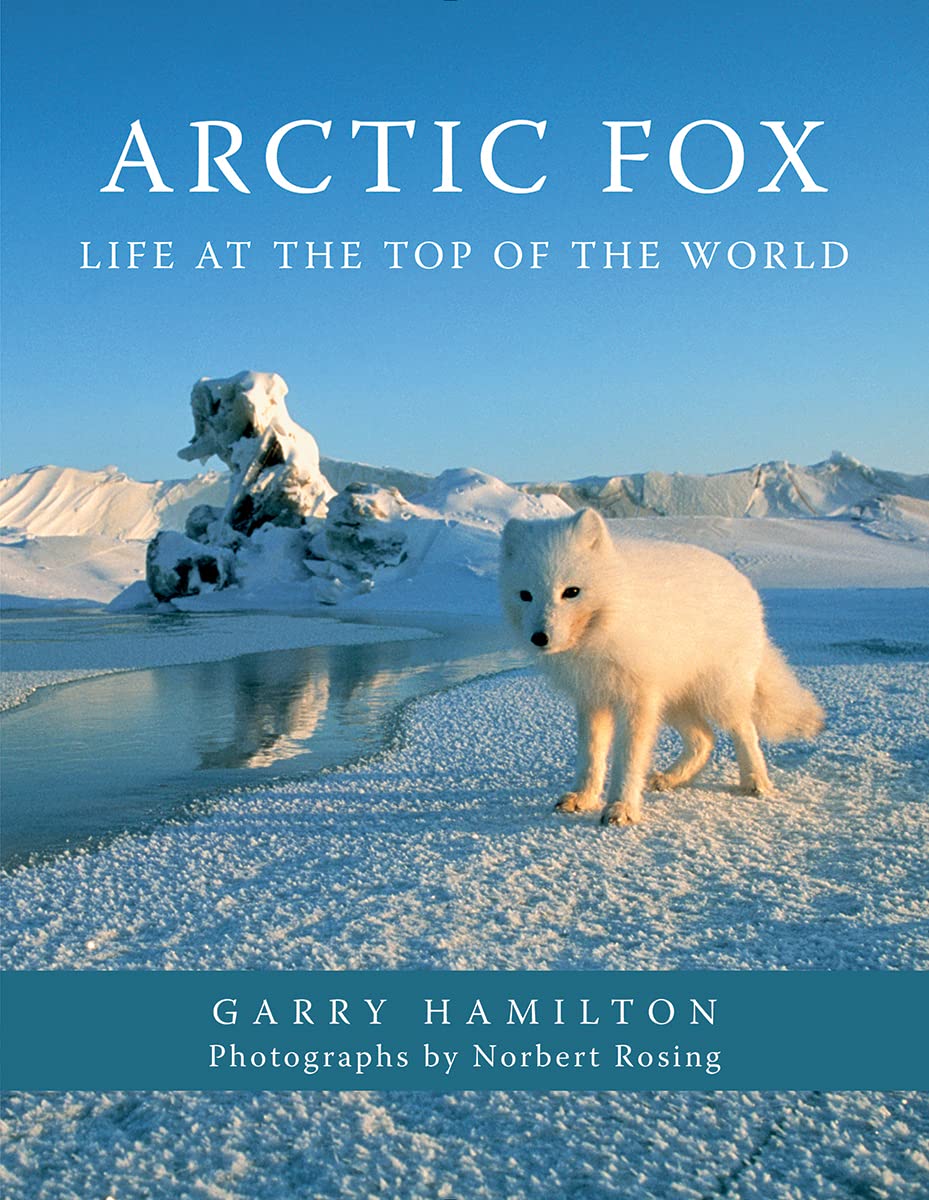



Curious, innovative and mysterious survivors of the arctic tundra. Look at it curled up in its cloudlike pillow of snow-white fur, an icon for beauty if there ever was one. Perhaps there is something deep within us that recognizes this material for what it is, one of nature's greatest feats of engineering. It is believed that no other animal coat can match the insulating properties of arctic fox fur. Ever since explorers began venturing north into the harsh lands of the Arctic, they have encountered arctic foxes in the unlikeliest and most inhospitable of places. The arctic fox is an extraordinary creature. No bigger than a house cat, it survives on almost nothing in the middle of a land so hostile it seems incompatible with the very existence of life. The tundra is a place of endless days or endless nights where temperatures can reach -58 degrees Fahrenheit (-50 degrees Celsius) for weeks at a time, and where the terrain consists mostly of ice sheets, pack ice, ice floes, icebergs, ice shelves and glaciers. Arctic Fox tells the story of this animal from its evolutionary beginnings to its difficult life in the far north involving: Mating and raising a family - Hunting and scavenging - Its relationship with the polar bear and other arctic inhabitants - The fur trade - Adaptation to seasonal changes - The never ending struggle for survival in a fragile and vanishing environment. This informative, lively and beautifully photographed book will fascinate naturalists and general readers. [Review of hardcover edition:] Journalist Hamilton covers the ecology and life cycle of this little fox, which has conquered one of the planet's most extreme climates. Hunting lemmings under packed snow, following reindeer herds on their migration, raising pups to independence in the three-month Arctic summer, and always looking for the next meal and eating whatever they can find, the behavior of the arctic fox makes for fascinating reading. One of the most interesting aspects of the fox's life is its ability to link up with polar bears and scavenge on their kills, behavior that Hamilton devotes an entire chapter to. Exquisitely illustrated with Rosing's photos, this is an intriguing look at a little-known animal. -- Nancy Bent ― Booklist Published On: 2008-12-15 Garry Hamilton is the author of the book Super Species , and his articles have appeared in New Scientist , Nature, Audubon , Conservation , National Wildlife , Canadian Geographic , Australian Geographic , Equinox , Wildlife Conservation and The Ecologist . He lives in Seattle. Norbert Rosing travels annually to the Arctic to photograph arctic foxes, polar bears and other inhabitants of the region. He is a regular contributor to National Geographic and has won many awards for his work. He is the author and photographer of The World of the Polar Bear .