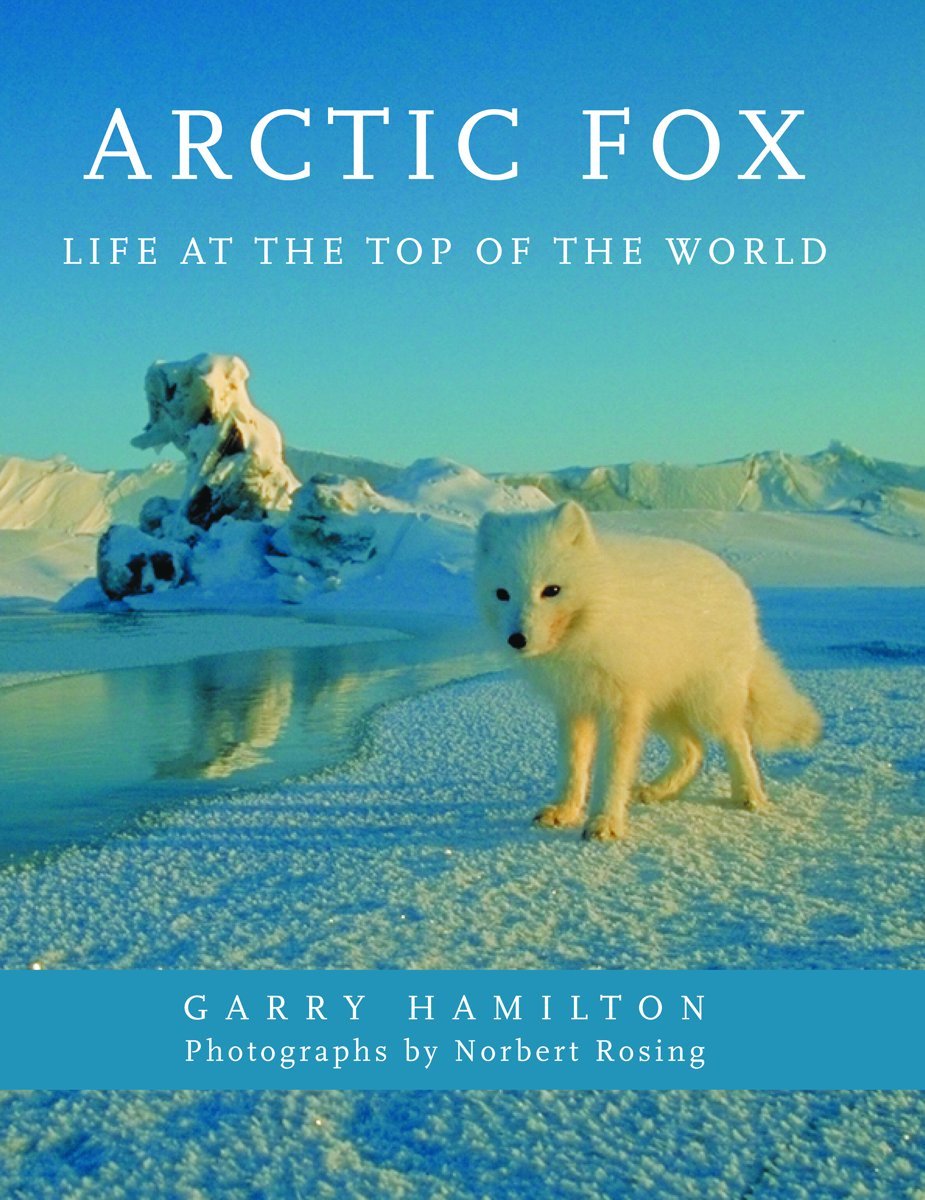



Curious, innovative and mysterious survivors of the arctic tundra. Ever since explorers began venturing north into the harsh lands of the arctic, they have encountered arctic foxes in the unlikeliest of places. The arctic fox is an extraordinary creature. No bigger than a house cat, it survives on almost nothing in the middle of a land so hostile it seems incompatible with the very existence of life. The tundra is a place of endless days or endless nights where temperatures can reach -58°F (-50°C) for weeks at a time, and where the terrain consists mostly of ice sheets, pack ice, ice floes, icebergs, ice shelves and glaciers. Arctic Fox tells the story of this animal from its evolutionary beginnings to its difficult life in the far north involving: Mating and raising a family - Hunting and scavenging - Its relationship with the polar bear and other arctic inhabitants - The fur trade - Adaptation to seasonal changes - The never-ending struggle for survival in a fragile and vanishing environment. This informative, lively and beautifully photographed book will fascinate naturalists and general readers. *Starred Review* The cover of this book sells it: a small fur ball of a white fox, gazing at the viewer with black shoe-button eyes as he stands on a wind-whipped ice floe. The reader’s immediate question—how can such a cute animal survive in such a harsh environment?—is amply explained in this marvelous new study of an animal few of us have ever seen outside the pages of a magazine. Arctic foxes are sublimely adapted for life in the polar region, possessing a fur coat that no other animal can match in terms of insulating properties and covering even the soles of their feet. Arctic foxes are ubiquitous around the North Pole, having been found on every land mass and even on the permanent polar ice. Journalist Hamilton covers the ecology and life cycle of this little fox, which has conquered one of the planet’s most extreme climates. Hunting lemmings under packed snow, following reindeer herds on their migration, raising pups to independence in the three-month Arctic summer, and always looking for the next meal and eating whatever they can find, the behavior of the arctic fox makes for fascinating reading. One of the most interesting aspects of the fox’s life is its ability to link up with polar bears and scavenge on their kills, behavior that Hamilton devotes an entire chapter to. Exquisitely illustrated with Rosing’s photos, this is an intriguing look at a little-known animal. --Nancy Bent Garry Hamilton has produced a wonderfully written account of a whimsical predator... He has gone to the source to obtain the most accurate and reliable information: the biologists and graduate students that ventured to the circumpolar region and studied the fox first hand. These interviews and summations of their research provide an added edge that is lacking in today's natural history writing.... Each chapter covers a particular aspect of Arctic fox biology and is accompanied by outstanding full-color photos by photographer Norbert Rosing. Indeed, the most striking aspect of Hamilton's writing is his ability to communicate the adaptability of the little fox, from reproduction to the constant struggle in obtaining food.... [The book] contains nearly everything currently known about the fox. In short, it is a thorough species account of the Arctic fox, and exceeded my initial expectations.... [It is] a must for those interested in carnivore ecology, and seeking a volume detailing the Arctic fox's struggle within the brutal frozen habitat north of the Arctic Circle. (Howard O. Clarke, Jr Canadian Field-Naturalist ) [Spotlight: Recent Publications of Particular Interest] The stunning photographs that accompany the text include many of the fox and its habitat as well as birds and other mammals that occur in the Arctic. ( Ecology, Vol. 89, No. 12 ) Journalist Hamilton covers the ecology and life cycle of this little fox, which has conquered one of the planet's most extreme climates. Hunting lemmings under packed snow, following reindeer herds on their migration, raising pups to independence in the three-month Arctic summer, and always looking for the next meal and eating whatever they can find, the behavior of the arctic fox makes for fascinating reading. One of the most interesting aspects of the fox's life is its ability to link up with polar bears and scavenge on their kills, behavior that Hamilton devotes an entire chapter to. Exquisitely illustrated with Rosing's photos, this is an intriguing look at a little-known animal. (Nancy Bent Booklist 2008-12-15) The text by Garry Hamilton and pictures by German Norbert Rosing paint an intriguing never-ending struggle for survival in great details. The Arctic fox is a biological accomplishment. The book is an impressive portrait. (Randy Midzain Winnipeg Free Press 2008-12-07) It must be said at once that the book has fulfilled its aim of being an up-to-date, full accoun