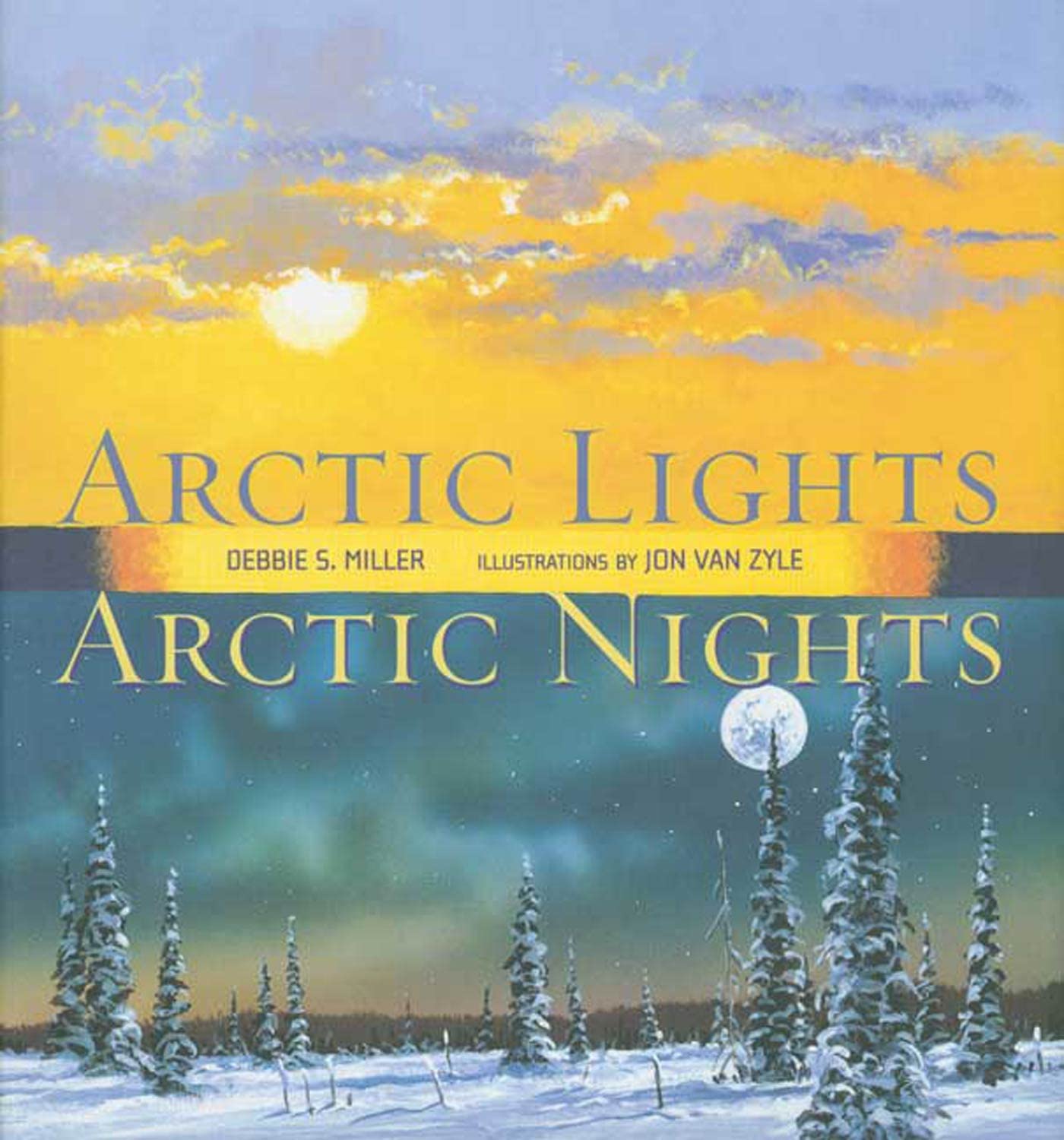



Imagine a land where the sun rises at 1:58 a.m. in the summer and shines for less than four hours on a winter's day. The animals in the wilderness near Fairbanks, Alaska, witness some of the world's greatest temperature extremes and light variations every year. At an average low of -16 degrees Fahrenheit, the winters may be unpleasantly frigid, but the light shows are always glorious! Acclaimed author Debbie S. Miller details the sunsets, twilight, alpenglow, diamond dust, and other quietly beautiful phenomena that color "the Land of the Midnight Sun," describing each animal's activities in both the warm and cold seasons. The dramatic changes in light are captured perfectly in Jon Van Zyle's striking illustrations. Grade 3-9-This book is based on a purely delightful concept-recording the changes in Arctic light from one summer solstice to the next. In Fairbanks, AK, Miller begins with the 21 hours and 49 minutes of daylight on June 21, then follows the light's diminution month by month to the winter solstice and its daylight of 3 hours and 43 minutes to its gradual swelling back to the summer solstice. Her brief text includes not only lyrical messages about light and its partner, darkness, but also references to the reaction of wildlife to the waxing and waning: the migration of birds and caribou, the hibernation of bears, the changing coat of the Arctic hare. Wrapped about this unfamiliar (to many of us) swirl of seasons of light are Van Zyle's superb and quietly beautiful acrylic paintings, which capture both light and dark in perfect harmony with the text. A map of Alaska, an introductory note, and an excellent glossary are included. Team this bit of loveliness and imagination with Ellen Jackson's delightful quartet Summer Solstice (2001), Autumn Equinox (2000), Winter Solstice (1994), and Spring Solstice (2002, all Millbrook); encourage children to get out a calendar, pen, paper, thermometer, and clock and jubilantly record the radiant pattern of light in their own little corners of the world. A winner. Patricia Manning, formerly at Eastchester Public Library, NY Copyright 2003 Reed Business Information, Inc. Gr. 2-4. Miller, a resident of Fairbanks, Alaska, explains the peculiarities of light and seasons near the Arctic Circle and briefly introduces some of the animals that live in the area. Text at the top of each page carries a date ("June 21," "July 21," and so on through a year); the hours of daylight; the time of sunrise and sunset; and the average temperatures. Below, a double-page painting shows a scene in the natural world, typically accompanied by one short paragraph commenting on what is happening and another discussing the length of day and night as well as natural phenomena, such as "sun dogs." The realistic paintings often focus on animals within a landscape. The book concludes with an unusually good glossary that describes phenomena and terms such as alpenglow , flat light , and vernal equinox. Useful for the classroom. Carolyn Phelan Copyright © American Library Association. All rights reserved Imagine a land where the sun rises at 1:58 a.m. in the summer and shines for less than four hours on a winter's day. The animals in the wilderness near Fairbanks, Alaska, witness some of the world's greatest temperature extremes and light variations every year. At an average low of -16 degrees Fahrenheit, the winters may be unpleasantly frigid, but the light shows are always glorious! Acclaimed author Debbie S. Miller details the sunsets, twilight, alpenglow, diamond dust, and other quietly beautiful phenomena that color "the Land of the Midnight Sun," describing each animal's activities in both the warm and cold seasons. The dramatic changes in light are captured perfectly in Jon Van Zyle's striking illustrations. Debbie S. Miller is the author of Walker & Company's The Great Serum Race , Are Trees Alive? and Disappearing Lake , which was named one of Bank Street College's Children's Books of the Year, was given the IRA-CBC Teachers' Choice Award, and earned starred reviews in School Library Journal and Kirkus Reviews . Debbie lives with her family in Fairbanks, Alaska. Jon Van Zyle has illustrated numerous award-winning children's books, including Walker & Company's The Great Serum Race and Disappearing Lake . He lives in Eagle River, Alaska, with his wife, Jona, and their Siberian husky dog team. Debbie S. Miller is the author of Walker & Company's The Great Serum Race , Are Trees Alive? and Disappearing Lake , which was named one of Bank Street College's Children's Books of the Year, was given the IRA-CBC Teachers' Choice Award, and earned starred reviews in School Library Journal and Kirkus Reviews . Debbie lives with her family in Fairbanks, Alaska. Jon Van Zyle has illustrated numerous award-winning children's books, including Walker & Company's The Great Serum Race and Disappearing Lake . He lives in Eagle River, Alaska, with his wife, Jona, and their S