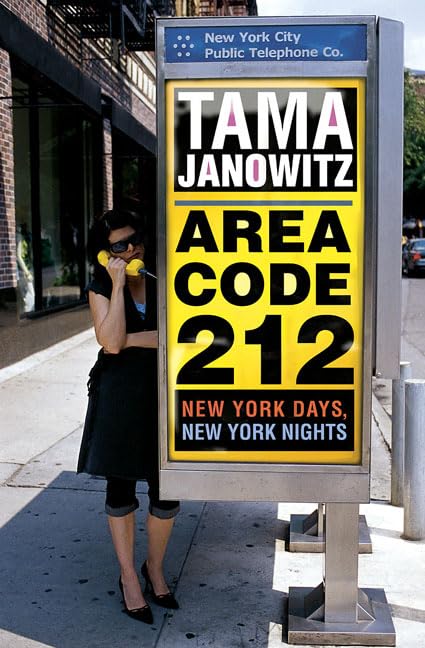



Welcome to the wonderful world of Tama Janowitz, one of New York's wittiest social chroniclers. Area Code 212 is filled with idiosyncratic delights and oddities, including her hilarious account of Andy Warhol's 1980s blind date club; her brief moment of celebrity as an elderly teenage extra in a ZZ Top video; the day she tested mentally retarded on an IQ test; and many other revealing tales of New York life, including its parties, its restaurants, and its fashion. Janowitz gives us her unique lowdown on her 1990s conversion from Manhattan to Brooklyn, on observing the Twin Towers come down from her apartment roof, on hairless dogs and ferrets, babies, the outer boroughs, big-hair days and bad-hair days. Above all, the humor and insights of Area Code 212 will not only appeal to all of those who live in New York City, but also to those from around the country who have a fascination with what it is like to thrive in the urban mecca. Self-deprecating, funny, and touching, Area Code 212 is an irresistible collection of essays. Janowitz's caustic wit, her taste for the sordid and the absurd, and her knack for skewering the fashionable and championing the clueless are as vividly present in her pithy nonfiction as they are in her spiky novels, which include A Certain Age (1999) and Peyton Amber (2003). This robust essay collection spans the past two decades and forms a montagelike self-portrait and a sharp critique of urban life. But will the reader get past the jarring opening essay, a deadpan and graphic account of her suffering a miscarriage at the Museum of Modern Art? This rough start does establish Janowitz's sanguinary tendencies, and things get far more engaging once she offers curmudgeonly yet affectionate tales about her adopted Chinese daughter and cops to her penchant for wearing bizarre outfits and her fondness for tiny, high-strung dogs. Janowitz is at her mordant best when she chronicles the spectrum of New York life, from her crummy neighborhood grocery and the fringes of Prospect Park to decadent promotional events and her hilarious escapades with Andy Warhol and their blind date club. Never correct or polite, Janowitz is sharply observant, bracingly frank, wryly skeptical, and fully aware of the deeper issues at stake, from the devaluing of art to homelessness to the precarious state of the environment. Donna Seaman Copyright © American Library Association. All rights reserved "The other day I was walking down the street (again, fully, 100 percent clothed, and when I say 100 percent, that means practically not an inch of exposed skin) and some man on a corner yelled, "You having a bad-hair day! Whoops, I mean you having a bad-hair month! I guess you probably having a bad-hair life!" - from Area Code 212 Praise for Tama Janowitz "A writer of considerable talent." - The New York Observer "A singular talent" - The New York Times Book Review "A true original." - San Francisco Chronicle "Funny, reflective . . . wonderfully sharp." - The Washington Post "A penetrating eye." - New York magazine Tama Janowitz exploded onto the literary scene in 1986 with her bestselling book, Slaves of New York . Her most recent novel is Peyton Amberg . Janowitz's work has appeared in many publications, including The New Yorker , Vogue , the New York Times Op-Ed page, and elsewhere. She lives in Brooklyn with her husband and daughter. Area Code 212 Part One Family Life Performance Art S ometimes, living in New York, I got invited to movie premieres and screenings. There were all kinds. Usually a premiere was held in a cinema—tickets and the invitation for the party to follow came in the mail. There would be a big crowd gathered in front of the theater to watch the arrival of the celebrities, a velvet rope, security guards, Klieg lights on the streets lighting huge arcs in the sky.After the movie there was usually a party of some sort. One I remember was held in the Plaza hotel, following a Western comedy: hamburgers and beans were served on paper plates. One was in the restaurant adjacent to the skating rink at Rockefeller Center. Another time the guests were taken in old-fashioned English double-decker buses from the movie theater to a restaurant.I had lost the passes to get us on the bus, so I went around the line to ask the woman taking the tickets what I should do—if she would let us on the bus without them. Later, somebody wrote an angry article in a local free newspaper, about how I had thought I was so important I tried to cut to the front of the line. I kept wanting to say, That’s not why I went to the front of the line! I went to the front of the line to find out whether or not I would even be let on to the bus without a ticket or should I find a taxi. But in this situation, my own personal equivalent to a movie star’s getting a mean mention for behavior, there was nothing I could do.Screenings were more fun; one got to see the movie in a little screening room, and