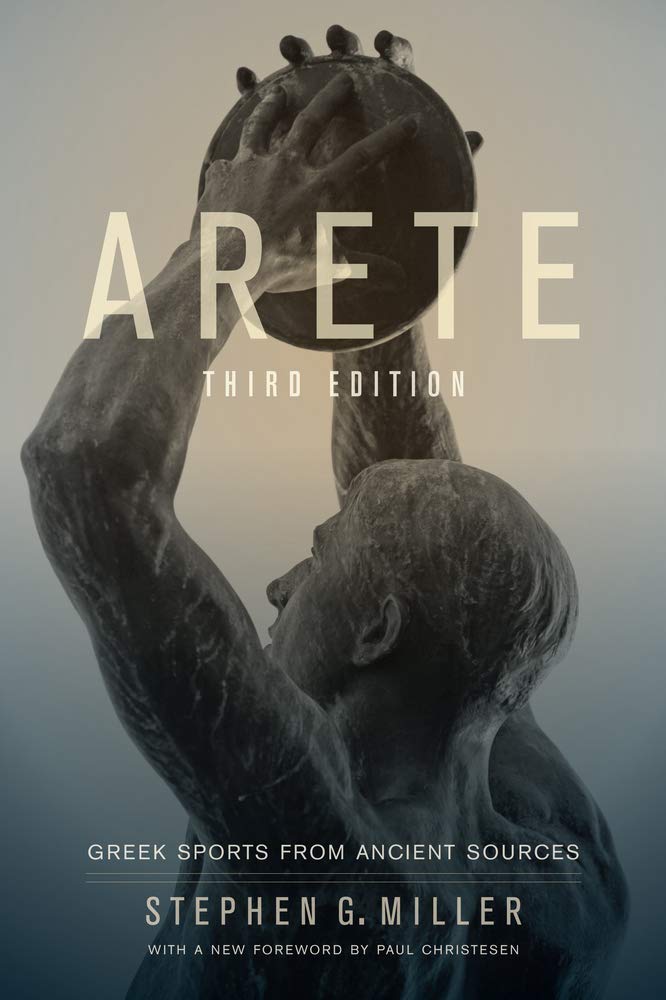



From the informal games of Homer's time to the highly organized contests of the Roman world, Miller has compiled a trove of ancient sources: Plutarch on boxing, Aristotle on the pentathlon, Philostratos on the buying and selling of victories, Vitruvius on literary competitions, and Xenophon on female body building. Arete offers readers an absorbing lesson in the culture of Greek athletics from the greatest of teachers, the ancients themselves, and demonstrates that the concepts of virtue, skill, pride, valor, and nobility embedded in the word arete are only part of the story from antiquity. This bestselling volume on the culture of Greek athletics is updated with a new preface by leading scholar Paul Christesen that discusses the book's continued importance for students of ancient athletics. "A remarkable compendium of ancient sources . . . An invaluable resource for the study of Greek sport . . . What Miller’s Arete does extremely well is to show that 'nearly almost every aspect of athletics we know today existed already in that distant but kindred world'" ― European Legacy "Unquestionably the best available sourcebook on the nature of athletics and its role in Greek society from Homeric through Roman Imperial times." ― Classical World Stephen G. Miller is Professor of Classical Archaeology Emeritus at the University of California, Berkeley. Paul Christesen is Associate Professor of Classics at Dartmouth College. Arete Greek Sports from Ancient Sources By Stephen G. Miller UNIVERSITY OF CALIFORNIA PRESS Copyright © 2012 the Regents of the University of California All rights reserved. ISBN: 978-0-520-27433-4 Contents Abbreviations, vii, Foreword, ix, Introduction, xv, I. THE EARLIEST DAYS OF GREEK ATHLETICS: 1–2, 1, II. NUDITY AND EQUIPMENT: 3–19, 16, III. THE EVENTS AT A COMPETITION, 23, IV. ORGANIZATION OF A PANHELLENIC FESTIVAL, 63, V. LOCAL FESTIVALS, 81, VI. THE ROLE OF THE GAMES IN SOCIETY: 128–148, 89, VII. WOMEN IN ATHLETICS: 149–162, 105, VIII. ATHLETES AND HEROES: 163–175, 111, IX. BALL PLAYING: 176–178, 120, X. GYMNASION, ATHLETICS, AND EDUCATION: 179–189, 126, XI. THE SPREAD OF GREEK ATHLETICS IN THE HELLENISTIC PERIOD: 190–199, 153, XII. GREEK ATHLETICS IN THE ROMAN PERIOD: 200–204, 160, XIII. AMATEURISM AND PROFESSIONALISM: 205–223, 165, XIV. NATIONALISM AND INTERNATIONALISM: 224–231, 181, XV. BEAUTY AND REALITY: 248–256, 192, Appendix: The Olympian and Pythian Programs, 201, Select Bibliography, 203, Index and Glossary, 209, Sources for the Chapter-Opening Sketches, 235, CHAPTER 1 The Earliest Days of Greek Athletics In the two passages from Homer which are presented here a picture emerges of what we may call Homeric athletics. The question is, however, whether that picture is one of his own day or a valid, if somewhat blurred, reflection of the athletic practices of the Mycenaean era. Comparison with archaeological discoveries from that era finds relatively little in common with the Homeric picture, while comparison with the development of the Olympic program (Appendix) suggests that the Homeric picture would have been valid only as of the early 7th century B.C. If so, the informality of the Homeric games might have been the case as well for the early days of the Olympics. 1 Homer, Iliad 23.256–24.6 ca. 750 B.C. Patroklos, the childhood and lifelong friend of Achilles, has fought in Achilles' place and been killed by Hektor outside the walls of Troy. The corpse of Patroklos has been cremated and the crowd at the funeral begins to disperse: But Achilles held the people there and sat them in a broad assembly, and brought prizes for games out of his ships, cauldrons and tripods and horses and mules and high-headed powerful cattle and beautifully girdled women and gray iron. First he set forth the glorious prizes for equine feet: a woman faultless in her work to be led away and a tripod with ears holding twenty-two measures for the first prize. Then for the second he set forth a six-year-old unbroken mare carrying an unborn mule foal. Then for the third prize he set forth a beautiful unfired cauldron holding four measures, still new and shiny. For the fourth he set forth two gold talents, and for the fifth a two-handled unfired bowl. Then he stood up and spoke out to the Argives: "These prizes are placed in competition awaiting the horsemen. If we Achaians were not competing for the sake of some other hero, I myself would take the first prizes away to my tent. You know by how much my horses surpass all others in their arete , for they are immortal, a gift of Poseidon to my father Peleus who handed them in turn to me. But I and my solid-hoofed horses stay aside; such is the fame of the charioteer whom they have lost, the gentle one, who so many times rubbed soft oil into their manes after he had washed them with shining water. Therefore they both stand here grieving him with manes trailing on the ground, both hearts grieving