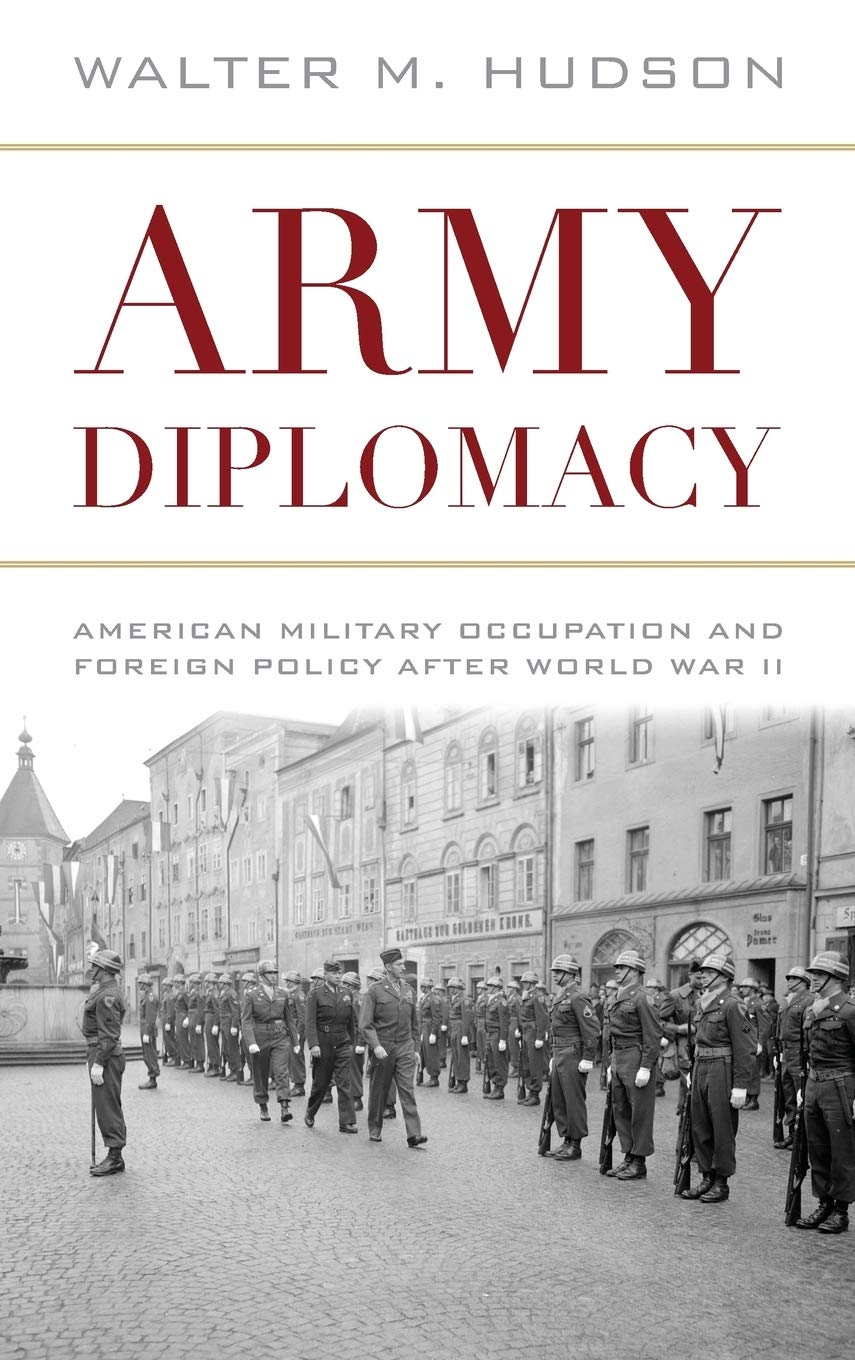
Army Diplomacy: American Military Occupation and Foreign Policy after World War II (Battles and Campaigns Series)
$45.00
by Walter M. Hudson



In the immediate aftermath of World War II, the United States Army became the principal agent of American foreign policy. The army designed, implemented, and administered the occupations of the defeated Axis powers Germany and Japan, as well as many other nations. Generals such as Lucius Clay in Germany, Douglas MacArthur in Japan, Mark Clark in Austria, and John Hodge in Korea presided over these territories as proconsuls. At the beginning of the Cold War, more than 300 million people lived under some form of U.S. military authority. The army's influence on nation-building at the time was profound, but most scholarship on foreign policy during this period concentrates on diplomacy at the highest levels of civilian government rather than the armed forces' governance at the local level. In Army Diplomacy , Hudson explains how U.S. Army policies in the occupied nations represented the culmination of more than a century of military doctrine. Focusing on Germany, Austria, and Korea, Hudson's analysis reveals that while the post–World War II American occupations are often remembered as overwhelming successes, the actual results were mixed. His study draws on military sociology and institutional analysis as well as international relations theory to demonstrate how "bottom-up" decisions not only inform but also create higher-level policy. As the debate over post-conflict occupations continues, this fascinating work offers a valuable perspective on an important yet underexplored facet of Cold War history. "A significant contribution to the literature on the U.S. Army's role in planning for and administering occupations. In particular, the focus cultural determinants reflecting past military experience and the Army's organizational perceptions and practices is a novel approach."―Theodore A. Wilson, editor of Victory in Europe 1945: From World War to Cold War "A new and important interpretation of 'war termination,' something that challenges all victorious armies and governments. Considering the recent reluctance by so many politicians to conduct nation building, it seems ironic that the U.S. Army had such a long and often successful history of doing just that in the twentieth century."―Jonathan House, author of A Military History of the Cold War, 1944-1962 "This book is well worth reading by any serious military historian."― Journal of America's Military Past "The book does fill a serious gap in the fast-growing scholarly literature on military occupations: it is a perceptive institutional history of over a century of the US Army theory and planning for developments that ensue after wars end. It also demonstrates how plans formed over decades can, to paraphrase Clausewitz, quickly be undone by the fog of peace. Hudson has provided a welcome, thorough longitudinal analysis of the evolution of US Army thinking and policy regarding postwar occupations. He presents a stunningly detailed breakdown of the complex institutional relationships within the US Army and between it and the nation's civilian government bureaucracies."― Michigan War Studies Review "Anyone interested or concerned with current events in the Middle East, including Iraq and Afghanistan, will find Army Diplomacy a key contribution to the knowledge base of how to successfully conduct occupation and governance 'when war stops and something like peace begins.'"― On Point "Walter M. Hudson's Army Diplomacy is a well written, thoughtful treatment of the origins of the military governments that the United States established to rule much of Europe and Asia in the aftermath of the Second World War. Army Diplomacy is a fascinating and provocative account of the postwar occupations, and one that any future work on these events will have to engage with."― Army Diplomacy Walter M. Hudson is an active duty judge advocate in the U.S. Army.