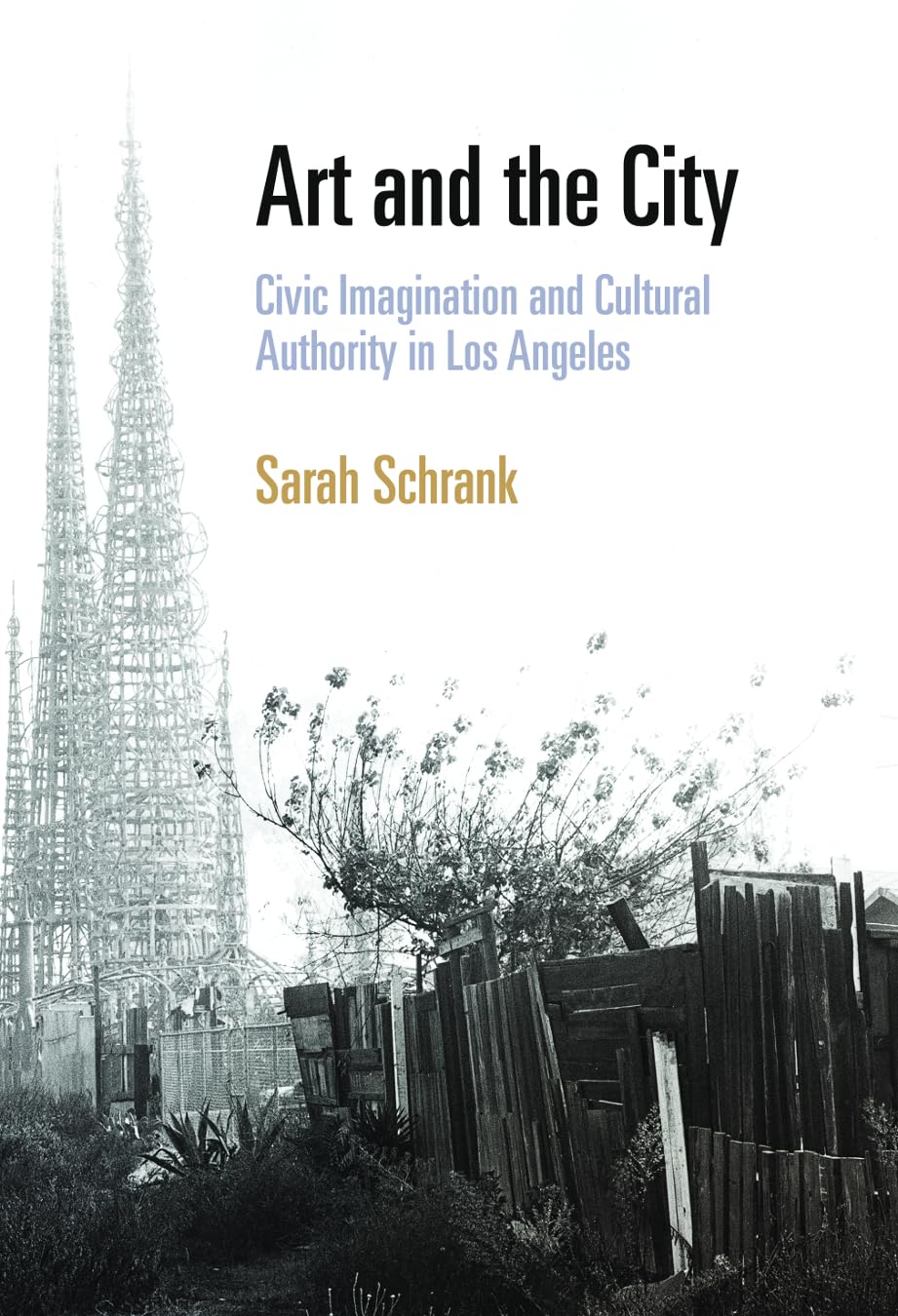
Art and the City: Civic Imagination and Cultural Authority in Los Angeles
$29.95
by Sarah Schrank



No longer represented only by Hollywood and the commercial fashion industry, Los Angeles in recent years has received international media attention as one of the world's new art centers. From the appearance of local artists in major European exhibitions to widely reported multimillion-dollar museum endowments, Los Angeles has entered the world cultural stage. Art and the City: Civic Imagination and Cultural Authority in Los Angeles places this celebrated arrival in the richer context of art controversies and political contests over modern art and art spaces in the twentieth century. The Ferus Gallery's pop-infused "L.A. Look" and "finish-fetish," now synonymous with Los Angeles's postwar modernist aesthetics, emerged from a dispersed art community that struggled in the 1950s to find a toehold in a local scene reeling from the censure of the McCarthy era. The Watts Towers have long faced neglect despite their international fame, while Venice Beach, Barnsdall Park, Griffith Park, and Olvera Street proved highly contentious sites of urban cultural expression. Challenging historical accounts that situate the city's origins as an art center in the 1960s, Art and the City argues that debates over modernism among artists and civic leaders alike made art a charged political site as early as the 1910s. The legacy of those early battles reverberated throughout the century. Because of a rich tradition of arts education and the presence of Hollywood, Los Angeles historically hosted a talented population of contemporary artists. However, because of the snug relationship between urban aesthetics and capital investment that underscored the booster goals of the civic arts movement, modern artists were pushed out of public exhibition spaces until after World War II. Art and the City uncovers the historic struggles for cultural expression and creative space that are hidden behind the city's booster mythology. "Sarah Schrank's richly detailed Art and the City provides a long-overdue social historical context for the city's much-touted status in recent years as a global art capital. It also refutes the notion that Los Angeles's arts scene emerged ex nihilo in the 1960s. Schrank posits, instead, that decades of reactionary cultural politics-not to mention spatial isolation and sprawl-were among the forces driving the city's artistic ascent." ― Journal of American History " Art and the City provides a much-needed synthesis of the meaning of art and place in Los Angeles and serves as a reminder that civic identity is forged in the conflict between the rhetoric of power, the desire to belong, and the difficult realities of community-building." ― College Art Association Reviews "Sarah Schrank's Art and the City could not be more timely. In her thoughtful, prescient, and well-researched book, she details the vivid and rich history of Los Angeles's art world and explains the political and cultural dynamics that have shaped the city's artistic identity and, at times, may have prevented the city from becoming a globally recognized art mecca in the first place. . . . Schrank's book does a service to history and urban planning. Most importantly, it offers an authentic account of Los Angeles's rich artistic legacy. . . .A mainstream audience of art aficionados, urbanists, and policymakers would find Art and the City a fascinating and fresh account of a complicated and dazzling city that is far greater than the sum of its parts." ― Journal of American Planning Association Sarah Schrank is Associate Professor of History at California State University, Long Beach. Introduction One year before millions of people took to the streets to protest new federal policies mandating the criminalization of undocumented workers in the United States, Los Angeles hosted its own demonstration of anti-immigrant sentiment. In the spring of 2005 the group Save Our State called on the city of Baldwin Park, a largely Latino municipality within Los Angeles, to remove offending language from Judith Baca's public artwork Danzas Indigenas . Installed at the Baldwin Park Metrolink station in 1993, the piece, which resembles eroding Spanish mission archways, is inscribed with passages from Chicano literature and Native American folklore. Danzas Indigenas had been commissioned by the city of Baldwin Park, which asked Baca, a University of California at Los Angeles professor, nationally acclaimed public artist, and youth activist, to create a monument that reflected the different voices of its community. According to Save Our State spokesman Joseph Turner, the offending passages included "It was better before they came" and a quotation from author Gloria Anzaldúa, "This land was Mexican once, was Indian always and is, and will be again." On May 14, 2005, members of Save Our State showed up at the Metrolink station waving American flags, carrying signs protesting "hate speech" and the "reconquista," and loudly proclaiming their support for the