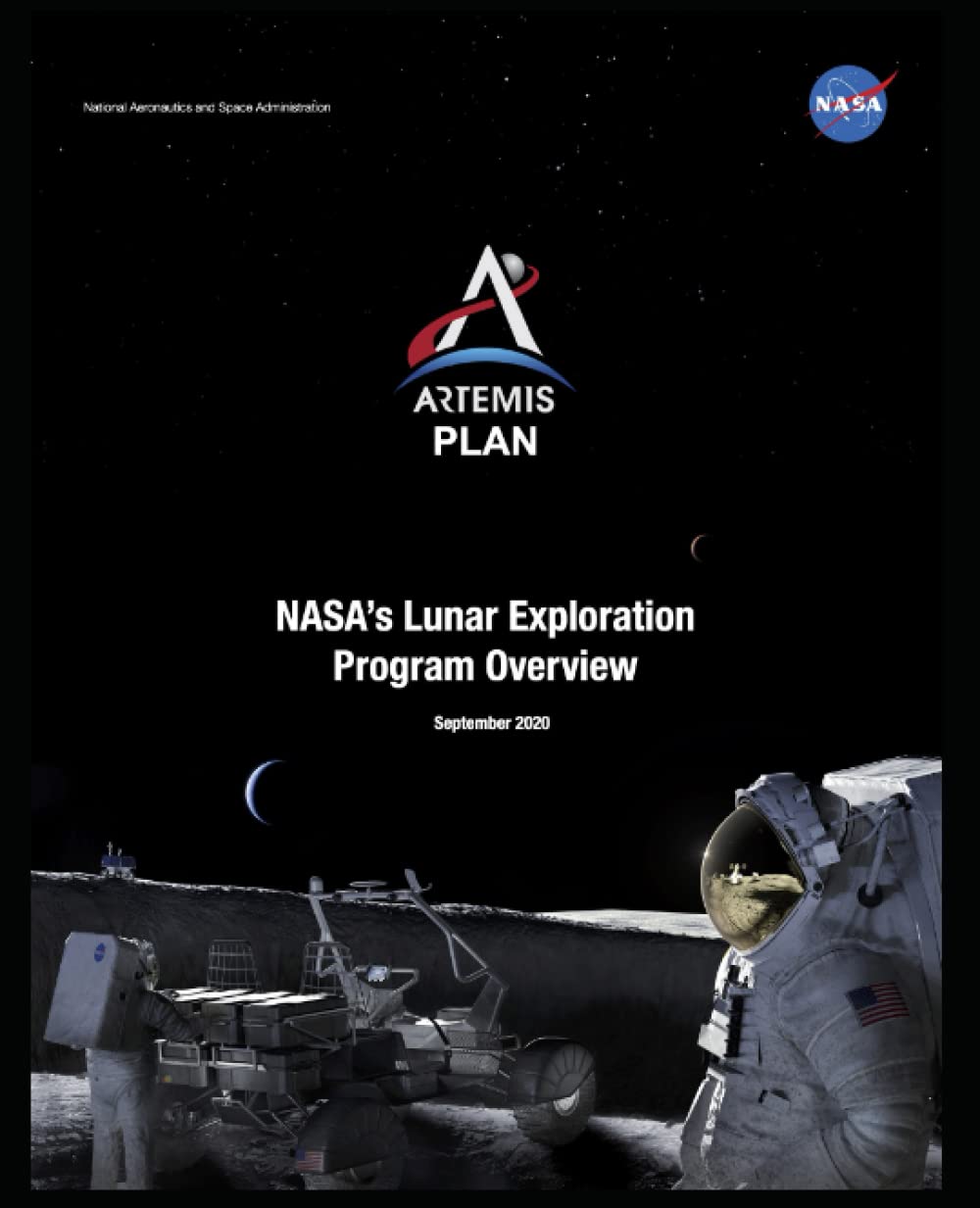
Artemis Plan - NASA'S Lunar Exploration Program Overview
$15.75
by National Aeronautics And Space Administration



Paperback Version Printed In COLOR! Enjoy this book! This is NASA's new plans to go to the moon with new technology, new challenges and with huge new exploratory research goals. You'll see this all develop in real life right now! NASA’s Artemis Plan—this is how we will go to the Moon once again. And how we will use the Moon as the stepping stone for our next greatest leap—human exploration of Mars. America has entered a new era of exploration. NASA’s Artemis program will lead humanity forward to the Moon and prepare us for the next giant leap, the exploration of Mars . It has been almost 50 years since astronauts last walked on the lunar surface during the Apollo program , and since then the robotic exploration of deep space has seen decades of technological advancement and scientific discoveries. For the last 20 years, humans have continuously lived and worked aboard the International Space Station 250 miles above Earth, preparing for the day we move farther into the solar system. Sending human explorers 250,000 miles to the Moon, then 140 million miles to Mars, requires a bold vision, effective program management, funding for modern systems development and mission operations, and support from all corners of our great nation as well as our partners across the globe. NASA has been fine-tuning the plan to achieve that bold vision since the president called on the agency in December 2017 to lead a human return to the Moon and beyond with commercial and international partners. Two years later, he challenged us yet again, this time to send the first woman and next man to the Moon within five years. NASA is implementing the Artemis program to achieve those goals, and this document lays out the agency’s Moon to Mars exploration approach explaining how we will do it. The Moon plan is twofold: it’s focused on achieving the goal of an initial human landing by 2024 with acceptable technical risks, while simultaneously working toward sustainable lunar exploration in the mid- to late 2020s. 2024 is not an arbitrary date. It is the most ambitious date possible, and our success at the Moon, and later, at Mars, will be grounded in our national goals and robust capabilities. The United States leads in space exploration now; however, as more countries and companies take aim at the Moon, America needs the earliest possible landing to maintain and build on that leadership, as well as to prepare for a historic first human mission to Mars. Landing astronauts on the Moon within four years will better focus this global initiative on the engineering, technology development, and process improvements necessary to safely and successfully carry out sustained human exploration of the Moon. It also paves the way for U.S. commercial companies and international partners to further contribute to the exploration and development of the Moon. We need several years in orbit and on the surface of the Moon to build operational confidence for conducting long-term work and supporting life away from Earth before we can embark on the first multi-year human mission to Mars . The sooner we get to the Moon, the sooner we get American astronauts to Mars. We need to act fast to make this vision a reality, and a crewed lunar landing by 2024 is the key to a successful Moon to Mars exploration approach. Our next lunar landing paves the way for a new and sustainable lunar economy—one where U.S. companies and international partners will benefit from and build on what we learn.