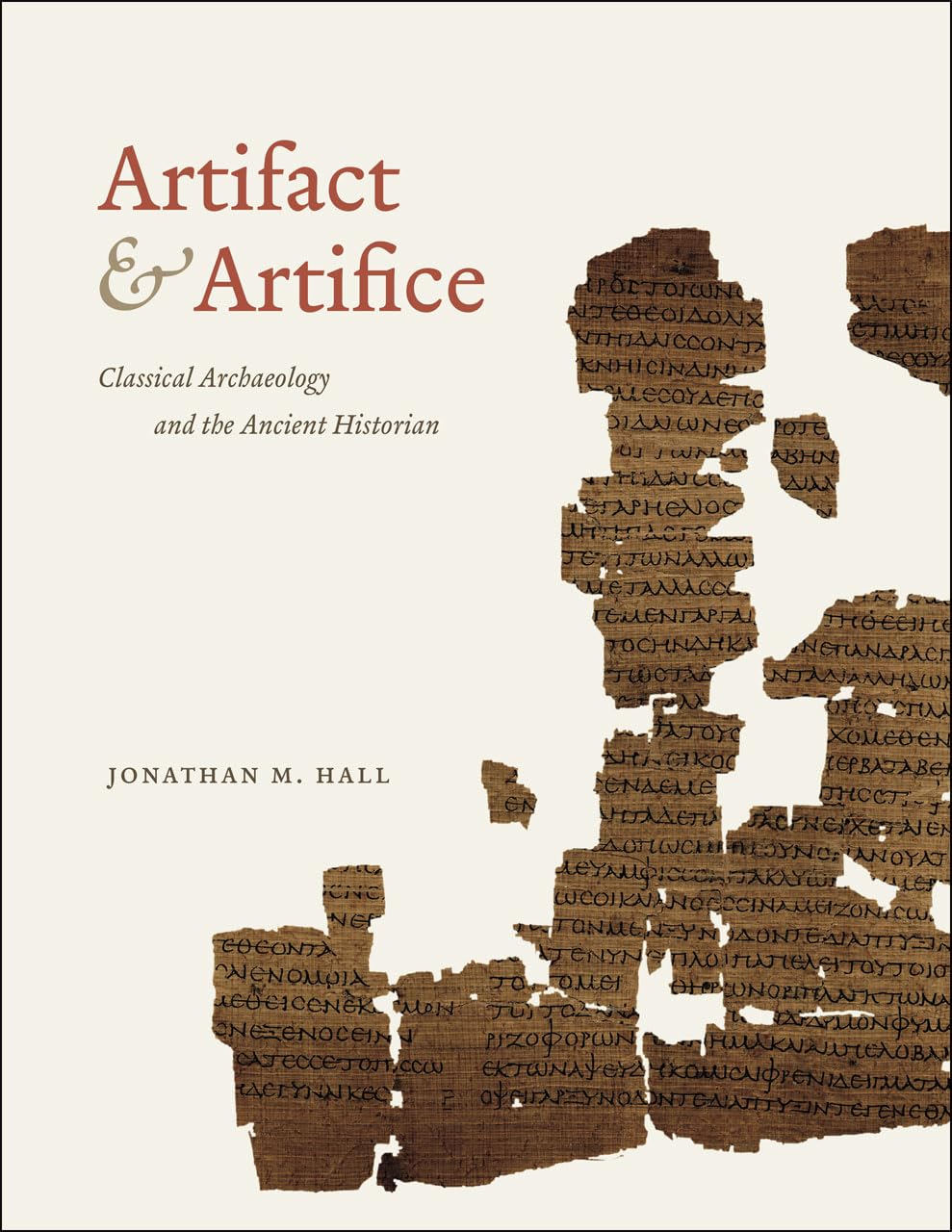
Artifact and Artifice: Classical Archaeology and the Ancient Historian
$51.25
by Jonathan M. Hall



Is it possible to trace the footprints of the historical Sokrates in Athens? Was there really an individual named Romulus, and if so, when did he found Rome? Is the tomb beneath the high altar of St. Peter’s Basilica home to the apostle Peter? To answer these questions, we need both dirt and words—that is, archaeology and history. Bringing the two fields into conversation, Artifact and Artifice offers an exciting excursion into the relationship between ancient history and archaeology and reveals the possibilities and limitations of using archaeological evidence in writing about the past. Jonathan M. Hall employs a series of well-known cases to investigate how historians may ignore or minimize material evidence that contributes to our knowledge of antiquity unless it correlates with information gleaned from texts. Dismantling the myth that archaeological evidence cannot impart information on its own, he illuminates the methodological and political principles at stake in using such evidence and describes how the disciplines of history and classical archaeology may be enlisted to work together. He also provides a brief sketch of how the discipline of classical archaeology evolved and considers its present and future role in historical approaches to antiquity. Written in clear prose and packed with maps, photos, and drawings, Artifact and Artifice will be an essential book for undergraduates in the humanities. “The premise of this book—to summarize the development of arguments concerning identification of particular sites in the ancient world known from both literary and archaeological sources—is very interesting. . . . Recommended.” ― Choice “ Artifact and Artifce makes clear that textual evidence and archaeological evidence must be situated within a broader literary and material context. No research field, regardless of its cumulative perceptions, is one dimensional; nothing is as simple as it appears. . . . [Hall’s] book demonstrates that . . . promising avenues for a fruitful dialogue between disciplines are certainly in the offing.” ― Journal of Interdisciplinary History "Hall deftly analyses the politics that lie behind the archaeology. This is an eloquent discussion." ― Current World Archaeology “In the shoes of a master sleuth, Hall, expert in many fields, guides his readers through nine prominent cases in which scholars have combined material and textual evidence to explain the archaeological record. Judiciously exposing errors and pitfalls and searching for methods that promise tenable results, he presents a thoroughly researched, well-written, and fascinating tale of history as an active, forensic practice that will help archaeologists and historians to collaborate more productively.” ― Kurt A. Raaflaub, Brown University "A careful and informative introduction to the case studies." ― Bryn Mawr Classical Review “Hall is one of our very best archaeo-historians, a specialist in ancient Greece who is as conversant with and as competent in handling the authentic but mute evidence of archaeology as the often-unsatisfactory written texts, and authoritative, especially in marrying the two different kinds of historical sources. In his latest book he ranges widely in period and place from archaic (preclassical) Delphi and Eretria to thirteenth-century CE Hierapolis in modern Turkey by way of classical Athens, Alexander’s Macedonia, and regal-period Rome, among others. Like many of the best books in his field, this series of acutely researched and shrewdly argued case studies is firmly based on his teaching at the University of Chicago and will be a boon for instructors and students alike.” ― P. A. Cartledge, author of After Thermopylae: The Oath of Plataea and the End of the Graeco-Persian “Too many books have been labeled thought provoking, but the verdict would in any case be an understatement here. Artifact and Artifice targets one of the most basic tenets in classical studies that impact archaeologists and ancient historians alike in their everyday research operations. Hall surveys the driving theories of the ‘Great Divide’ to take us on an eventful journey to ancient places that are well known. Or are they? From the Pythia at Delphi to the Bones of St. Peter, from the Athenian agora to the House of Augustus, Hall discloses how our understanding is blurred by entangled preconceptions of visual and textual legacies. Accented with superb snapshots of the mind and rich illustrations, his case studies offer dazzling aperçus into key themes in antiquity. Artifact and Artifice should be in the hands of anyone interested in the field of classical studies.” ― Hans Beck, McGill University “Offers a good overview of important discoveries and their historical context, particularly for students of ancient history and classical archaeology, and also increases awareness of the proper use of sources within and among disciplines. Spanning both fields, this study integrates crucial questio