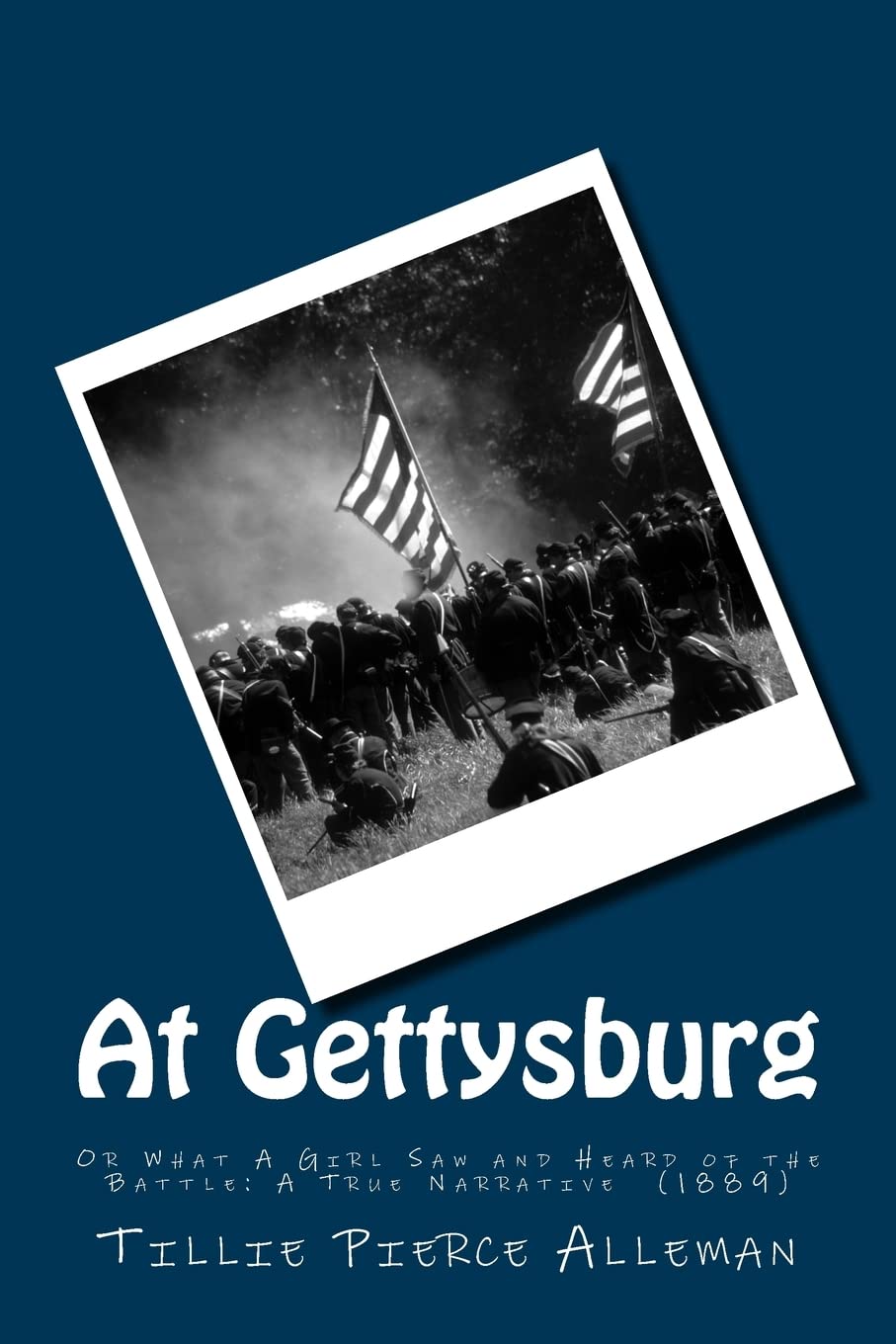
At Gettysburg: Or What A Girl Saw and Heard of the Battle: A True Narrative (1889)
$9.99
by Tillie Pierce Alleman



Imagine being fifteen years old when the most catastrophic battle on American soil erupts—quite literally—on your doorstep. That was Tillie Pierce’s reality in Gettysburg, 1863. Sent by her parents to the “safety” of the Weikert farm just outside town, Tillie soon discovered she had stepped not away from danger, but directly into the heart of it. As the Battle of Gettysburg exploded across the fields, hillsides, and farmhouses around her, Tillie watched the quiet countryside transform into a desperate field hospital. On the second and third days of battle—when cannon fire shook the ground and sharpshooters hid in the woods—the Weikert farm became a place of agony and courage. Tillie witnessed amputation benches, heaps of severed limbs, wounded men pleading for water, and surgeons working without rest. Yet she also witnessed moments of astonishing humanity: offering a drink of spring water to a weary General Meade, speaking to the mortally wounded General Stephen Weed, and helping tend soldiers who clung to life through the chaos. Though she wrote her memoir decades later, Tillie’s voice is unmistakably that of a teenager—honest, startled, compassionate, and unforgettable. Her account offers a rare and gripping window into the Civil War as lived by a young girl , not a soldier or general. It reveals how the war reached into the lives of ordinary families, how children were forced to grow up overnight, and how bravery often came from the least expected places. More than just a historical narrative, Tillie Pierce’s memoir remains one of the most vivid and beloved eyewitness accounts of Gettysburg. It is indispensable for anyone who wants to understand the human cost of war—and the extraordinary courage of one young girl who refused to look away. Tillie Pierce Alleman (1848-1914) was a young girl of 15 and a resident of Gettysburg during the battle of Gettysburg. Her maiden name was Tillie Pierce. During the first day's fighting, Tillie's father, James Pierce, ran a butcher shop in the town. During the first day of fighting at Gettysburg, the Pierces moved Tillie out of the town to a farm, thinking she would be safer there. It turned out that Tillie ended up right behind the Union lines on the second and third day. The farm where she stayed became a field hospital, and this young girl witnessed much suffering and death. Later in life, Mrs. Alleman wrote an account of what she saw, and it is considered a very accurate and excellent first hand source.