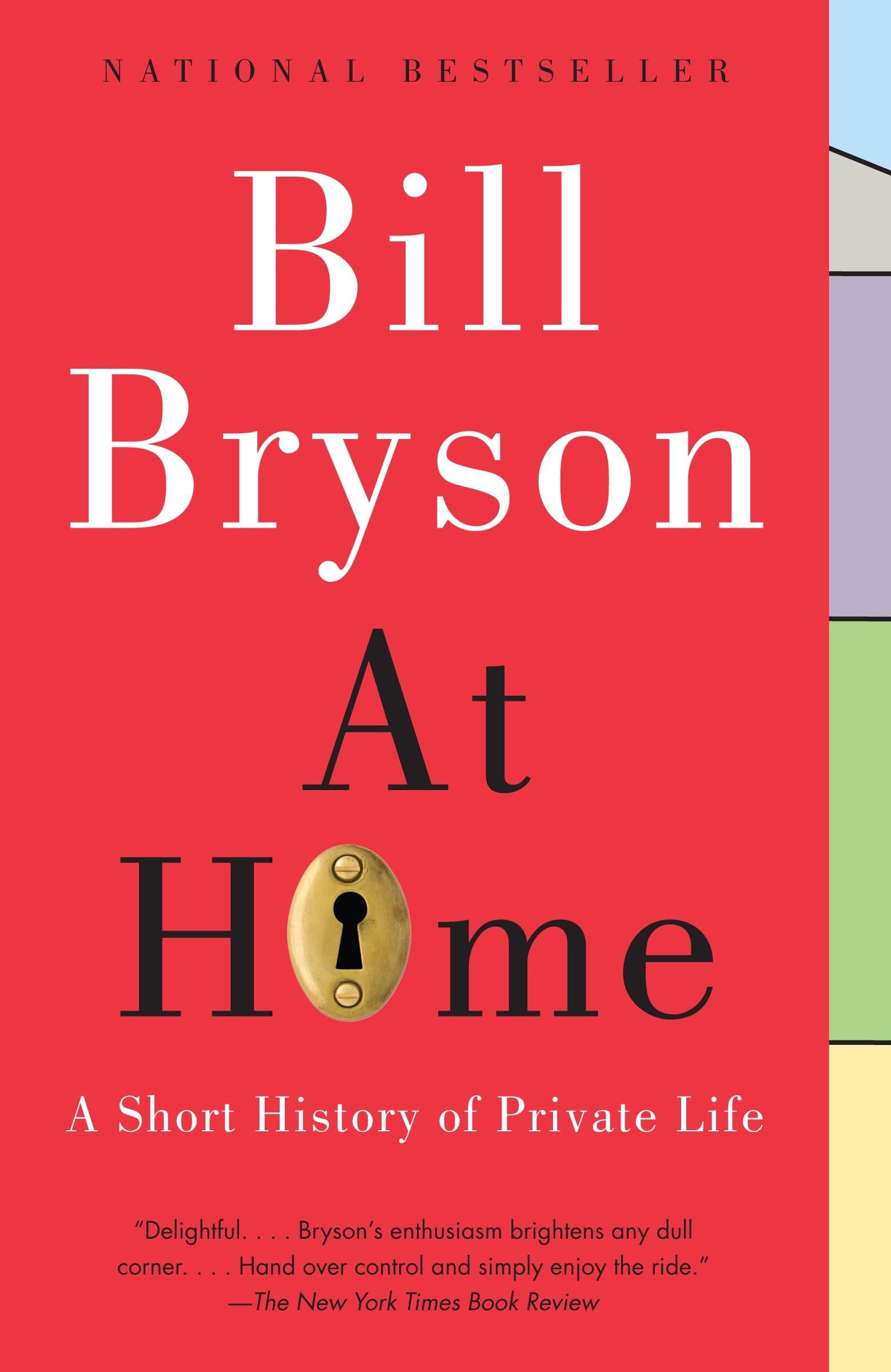



In these pages, the beloved Bill Bryson gives us a fascinating history of the modern home, taking us on a room-by-room tour through his own house and using each room to explore the vast history of the domestic artifacts we take for granted. As he takes us through the history of our modern comforts, Bryson demonstrates that whatever happens in the world eventually ends up in our home, in the paint, the pipes, the pillows, and every item of furniture. Bryson has one of the liveliest, most inquisitive minds on the planet, and his sheer prose fluency makes At Home one of the most entertaining books ever written about private life. “Delightful. . . . Bryson’s enthusiasm brightens any dull corner. . . . Hand over control and simply enjoy the ride.” – The New York Times Book Review "An exuberant, shared social history. . . . Told with Bryson's habitual brio. . . . A personal compendium of fascinating facts, suggesting how the history of houses and domesticity has shaped our lives, language, and ideas." - The New York Review of Books “A treasure trove. . . . Playful, yes, but Bryson is also a deft historian.” – Los Angeles Times “If this book doesn’t supply you with five years’ worth of dinner conversation, you’re not paying attention.” – People “Bryson is fascinated by everything, and his curiosity is infectious. . . . You can take this class in your pajamas—and, judging by the book’s laid-back, comfy tone, I have a sneaking suspicion that Bryson wrote much of it in his.” – New York Times Book Review “The experience of reading a Bill Bryson book is something you don’t want to stop—a pip and a spree and, almost incidentally, a serious education. And never tiresome, for Bryson has the gift of being the student and not the tutor.” – Washington Post “At Home is both insightful and entertaining, leaving a deeper appreciation of the stuff of home life that will never again be viewed as mundane.” – Seattle Times “Readers who enjoyed Mr. Bryson’s apparently inexhaustible supply of nifty facts in such previous books as “A Short History of Nearly Everything” (2004) or “The Mother Tongue” (1991) will be happy to find the author’s pen as nimble and his narrative persona as genial as ever.” – Wall Street Journal “Bryson serves up a rich banquet of utterly fascinating and sometimes horrifying facts of where and how people have slept, eaten, made a living, built homes and monuments, frolicked, traveled, given birth and been laid to rest.” –Bookreporter.com “Its lasting impression is the author’s delightful, boundless curiosity. . . . The best nonfiction illuminates what we found impossible to see without it, and perhaps more so than any of his other wonderful books, At Home proves that Bryson writes some of the very best.” –"The AV Club," The Onion “Bryson writes with his usual slyly sassy humor. . . . The result makes for reading that charms as it informs.” – St. Louis Post-Dispatch “Reading Bill Bryson is like having one of those friends around who’s always discovering something new—some pastime or place or piece of information—and can’t wait to breathlessly pass it along.” – Dallas Morning News “Deliciously informative. . . . A treasure trove of facts in an engaging history of how we once lived.” – Richmond Times-Dispatch “At Home is terrific. Bryson is a brilliant writer.” – The Charlotte Observer “Bryson is the ultimate fact-filled uncle. . . . A delightful book filled with humor and astonishing facts.” – Vancouver Sun Bill Bryson’s bestselling books include A Walk in the Woods (now a major motion picture starring Robert Redford and Nick Nolte), Notes from a Small Island, I’m a Stranger Here Myself, In a Sunburned Country, A Short History of Nearly Everything (which earned him the 2004 Aventis Prize), The Life and Times of the Thunderbolt Kid, At Home, and One Summer. He lives in England with his wife. www.billbrysonbooks.com CHAPTER I THE YEAR I In the autumn of 1850, in Hyde Park in London, there arose a most extraordinary structure: a giant iron-and-glass greenhouse covering nineteen acres of ground and containing within its airy vastness enough room for four St. Paul's Cathedrals. For the short time of its existence, it was the biggest building on Earth. Known formally as the Palace of the Great Exhibition of the Works of Industry of All Nations, it was incontestably magnificent, but all the more so for being so sudden, so startlingly glassy, so gloriously and unexpectedly there. Douglas Jerrold, a columnist for the weekly magazine Punch, dubbed it the Crystal Palace, and the name stuck. It had taken just five months to build. It was a miracle that it was built at all. Less than a year earlier it had not even existed as an idea. The exhibition for which it was conceived was the dream of a civil servant named Henry Cole, whose other principal claim to history's attention is as the inventor of the Christmas card (as a way of encouraging people to use the new penny pos