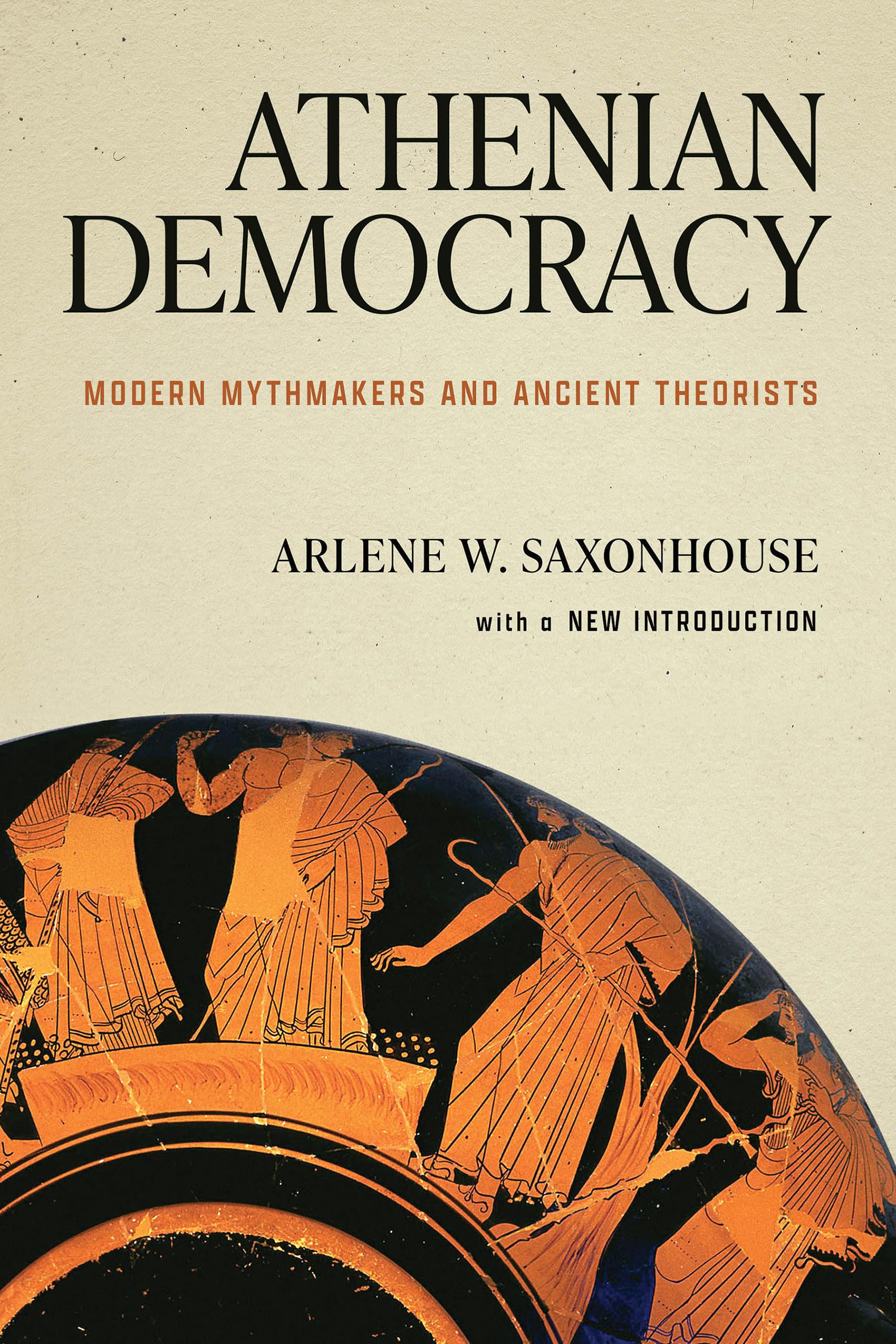



Athenian Democracy provides innovative readings of ancient theorists to reveal both the complexity of democracy’s achievements and its limits. In this classic work, noted political scientist Arlene W. Saxonhouse offers fresh and provocative explorations of ancient political theorists, lending new insights about democracy’s foundations and principles. These insights are more relevant than ever in a moment when the viability of democratic regimes is under scrutiny. Saxonhouse provides an in-depth discussion of the modern mythmakers (Hobbes, Paine, Hamilton, Mill, and Arendt, among others) who, in praising or excoriating Athenian democracy, have in fact distorted it to support their own assessments of democracy. She then offers detailed reinterpretations of the writings on democracy of four ancient theorists who had directly experienced life in the first democratic regime: Herodotus, Thucydides, Plato, and Aristotle. Saxonhouse argues that the mythmaking that often attends our views of Athenian democracy―whether as a flawed, slaveholding regime that fostered factions and oppressed women or as an ideal regime of egalitarian and participatory democracy―blinds us to the deeper understanding of democracies that these ancient theorists can offer. “Arlene W. Saxonhouse’s lively and entertaining discussion . . . is ably conducted by a master teacher who has succeeded in conquering the ancient and modern teachings about democracy.” ― Perspectives on Political Science “In this clearly written volume [Saxonhouse] searches for those largely untapped veins of ore overlooked by the majority of scholars who have been misdirected in their own pursuits of the ancients by the modern mythmakers of her subtitle.” ― Ethics “Saxonhouse’s contribution both forces classicists to think carefully about ingrained presuppositions and habits of reading and also provokes further reflection upon the timely question of what we can learn about our own democratic culture from studying ancient authors who analyzed democracy.” ― Bryn Mawr Classical Review “By scrupulously insisting on understanding the Greek theorists as they understood themselves, Saxonhouse’s lively, engaging book develops fresh perspectives on modern as well as ancient politics.” ―Stephen G. Salkever, author of Finding the Mean “In this helpful meditation, an open-minded book, Saxonhouse wonders how the ancient theorists can be brought to the understanding and aid of modern democracy.” ― American Political Science Review “Saxonhouse's judicious account is always interesting and the book abounds in useful insights.” ― The Review of Politics Arlene W. Saxonhouse is the Caroline Robbins Professor of Political Science and Women's Studies at the University of Michigan. In 2017 the Washington Post adopted the slogan “Democracy Dies in Darkness.” An informed citizenry, one presumably enlightened by the newspaper’s reporting, the slogan suggests, is essential if democratic regimes are to survive. The potential demise of democracy has been a consistent theme of politics in the 21st century as politicians, pundits, political scientists and political theorists identify a multitude of threats to the life of such a regime. And yet, even as we fear its demise, what we may mean by the language of democracy, what institutions constitute a democratic regime, what justifications there are for supporting democratic practices, all these remain highly contested. As I argue in this book, Athenian democracy has long been a resource for those exploring the nature, benefits, possibilities and dangers of democracy. Some in the past have viewed Athenian democracy as embodying a threat to stability and human happiness, while others have seen it as a model of the freedoms entailed in self-rule. These are the writers I dubbed the “mythmakers,” who presented a stylized image of Athenian democracy, one that might serve their various political orientations. The language of the early 19th century English historian William Mitford who referred to Athenian democracy as a “Tyranny of the People” may be long gone, replaced by deep-seated beliefs in the fundamental value of the freedom and self-rule characteristic of a democratic regime, qualities that had been manifest in the political life of ancient Athens. Democracy, as the Washington Post slogan attests, is now the political regime that we aim to protect, preserve and encourage. Excoriation of democracy is over – at least in the West. But just what is this regime that we are eager to save from death? Why do we aim to preserve it? What are its possibilities and what are its liabilities for the pursuit of freedom and human happiness? Thirty years ago, in the lectures that were to become the basis of this book, I suggested that we turn to ancient Athens, but not as an idealized model to be emulated as so many in the 19th and 20th century had done and were doing. Rather, I suggested we look to those authors who were writing during the period