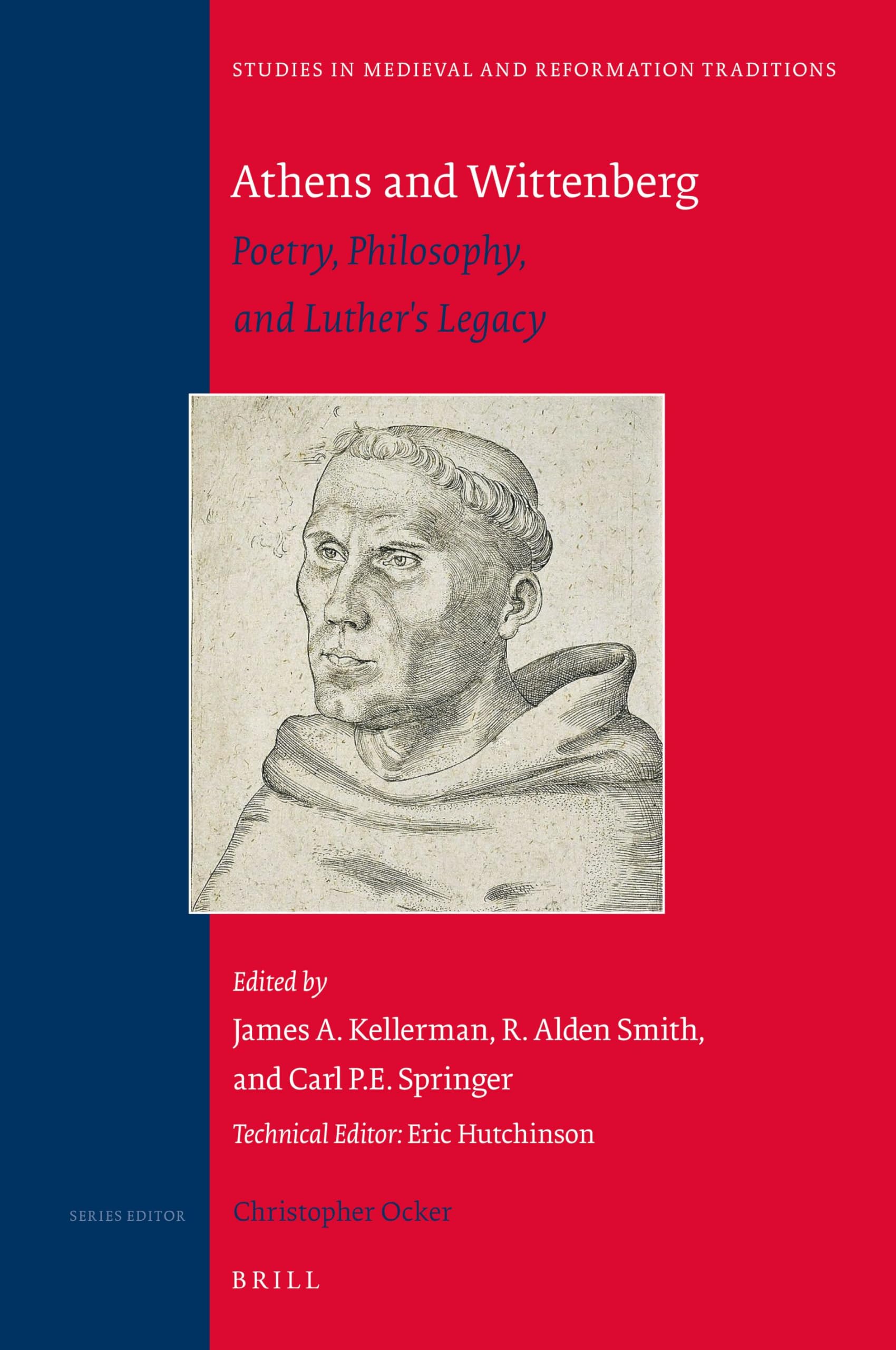
Athens and Wittenberg: Poetry, Philosophy, and Luther's Legacy (Studies in Medieval and Reformation Traditions, 234)
$151.95
by James A. Kellerman



Scholarship has tended to assume that Luther was uninterested in the Greek and Latin classics, given his promotion of the German vernacular and his polemic against the reliance upon Aristotle in theology. But as Athens and Wittenberg demonstrates, Luther was shaped by the classical education he had received and integrated it into his writings. He could quote Epicurean poetry to non-Epicurean ends; he could employ Aristotelian logic to prove the limits of philosophy’s role in theology. This volume explores how Luther and early Protestantism, especially Lutheranism, continued to draw from the classics in their quest to reform the church. In particular, it examines how early Protestantism made use of the philosophy and poetry from classical antiquity. Contributors to this volume: Joseph Herl, Jane Schatkin Hettrick, E.J. Hutchinson, Jack D. Kilcrease, E. Christian Kopf, John G. Nordling, Piergiacomo Petrioli, Eric G. Phillips, Richard J. Serina, Jr, R. Alden Smith, Carl P.E. Springer, Manfred Svensson, William P. Weaver, and Daniel Zager. James R. Kellerman teaches at Concordia Lutheran Theological Seminary in St. Catharines, Canada. His main interests are Pauline Epistles, Synoptic Gospels, Plato, and Patristics. His publications include Ad fontes Witebergenses , co-edited with Carl P.E. Springer (2014), and Ad fontes Witebergenses , co-edited with E.J. Hutchinson and Joshua J. Hayes (2017). R. Alden Smith teaches at Baylor University in Waco, Texas. His main interest is Latin poetry of the Augustan age. His book publications include Classics from Papyrus to the Internet: An Introduction to Transmission and Reception (2017), co-authored with Jeffrey M. Hunt and Fabio Stok, Virgil, Aeneid 8: Text, Translation and Commentary (2018), co-authored with Lee Fratantuono, and a translation of The Shroud of Turin: The History and Legends of the World’s Most Famous Relic , by Andrea Nicoletti (2020). Carl P.E. Springer holds the SunTrust Chair of Excellence in the Humanities in the Department of Modern and Classical Languages at the University of Tennessee. He has written extensively on the relationship between Martin Luther and the Classics, including Cicero in Heaven: The Roman Rhetor and Luther’s Reformation (2018), and Sedulius: The Paschal Song and Hymns (2013).