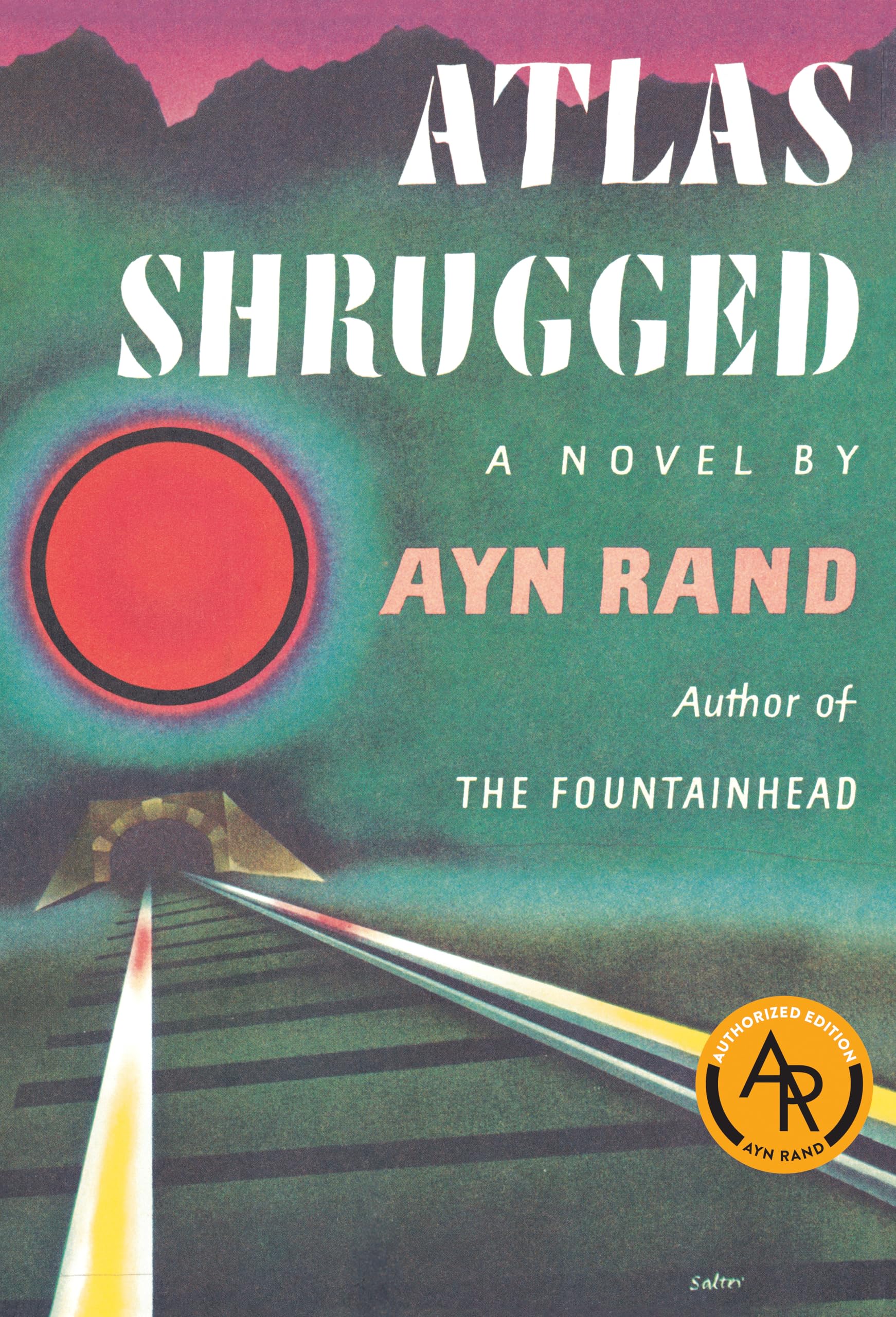



Peopled by larger-than-life heroes and villains, charged with towering questions of good and evil, Atlas Shrugged is Ayn Rand’s magnum opus: a philosophical revolution told in the form of an action thriller—n ominated as one of America’s best-loved novels by PBS’s The Great American Read . Who is John Galt? When he says that he will stop the motor of the world, is he a destroyer or a liberator? Why does he have to fight his battles not against his enemies but against those who need him most? Why does he fight his hardest battle against the woman he loves? You will know the answer to these questions when you discover the reason behind the baffling events that play havoc with the lives of the amazing men and women in this book. You will discover why a productive genius becomes a worthless playboy...why a great steel industrialist is working for his own destruction...why a composer gives up his career on the night of his triumph...why a beautiful woman who runs a transcontinental railroad falls in love with the man she has sworn to kill. Atlas Shrugged , a modern classic and Rand’s most extensive statement of Objectivism—her groundbreaking philosophy—offers the reader the spectacle of human greatness, depicted with all the poetry and power of one of the twentieth century’s leading artists. A writer of great power. She has a subtle and ingenious mind and the capacity of writing brilliantly, beautifully, bitterly. ("The New York Times") Born February 2, 1905, Ayn Rand published her first novel, We the Living , in 1936. Anthem followed in 1938. It was with the publication of The Fountainhead (1943) and Atlas Shrugged (1957) that she achieved her spectacular success. Rand’s unique philosophy, Objectivism, has gained a worldwide audience. The fundamentals of her philosophy are put forth in three nonfiction books, Introduction to Objectivist Epistemology , The Virtues of Selfishness , and Capitalism: The Unknown Ideal . They are all available in Signet editions, as is the magnificent statement of her artistic credo, The Romantic Manifesto . PART ONE NON-CONTRADICTION Chapter I THE THEME “Who is John Galt?” The light was ebbing, and Eddie Willers could not distinguish the bum’s face. The bum had said it simply, without expression. But from the sunset far at the end of the street, yellow glints caught his eyes, and the eyes looked straight at Eddie Willers, mocking and still—as if the question had been addressed to the causeless uneasiness within him. “Why did you say that?” asked Eddie Willers, his voice tense. The bum leaned against the side of the doorway; a wedge of broken glass behind him reflected the metal yellow of the sky. “Why does it bother you?” he asked. “It doesn’t,” snapped Eddie Willers. He reached hastily into his pocket. The bum had stopped him and asked for a dime, then had gone on talking, as if to kill that moment and postpone the problem of the next. Pleas for dimes were so frequent in the streets these days that it was not necessary to listen to explanations and he had no desire to hear the details of this bum’s particular despair. “Go get your cup of coffee,” he said, handing the dime to the shadow that had no face. “Thank you, sir,” said the voice, without interest, and the face leaned forward for a moment. The face was wind-browned, cut by lines of weariness and cynical resignation; the eyes were intelligent. Eddie Willers walked on, wondering why he always felt it at this time of day, this sense of dread without reason. No, he thought, not dread, there’s nothing to fear: just an immense, diffused apprehension, with no source or object. He had become accustomed to the feeling, but he could find no explanation for it; yet the bum had spoken as if he knew that Eddie felt it, as if he thought that one should feel it, and more: as if he knew the reason. Eddie Willers pulled his shoulders straight, in conscientious self-discipline. He had to stop this, he thought; he was beginning to imagine things. Had he always felt it? He was thirty-two years old. He tried to think back. No, he hadn’t; but he could not remember when it had started. The feeling came to him suddenly, at random intervals, and now it was coming more often than ever. It’s the twilight, he thought; I hate the twilight. The clouds and the shafts of skyscrapers against them were turning brown, like an old painting in oil, the color of a fading masterpiece. Long streaks of grime ran from under the pinnacles down the slender, soot-eaten walls. High on the side of a tower there was a crack in the shape of a motionless lightning, the length of ten stories. A jagged object cut the sky above the roofs; it was half a spire, still holding the glow of the sunset; the gold leaf had long since peeled off the other half. The glow was red and still, like the reflection of a fire: not an active fire, but a dying one which it is too late to stop. No, thought Eddie Willers, there was nothing disturbing in the si