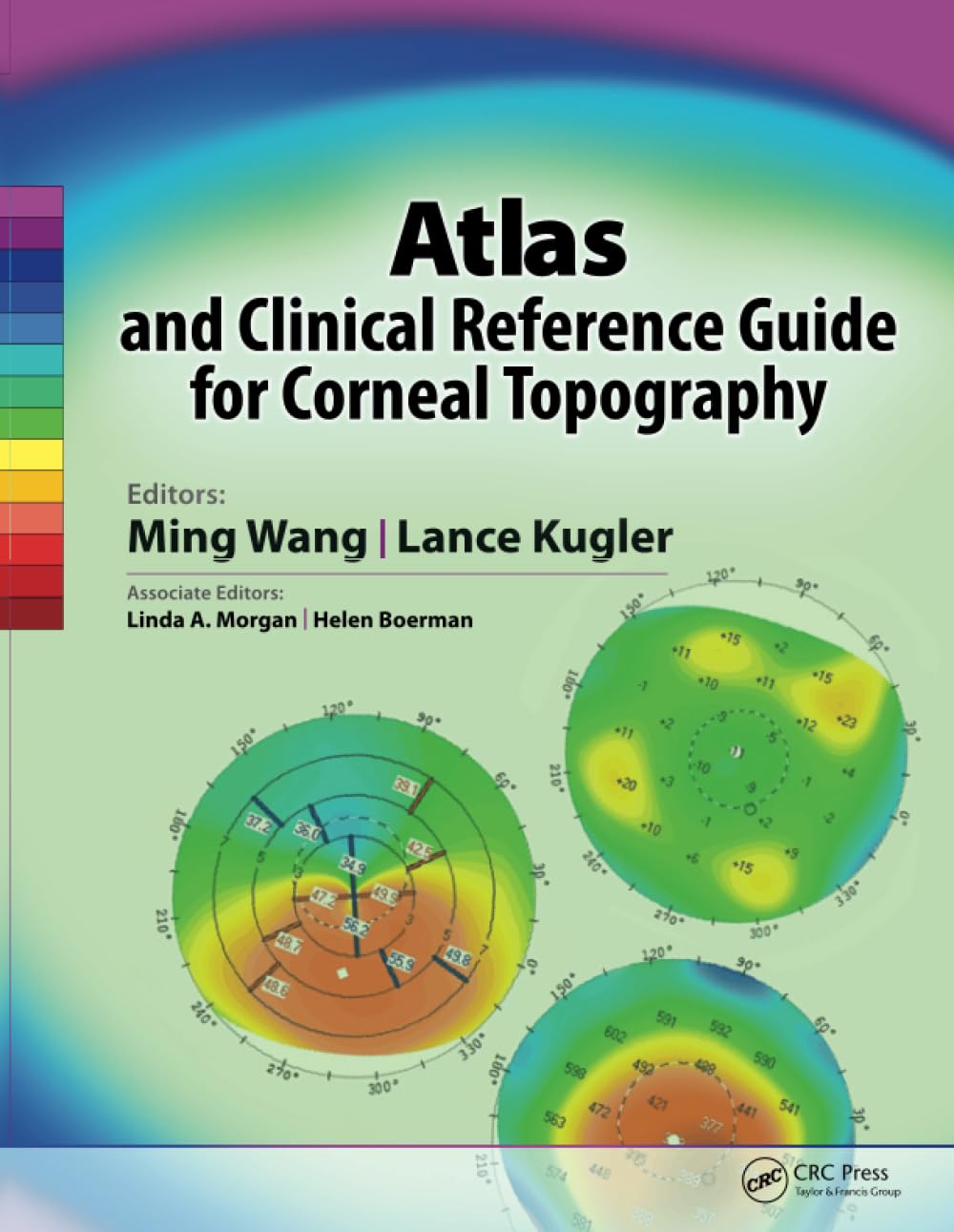
Atlas and Clinical Reference Guide for Corneal Topography [Paperback, SpiralBound]
$143.95
by Ming Wang MD PhD



Corneal topography has become essentially a pattern recognition trade, best learned by viewing multiple images of representative patterns. In spite of this, currently available topography books focus only on the technology behind topography, or a particular application of topography, as opposed to presenting a comprehensive collection of topographic patterns that provide quick, consistent pattern recognition and identification. Drs. Wang and Kugler, along with Drs. Morgan and Boerman, look to fill this void with Atlas and Clinical Reference Guide for Corneal Topography. Atlas and Clinical Reference Guide for Corneal Topography is the first corneal topography book that lends itself to efficient image search and reference for busy clinicians at chair side. Organized into both map-based and disease-based sections, the book allows for quick reference in busy clinical situations. Images come from the commonly used topographers, the Zeiss Atlas and the Oculus Pentacam, but the principles of pattern recognition can be applied to any topographer. Due to the text’s large collection of topographic images and corresponding corneal conditions, Atlas and Clinical Reference Guide for Corneal Topography can be used side by side with the topographer. Designed as both a learning tool for students and a reference for clinicians to use when faced with a challenging topography interpretation, Atlas and Clinical Reference Guide for Corneal Topography will be appreciated by a wide spectrum of eye care professionals. General ophthalmologists, cataract and refractive surgeons, corneal specialists, optometrists, and ophthalmology residents and students will benefit from this invaluable atlas for corneal topography. “This corneal topography atlas is the first of its kind and is a wonderful resource for eye care providers. It is organized for easy access so clinicians can quickly visualize images of commonly encountered corneal disorders. This book is indispensable for surgeons because accurate interpretation of the shape of a cornea can prevent bad surgical outcomes. The full-color images are of excellent quality and value to readers. This atlas will, without doubt, become the standard reference for corneal topography.” - Brian Marshall, OD, Marshall Family Eye Care, Doody’s Review Service Ming Wang, MD, PhD, is the Director of Wang Vision Cataract and LASIK Center in Nashville, Tennessee, Clinical Associate Professor of the University of Tennessee, and International president of Shanghai Aier Eye Hospital, Shanghai, China. Dr. Wang graduated from Harvard Medical School and Massachusetts Institute of Technology (MD, magna cum laude) in Boston, Massachusetts and holds a doctorate degree in laser spectroscopy. He completed his residency at Wills Eye Hospital in Philadelphia, Pennsylvania and his corneal and refractive surgery fellowship at Bascom Palmer Eye Institute, Miami, Florida. He is an editorial board member of Cataract and Refractive Surgery Today and Refractive EyeCare. A former panel consultant to the US FDA Ophthalmic Device Panel and a founding director of Vanderbilt Laser Sight Center, Dr. Wang published a paper in the world-renowned journal Nature, as well as 5 ophthalmic textbooks (Corneal Topography in the Wavefront Era; Irregular Astigmatism: Diagnosis and Treatment; Corneal Dystrophy and Degeneration: A Molecular Genetic Approach; Keratoconus and Keratoectasia: Prevention, Diagnosis and Treatment; and Corneal Topography in the Wavefront Era, Second Edition). Additionally, he has published over 120 papers and book chapters. Dr. Wang holds several US patents for his inventions of new biotechnologies to restore sight, including an amniotic membrane contact lens, an adaptive infrared retinoscopic device for detecting ocular aberrations, a digital eye bank for virtual clinical trials, phaco balloonplasty, and all-laser no-phaco cataract surgery technology. His invention of the amniotic membrane contact lens has resulted in a commercially available product, AmbioDisk amniotic membrane contact lens, which has been used widely by surgeons worldwide. Dr. Wang is one of the investigators in the United States conducting an FDA-regulated clinical trial to treat presbyopia (Refocus) and to treat keratoconus using cross-linking (Avedro). He introduced the femtosecond laser to China, and performed China’s first LASIK procedure using this laser in 2005. He also performed the world’s first femtosecond laser-assisted artificial cornea implantation (Alphacor), and the first 3D LASIK procedure. Dr. Wang was a recipient of the Honor Award from The American Academy of Ophthalmology and Lifetime Achievement Award from The Association of Chinese American Physicians. Dr. Wang is a founding president of the Tennessee Chinese Chamber of Commerce, and co-owner and international president of Shanghai Aier Eye Hospitals in Shanghai, China, which is the largest private eye hospital group in China today with 50 locations and holds