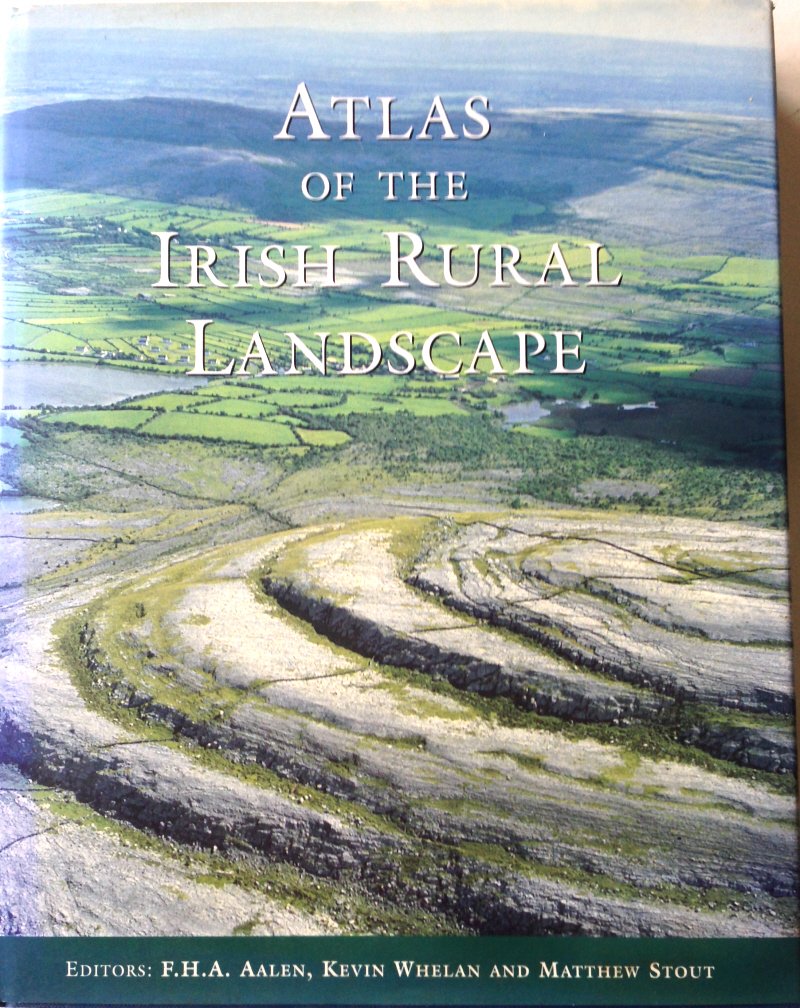



Lush and green, the beauty of Ireland's landscape is legendary. "The Atlas of the Irish Rural Landscape" has harnessed the expertise of dozens of specialists to produce an exciting and pioneering study which aims to increase understanding and appreciation for the landscape as an important element of Irish national heritage, and to provide a much needed basis for an understanding of landscape conservation and planning. Essentially cartographic in approach, the Atlas is supplemented by diagrams, photographs, paintings, and explanatory text. Regional case studies, covering the whole of Ireland from north to south, are included, along with historical background. The impact of human civilization upon Ireland's geography and environment is well documented, and the contributors to the Atlas deal with contemporary changes in the landscape resulting from developments in Irish agriculture, forestry, bog exploitation, tourism, housing, urban expansion, and other forces. "The Atlas of the Rural Irish Landscape" is a book which aims to educate and inform the general reader and student about the relationship between human activity and the landscape. It is a richly illustrated, beautifully written, and immensely authoritative work that will be the guide to Ireland's geography for many years to come. Chosen as one of the Times Literary Supplement's (1997) International Books of the Year 'Lavish in form and erudite in content. There are sections on bogs and demesnes, fields and villages, mining and the destruction of antiquities. The Irish landscape, now in places under grave ecological threat, has always been a visual palimpsest of the country's turbulent history, a text to be deciphered as much as to be savoured. This beautifully illustrated essay interweaves geology, archaeology, demography, social history and a host of other disciplines, moving from tourism to the rural poor, peat to parks, vernacular rural architecture to landscape management. It demonstrates the point that, rather like literary studies, there is almost nothing that geography isn't about; but after productions as ambitious as this, literary studies had better look to its laurels.' (Terry Eagleton Times Literary Supplement ) 'Anyone interested in Ireland, especially the Irish countryside, will find this attractive volume anything from engaging to indispensable. A main purpose of the book -undertaken by two professors at Trinity College, Dublin and Whelan, Ireland's foremost historical geographer - is to be a warning about the degradation of Ireland's rural heritage. But the book, using up-to-the-minute computer cartography and drawing on a variety of disciplines, is also a vivid, colourful evocation and analysis of the physical and human features of a superb landscape.' ( The Globe and Mail ) Chosen as a Lingua Franca Breakthrough Book as one of the most illuminating recent books on Ireland 'A remarkable multidisciplinary survey of the landscape that shaped Irish folklore, literature, and visual art - focusing on the seven centuries of colonial rule. This intelligently illustrated atlas provides a social, archaeological, and geological history of the land and a polemic against Ireland's failure to protect its rural region.' (Vera Kreilkamp Lingua Franca ) Chosen as a Lingua Franca Breakthrough Book as one of the most illuminating recent books on Ireland 'A remarkable multidisciplinary survey of the landscape that shaped Irish folklore, literature, and visual art - focusing on the seven centuries of colonial rule. This intelligently illustrated atlas provides a social, archaeological, and geological history of the land and a polemic against Ireland's failure to protect its rural region.' 'I have been waiting for the one book which will make me hear what the Irish landscape is saying to me. I know the Atlas will be it. All the fragments of knowledge, the living fabric of this country will at last be shaped into a coherent whole. The art of seeing Ireland will be transformed.' 'Ireland's landscape heritage, like that of many parts of rural Europe, is under threat. The value of this Atlas of the Irish Rural Landscape is that it will help deepen understanding of the landscape heritage and why it should be cared for. It should be read by everyone who takes pleasure in Ireland's countryside, admires its natural environment or respects its cultural history, and consulted by all those who have the responsibility to shape the landscape of the future.' F.H.A. Aalen is professor of Geography at Trinity College, Dublin, and has served with various government bodies in Ireland regarding environmental issues, landscape preservation, and regional development. Matthew Stout , the cartographic editor, is a lecturer at Trinity College, Dublin. Kevin Whelan , widely regarded as Ireland's most important historical geographer, teaches at Boston College, Massachussets. Used Book in Good Condition