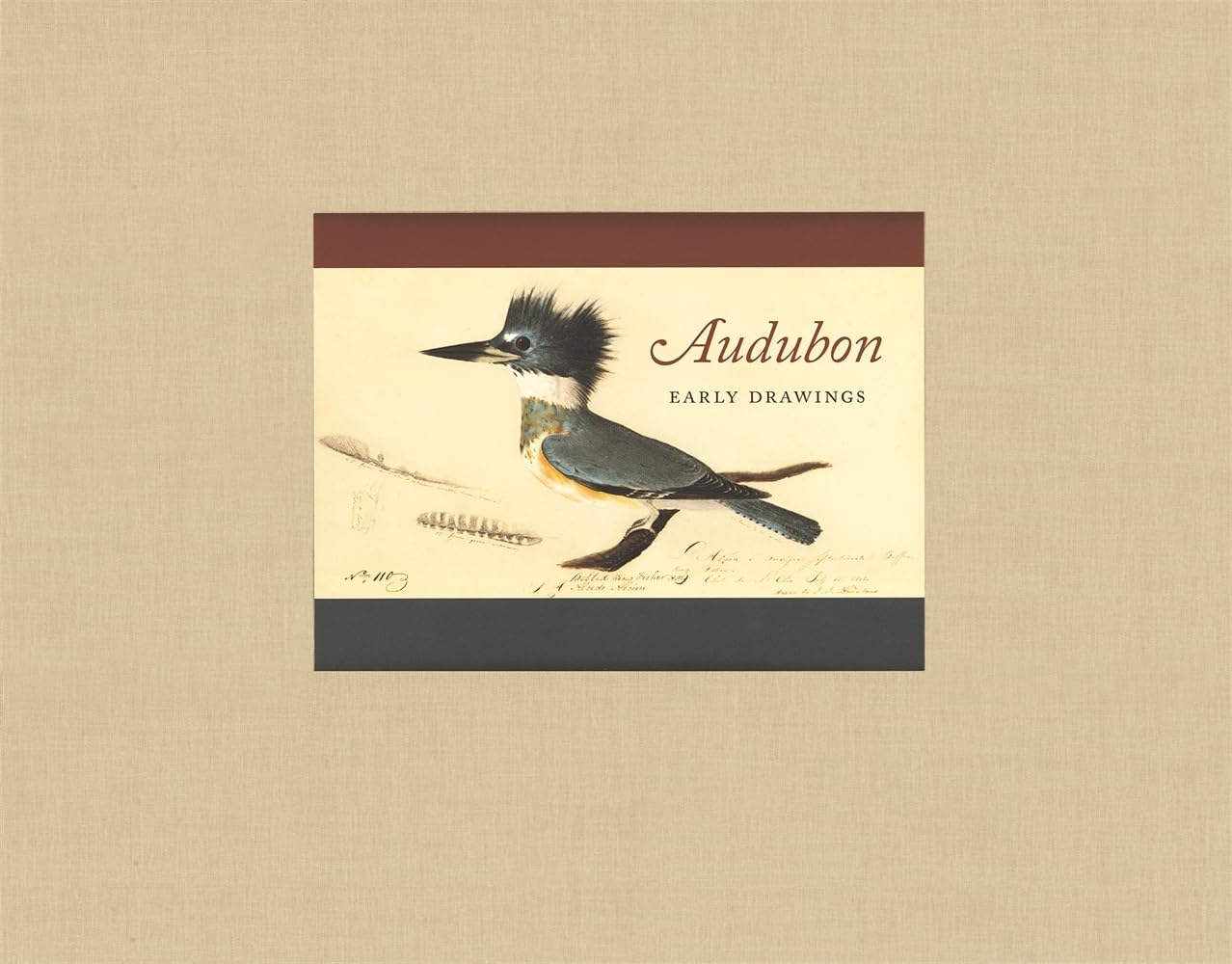



In 1805, Jean Jacques Audubon was a twenty-year-old itinerant Frenchman of ignoble birth and indifferent education who had fled revolutionary violence in Haiti and then France to take refuge in frontier America. Ten years later, John James Audubon was an American citizen, entrepreneur, and family man whose fervent desire to “become acquainted with nature” had led him to reinvent himself as a naturalist and artist whose study of birds would soon earn him international acclaim. The drawings he made during this crucial decade―sold to Audubon’s friend and patron Edward Harris to help fund his masterwork The Birds of America , and now held by Harvard’s Houghton Library and Museum of Comparative Zoology―are published together here for the first time in large format and full color. In these 116 portraits of species collected in America and in Europe we see Audubon inventing his ingenious methods of posing and depicting his subjects, and we trace his development into a scientist and an artist who could proudly sign his artworks “drawn from Nature.” The drawings also serve as a record of the birds found in Europe and the Eastern United States in the early nineteenth century, some now rare or extinct. The drawings are enhanced by an essay on the sources of Audubon’s art by his biographer, Richard Rhodes; transcription of Audubon’s own annotations to the drawings, including information on when and where the specimens were collected; ornithological commentary by Scott V. Edwards, along with reflections on Audubon as scientist; and an account of the history of the Harris collection by Leslie A. Morris. Splendid in their own right, these drawings also illuminate the self-invention of one of the most important figures in American natural history. They will delight all those interested in American art, nature, birds, and the life and times of John James Audubon. “ Audubon: Early Drawings is a record of nature and of Audubon’s own artistic apprenticeship―we can watch Audubon becoming Audubon. The earliest drawings―done in watercolor and, later, pastel―are simple profiles of birds silhouetted against the blank page with little in the way of natural context. They are delicate, hesitant, almost childlike renderings. Later drawings―made after Audubon had invented his celebrated technique of pinning dead birds into naturalistic poses―are more lifelike and animated, more confidently rendered. These look toward the fully realized images of The Birds of America , with their intense drama and implied narratives. Even at an early stage this self-taught artist possessed a powerful sense of color and a keen sensitivity to the way light can model a form. Yet we see him reaching the limits of his technique in his almost-but-not-quite depiction of the male wood grouse’s variegated plumage. Mastery would come later. Each rendering in Audubon: Early Drawings gets both a full-page reproduction and a facing-page commentary. About a bird known as the Willet, shown with a worm squirming in its beak, we read: ‘The May date of this drawing tells us that Audubon crossed paths with the Willet during the spring migration between its wintering grounds on the Gulf Coast of Mexico and the Caribbean and its breeding areas in wetlands of the interior West.’ We are right there with Audubon, his traveling bird and the unlucky worm.” ― Eric Gibson , Wall Street Journal “Before [ Birds of America ] made him famous, [Audubon] had spent decades trying to find a way to make his birds appear to fly off the page. This collection of 116 early drawings, published together for the first time, shows that while his early birds didn’t quite take off, they did have a delicacy and charm that somehow went missing from his later masterworks.” ― Stephanie Pain , New Scientist “One of the great pleasures of Audubon: Early Drawings , with its lavish reproductions and scientific notes, is that it allows us to see the naturalist turning into the artist, laboring not merely to give his birds scientific accuracy but an almost uncanny life force.” ― Jonathan Rosen , New York Times Book Review “This is the first book to collect and reproduce the pastel, ink, and watercolor studies from early in [Audubon’s] career―it’s not hard to glean the first principle that makes his illustrations so effective: spareness. Although Audubon usually sketches in some contextual clues―a tree stump, some sand, three or four leaves―his pages are remarkably blank. What he is really studying is the bird, so Audubon surrounds the specimen―the osprey, the bullfinch, or the linnet―in white, letting his notes take care of the habitat, migration patterns, and the rest. Audubon preemptively limits the context, isolating and foregrounding the more salient details so we know at a glance what’s important and what isn’t.” ― Dushko Petrovich , Boston Globe “In 1805, Jean-Jacques (later to become John James) Audubon, the son of a chambermaid who worked on his father’s plantation in Saint-Domingue