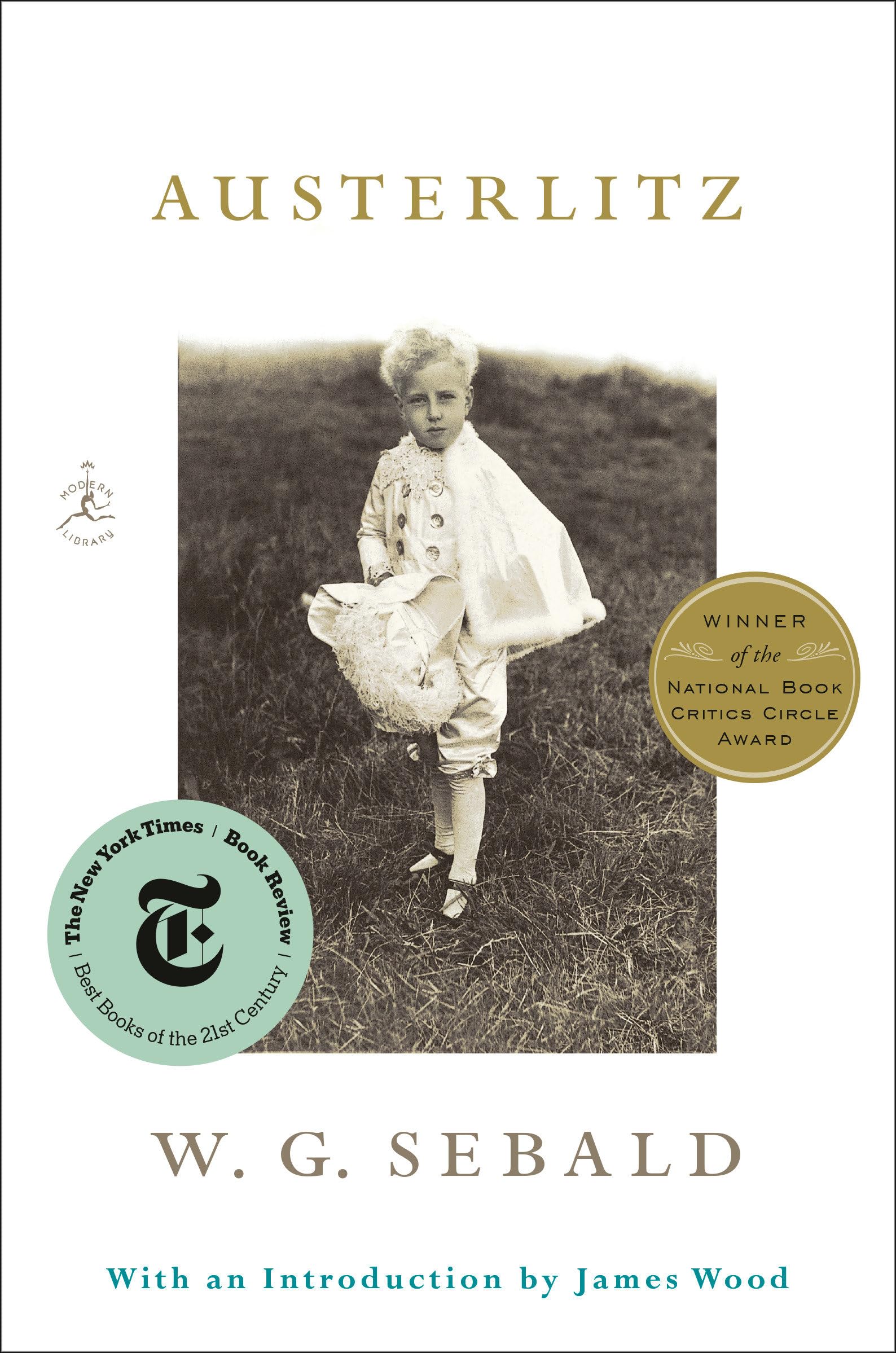



W. G. Sebald’s celebrated masterpiece, “one of the supreme works of art of our time” ( The Guardian ), follows a man’s search for the answer to his life’s central riddle. “Haunting . . . a powerful and resonant work of the historical imagination . . . Reminiscent at once of Ingmar Bergman’s Wild Strawberries, Kafka’s troubled fables of guilt and apprehension, and, of course, Proust’s Remembrance of Things Past. ”—Michiko Kakutani, The New York Times One of The New York Times ’s 10 Best Books of the 21st Century • A Kirkus Reviews Best Fiction Book of the Century • A Los Angeles Times, Entertainment Weekly, and New York Magazine Best Book of the Year Winner of the National Book Critics Circle Award, Koret Jewish Book Award, Independent Foreign Fiction Prize, and Jewish Quarterly Wingate Literary Prize A small child when he comes to England on a Kindertransport in the summer of 1939, Jacques Austerlitz is told nothing of his real family by the Welsh Methodist minister and his wife who raise him. When he is a much older man, fleeting memories return to him, and obeying an instinct he only dimly understands, Austerlitz follows their trail back to the world he left behind a half century before. There, faced with the void at the heart of twentieth-century Europe, he struggles to rescue his heritage from oblivion. Over the course of a thirty-year conversation unfolding in train stations and travelers’ stops across England and Europe, W. G. Sebald’s unnamed narrator and Jacques Austerlitz discuss Austerlitz’s ongoing efforts to understand who he is—a struggle to impose coherence on memory that embodies the universal human search for identity. “[A] beautiful novel . . . quietly breathtaking . . . Sebald contrives not to offer an ordinary, straightforward recital. For what is so delicate is how Sebald makes Austerlitz’s story a broken, recessed enigma whose meaning the reader must impossibly rescue.” —James Wood, from the Introduction “Sebald stands with Primo Levi as the prime speaker of the Holocaust and, with him, the prime contradiction of Adorno’s dictum that after it, there can be no art.” —Richard Eder, The New York Times Book Review “Sebald is a rare and elusive species . . . but still, he is an easy read, just as Kafka is. . . . He is an addiction, and once buttonholed by his books, you have neither the wish nor the will to tear yourself away.” —Anthony Lane, The New Yorker “Sebald’s final novel; his masterpiece, and one of the supreme works of art of our time.” —John Banville, The Guardian W. G. Sebald was born in Wertach im Allgäu, Germany, in 1944. He studied German language and literature in Freiburg, Switzerland, and Manchester. He taught at the University of East Anglia in Norwich, England, for thirty years, becoming professor of European literature in 1987, and from 1989 to 1994 was the first director of the British Centre for Literary Translation. His books The Rings of Saturn, The Emigrants, Vertigo, and Austerlitz have won a number of international awards, including the National Book Critics Circle Award, the Los Angeles Times Book Award, the Berlin Literature Prize, and the Literatur Nord Prize. His other books include After Nature, Campo Santo, and On the Natural History of Destruction . He died in December 2001. In the second half of the 1960s I traveled repeatedly from England to Belgium, partly for study purposes, partly for other reasons which were never entirely clear to me, staying sometimes for just one or two days, sometimes for several weeks. On one of these Belgian excursions which, as it seemed to me, always took me further and further abroad, I came on a glorious early summer’s day to the city of Antwerp, known to me previously only by name. Even on my arrival, as the train rolled slowly over the viaduct with its curious pointed turrets on both sides and into the dark station concourse, I had begun to feel unwell, and this sense of indisposition persisted for the whole of my visit to Belgium on that occasion. I still remember the uncertainty of my footsteps as I walked all round the inner city, down Jeruzalemstraat, Nachtegaalstraat, Pelikaanstraat, Paradijsstraat, Immerseelstraat, and many other streets and alleyways, until at last, plagued by a headache and my uneasy thoughts, I took refuge in the zoo by the Astridplein, next to the Centraal Station, waiting for the pain to subside. I sat there on a bench in dappled shade, beside an aviary full of brightly feathered finches and siskins fluttering about. As the afternoon drew to a close I walked through the park, and finally went to see the Nocturama, which had first been opened only a few months earlier. It was some time before my eyes became used to its artificial dusk and I could make out different animals leading their sombrous lives behind the glass by the light of a pale moon. I cannot now recall exactly what creatures I saw on that visit to the Antwerp Nocturama, but ther