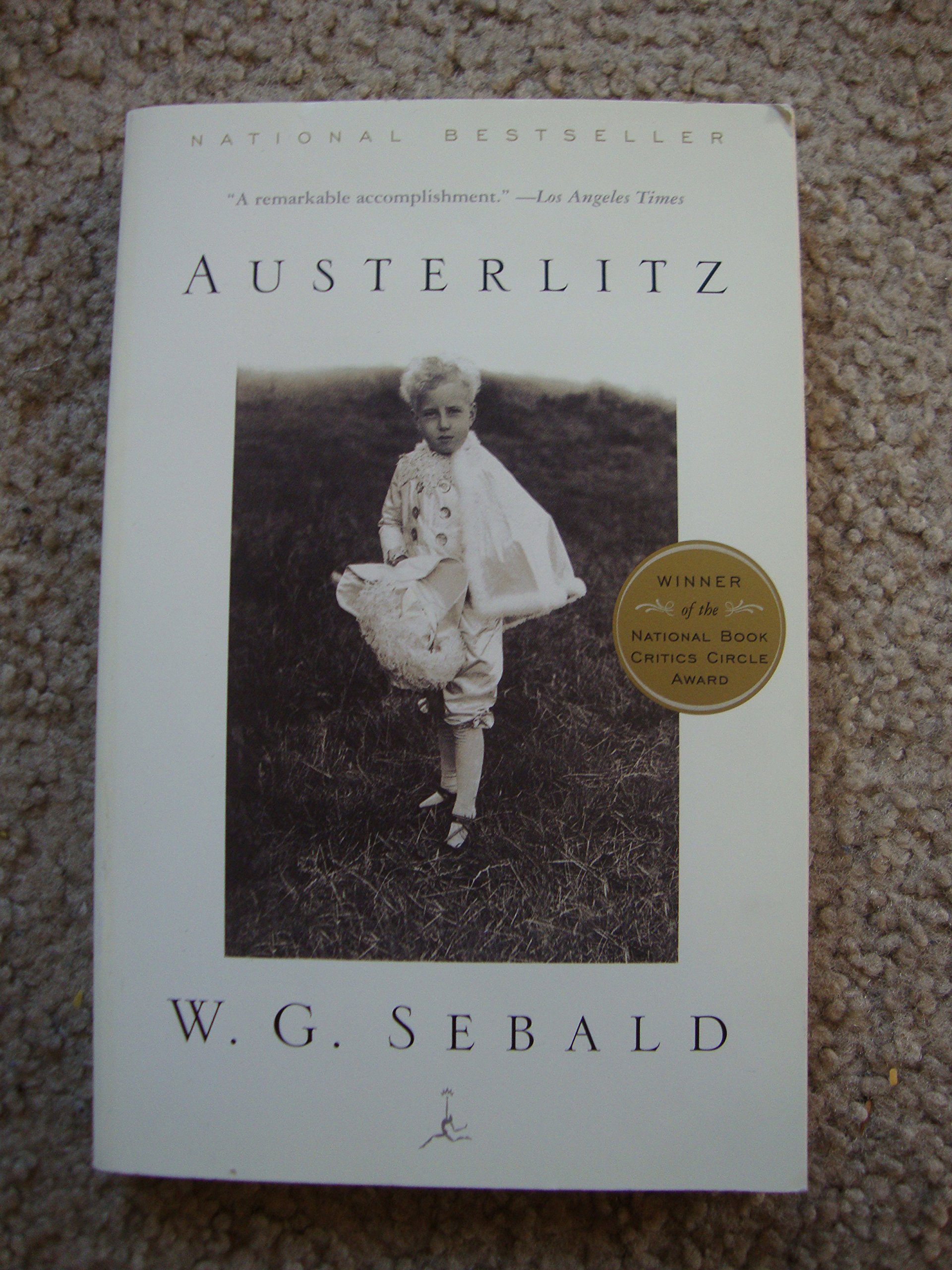



Austerlitz , the internationally acclaimed masterpiece by “one of the most gripping writers imaginable” ( The New York Review of Books ), is the story of a man’s search for the answer to his life’s central riddle. A small child when he comes to England on a Kindertransport in the summer of 1939, one Jacques Aus-terlitz is told nothing of his real family by the Welsh Methodist minister and his wife who raise him. When he is a much older man, fleeting memories return to him, and obeying an instinct he only dimly understands, he follows their trail back to the world he left behind a half century before. There, faced with the void at the heart of twentieth-century Europe, he struggles to rescue his heritage from oblivion. When Austerlitz, a child of the Holocaust, recovers memories of his lost parents, he must find a way to reconstruct his own history—that is, to imagine the unimaginable. Such impossibilities are the purview of Sebald, who writes about the conundrums of memory in such a way that we feel ourselves to be inhabited by his characters, rather than the other way around. Copyright © 2005 The New Yorker “A remarkable accomplishment.” — Los Angeles Times “Sebald stands with Primo Levi as the prime speaker of the Holocaust and, with him, the prime contradiction of Adorno’s dictum that after it, there can be no art.” — Richard Eder, The New York Times Book Review “Sebald is a rare and elusive species . . . but still, he is an easy read, just as Kafka is. . . . He is an addiction, and once buttonholed by his books, you have neither the wish nor the will to tear yourself away.” — Anthony Lane, The New Yorker “Is literary greatness still possible? What would a noble literary enterprise look like? One of the few answers available to English-speaking readers is the work of W. G. Sebald.” — Susan Sontag Austerlitz , the internationally acclaimed masterpiece by "one of the most gripping writers imaginable" ( The New York Review of Books ), is the story of a man's search for the answer to his life's central riddle. A small child when he comes to England on a Kindertransport in the summer of 1939, one Jacques Aus-terlitz is told nothing of his real family by the Welsh Methodist minister and his wife who raise him. When he is a much older man, fleeting memories return to him, and obeying an instinct he only dimly understands, he follows their trail back to the world he left behind a half century before. There, faced with the void at the heart of twentieth-century Europe, he struggles to rescue his heritage from oblivion. “A remarkable accomplishment.” — Los Angeles Times “Sebald stands with Primo Levi as the prime speaker of the Holocaust and, with him, the prime contradiction of Adorno’s dictum that after it, there can be no art.” — Richard Eder, The New York Times Book Review “Sebald is a rare and elusive species . . . but still, he is an easy read, just as Kafka is. . . . He is an addiction, and once buttonholed by his books, you have neither the wish nor the will to tear yourself away.” — Anthony Lane, The New Yorker “Is literary greatness still possible? What would a noble literary enterprise look like? One of the few answers available to English-speaking readers is the work of W. G. Sebald.” — Susan Sontag W. G. Sebald was born in Wertach im Allgäu, Germany, in 1944. He studied German language and literature in Freiburg, Switzerland, and Manchester. He taught at the University of East Anglia in Norwich, England, for thirty years, becoming professor of European literature in 1987, and from 1989 to 1994 was the first director of the British Centre for Literary Translation. His previously translated books— The Rings of Saturn , The Emigrants , Vertigo , and Austerlitz —have won a number of international awards, including the National Book Critics Circle Award, the Los Angeles Times Book Award, the Berlin Literature Prize, and the Literatur Nord Prize. He died in December 2001. From the Hardcover edition. Chapter 1 In the second half of the 1960s I traveled repeatedly from England to Belgium, partly for study purposes, partly for other reasons which were never entirely clear to me, staying sometimes for just one or two days, sometimes for several weeks. On one of these Belgian excursions which, as it seemed to me, always took me further and further abroad, I came on a glorious early summer's day to the city of Antwerp, known to me previously only by name. Even on my arrival, as the train rolled slowly over the viaduct with its curious pointed turrets on both sides and into the dark station concourse, I had begun to feel unwell, and this sense of indisposition persisted for the whole of my visit to Belgium on that occasion. I still remember the uncertainty of my footsteps as I walked all round the inner city, down Jeruzalemstraat, Nachtegaalstraat, Pelikaanstraat, Paradijsstraat, Immerseelstraat, and many other streets and alleyways, until at last, plagued by a headache and my