Autonomous Vehicles: Technologies, Regulations, and Societal Impacts
$115.83
by George Dimitrakopoulos



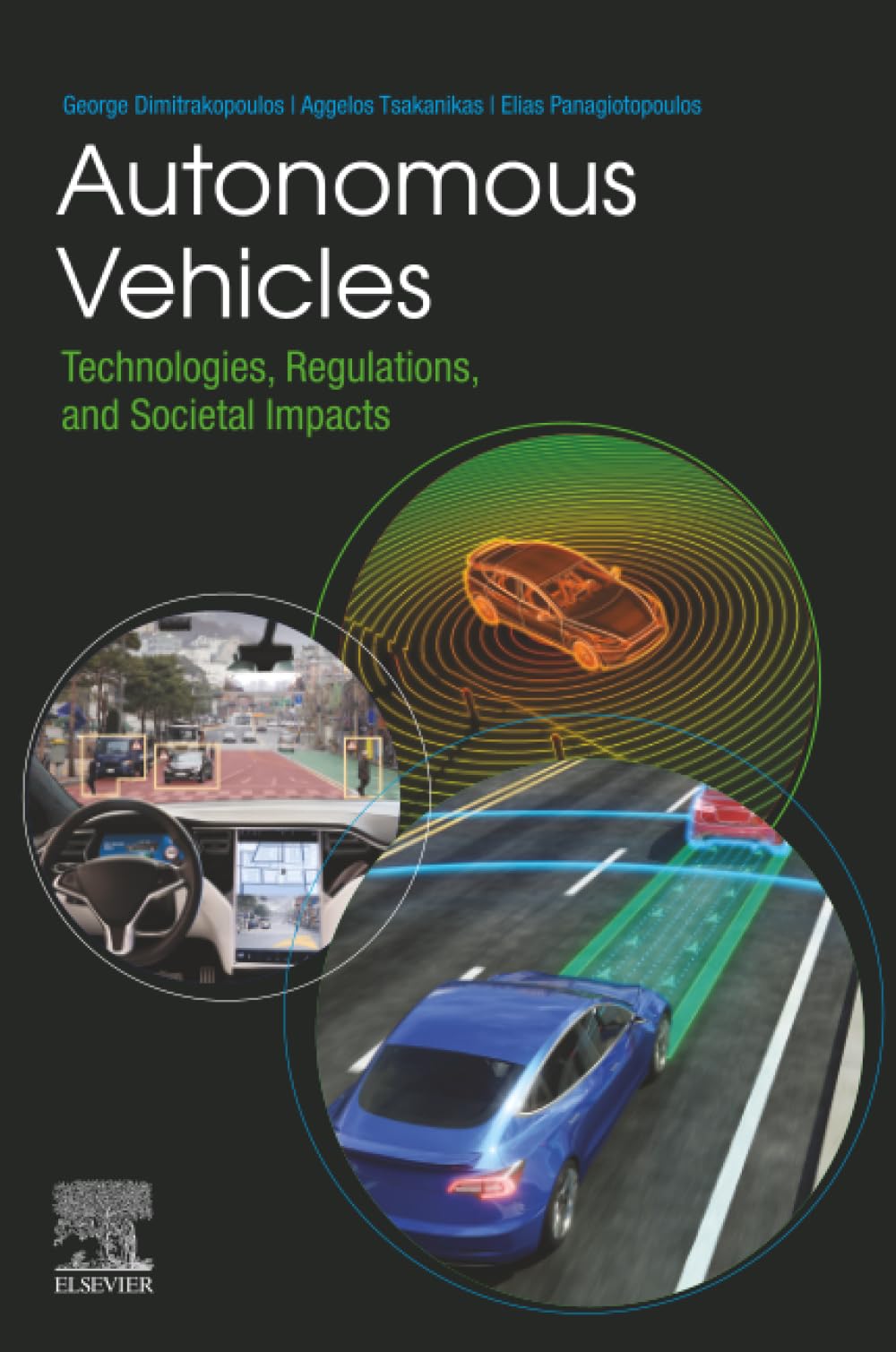
Autonomous Vehicles: Technologies, Regulations, and Societal Impacts explores both the autonomous driving concepts and the key hardware and software enablers, Artificial intelligence tools, needed infrastructure, communication protocols, and interaction with non-autonomous vehicles. It analyses the impacts of autonomous driving using a scenario-based approach to quantify the effects on the overall economy and affected sectors. The book assess from a qualitative and quantitative approach, the future of autonomous driving, and the main drivers, challenges, and barriers. The book investigates whether individuals are ready to use advanced automated driving vehicles technology, and to what extent we as a society are prepared to accept highly automated vehicles on the road. Building on the technologies, opportunities, strengths, threats, and weaknesses, Autonomous Vehicles: Technologies, Regulations, and Societal Impacts discusses the needed frameworks for automated vehicles to move inside and around cities. The book concludes with a discussion on what in applications comes next, outlining the future research needs. Broad, interdisciplinary and systematic coverage of the key issues in autonomous driving and vehicles - Examines technological impact on society, governance, and the economy as a whole - Includes foundational topical coverage, case studies, objectives, and glossary In-depth, holistic and systematic insights on passenger and freight autonomous vehicles from technological, business, economic, user acceptance, ethics, policy, and regulation perspectives George J. Dimitrakopoulos is Assistant Professor at the Department of Informatics and Telematics of the Harokopio University of Athens, Greece. He is author of The Future of Intelligent Transport Systems (Elsevier, 2020) and more than 150 journal articles. He has been actively involved in more than 30 large scale R&D projects related to automated driving, transportation and urban mobility. Aggelos Tsakanikas is Director at the Laboratory of Industrial and Energy Economics, and Associate Professor of Systems of Technology, Innovation and Entrepreneurship, National Technical University of Athens. His research and published works are in technology strategy, business strategy, innovation economics, entrepreneurship, public policies, innovation studies, socioeconomics research and information society. Elias E. Panagiotopoulos is an Associate Professor at the Hellenic Military Academy. He holds a degree in Mechanical and Aeronautics Engineering and a PhD in Aerospace Engineering from the University of Patras, Greece. He also holds a second PhD in Intelligent Transport Systems from the Harokopio University of Athens, Greece. His research activities are mainly focusing on the fields of Aerospace Engineering, and Autonomous and Intelligent Transportation Systems. He is the author of more than 80 articles in international journals and conferences. He has been actively involved in large scale R&D projects related to automated driving, transportation and urban mobility. Comprehensive, multidisciplinary exploration of autonomous driving's core aspects Analyzes tech's societal, political, and economic impacts Offers fundamental topics, case studies, goals, and terminology overview