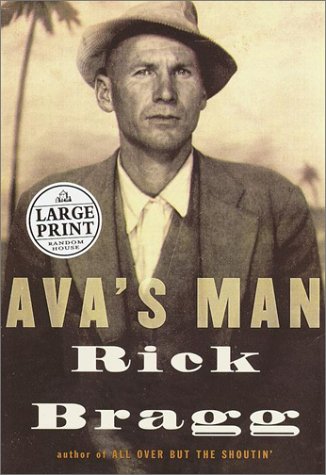



The Pulitzer Prize-winning journalist and author of All Over But the Shoutin' continues his personal history of the Deep South with an evocation of his mother's childhood in the Appalachian foothills during the Great Depression, and the magnificent story of the man who raised her. Rick Bragg brings his astonishing gift for storytelling to the tale of his grandfather, a man who kept his family one step ahead of poverty and starvation during the decade of the Great Depression. Charlie Bundrum was a roofer, a carpenter, a bootlegger, and a fisherman. He could not read, but he asked his wife, Ava, to read him the paper every day so he would not be ignorant. He was a man who took giant steps in rundown boots, a true hero whom history would otherwise have overlooked. A portrait of an ineradicable, memorable figure in a singular time, a moving reflection on home and family and on the author's own connection to a lost stretch of dirt road along the Alabama-Georgia border—AVA'S MAN is Rick Bragg at his stunning best. “A lovely book, with a certain gritty grandeur . . . This is a worthy successor to All Over but the Shoutin’.” —Larry McMurtry “Rick Bragg has written a powerful and poignant book about his kin, the kind of people we hear about too seldom . . . At the end I shared Rick’s pride and awe of what his family had endured.” —Tom Brokaw Rick Bragg was awarded the Pulitzer Prize for feature writing in 1996. A national correspondent for the New York Times , he lives in Miami, Florida. Ava's Man By Rick Bragg Random House Large Print Publishing Copyright ©2001 Rick Bragg All right reserved. ISBN: 0375431209 Chapter One The beatin’ of Blackie Lee The foothills of the Appalachians the 1930s Ava met him at a box-lunch auction outside Gadsden, Alabama, when she wasbarely fifteen, when a skinny boy in freshly washed overalls stepped from thecrowd of bidders, pointed to her and said, “I got one dollar, byGod.” In the evening they danced in the grass to a fiddler and banjopicker, and Ava told all the other girls she was going to marry that boysomeday, and she did. But to remind him that he was still hers, after the cottonrows aged her and the babies came, she had to whip a painted woman named BlackieLee. Maybe it isn’t quite right to say that she whipped her. To whip somebody,down here, means there was an altercation between two people, and somebody, theone still standing, won. This wasn’t that. This was a beatin’, andit is not a moment that glimmers in family history. But of all the stories I wastold of their lives together, this one proves how Ava loved him, and hated him,and which emotion won out in the end. Charlie Bundrum was what women here used to call a purty man, a man with thick,sandy hair and blue eyes that looked like something you would see on a richwoman’s bracelet. His face was as thin and spare as the rest of him, andhe had a high-toned, chin-in-the-air presence like he had money, but he neverdid. His head had never quite caught up with his ears, which were still too bigfor most human beings, but the women of his time were not particular as to ears,I suppose. He was also a man who was not averse to stopping off at the beer joint, now andagain, and that was where he encountered a traveling woman with crimson lipstickand silk stockings named Blackie Lee. People called her Blackie because of hercoal-black hair, and when she told my granddaddy that she surely was parched andtired and sure would ’preciate a place to wash her clothes and rest aspell before she moved on down the road, he told her she was welcome at hishouse. They were living in north Georgia at that time, outside Rome. Ava and the fivechildren—there was only James, William, Edna, Juanita and Margaretthen—were a few miles away, working in Newt Morrison’s cotton field.Charlie always took in strays—dogs, men and women, who needed aplace—but Blackie was a city woman and pretty, too, which set the stagefor mayhem. It all might have gone unnoticed. Blackie Lee might’ve washed her clothes,set a spell and then just moved along, if that was all that she was after. Butwe’ll never know. We’ll never know because she had the misfortune tohang her stockings on Ava Bundrum’s clothesline in front of God andeverybody. Miles away from there, Ava was hunched over in the cotton field, dragging aheavy sack, her fingers and thumbs on fire from the needle-sharp stickers on thecotton bolls. Newt Morrison’s daughter, Sis, came up alongside of her inthe field, one row over, and lit the fuse. “Ava,” said Sis, who had driven past Ava and Charlie’s houseearlier that day, “did you get you some silk stockings?” Ava said no she had not, what foolishness, and just picked on. “Well,” Sis said, “is your sister Grace visitin’you?” No, Ava said, if Grace had come to visit, she would have written or sent word. “Well,” said Sis, “I drove past y’all’s place andseen some silk stockings on the line, and I thought they must have beenGrace’s, ’cause she