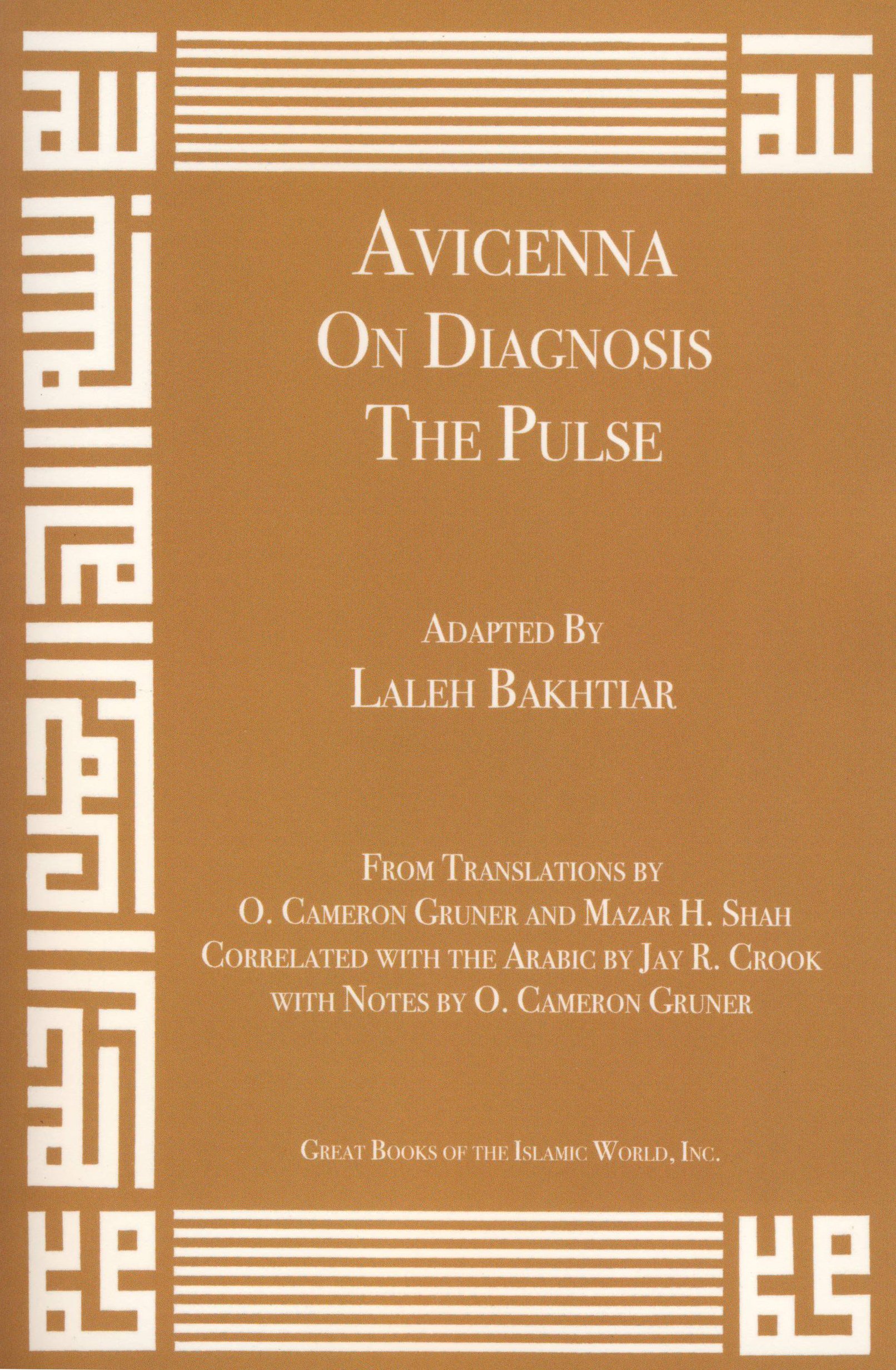
Avicenna On Diagnosis The Pulse from the Canon of Medicine Volume 1
$18.95
by Abu 'Ali Al-Husayn Ibn Sina



Avicenna summarizes: (1) why every pulse beat consists of four moments; (2) a list of ten types of pulse condition with descriptions of symptoms that permit diagnosis of each; (3) explanation of the causes of these ten types of varieties and sub-varieties to be found in each: long pulse, short pulse in conditions identifiable by the length of the beat, rapid and slow in conditions identifiable by its frequency, even and uneven in conditions identifiable by the symmetry or dissymmetry of the beats. He also discusses regular and irregular pulse behavior and enumerates varieties and names of composite pulse conditions. Encyclopedia Iranica, Avicenna xi. Persian Works. It will suffice here to evoke a few glorious names without contemporary equivalents in the West: Jabir ibn Haiyan, al-Kindi, al-Biruni, Ibn Sina. . . . A magnificent array of names which it would not be difficult to extend. If anyone tells you that the Middle Ages were scientifically sterile, just quote these men to him, all of whom flourished within a short period, 750 to 1100 CE. --George Sarton, Introduction to the History of Science. Abu Ali al-Husayn ibn Abd Allah ibn Sina, known to many by his westernized name, Avicenna, wrote the Canon of Medicine [Law of Natural Healing] around 1000 CE, squarely in what Lyons defines as the Golden Age of Islamic culture, between the 8th and 13th centuries. A comprehensive encyclopedia in five volumes, the Canon is widely regarded as the most important book on medicine ever written. The medical historian, Dr. William Osler, described it as a medical bible for longer than any other work in his Evolution of Modern Medicine. Drawing on the tradition of Muslim universalism, Ibn Sina incorporated sources from Greek, Roman, Arabic, Indian, and Chinese medicine, his work encompassing an almost complete scope of medical knowledge at the time. For this and other reasons, the Canon maintained its importance as an educational manual for an unprecedented period, appearing on medical school course syllabi well into the 17th century. --Ibn Sina s Canon of Medicine, A Medical Bible. Ibn Sina was particularly noted for his contributions to the fields of medicine . . . . . His two most important works are The Book of Healing and Al Qanun, known as the Canon of Medicine in the West. . . . The [Canon of Medicine or Law of Natural Healing ] (circa 1030 A.D.) is the one of the most famous books in the history of medicine. In it [Avicenna] surveyed the entire medical knowledge available from ancient Christian Latin and Muslim sources, and the book is enriched by the author's original contributions. The Canon became the standard of medical science and was on par with works of Hippocrates (460 377 B.C.) and Galen (129 199 A.D.) in all important libraries of Eu- ropean universities. Ibn Sina begins his Canon with the following words: It is my heart s desire, to start off with speaking about the general and common principles of both parts of medicine, i.e., theory and practice. The first translation into Latin was written in the 12th century by Gerhard von Cremona (1135 1187), and the first Hebrew version appeared around 1491. In the Arabic language the Canon of Medicine appeared in 1593 and is thought to be the second book ever printed in Arabic. The Canon gained widespread popularity only after the introduction of typography in the 15th and 16th cen- turies, but its impact throughout Europe remained steady until the end of the 18th century. . . . --Asita S. Sarrafzadeh, M.D. Ibn Sina. Abu Ali al-Husayn ibn Abd Allah ibn Sina, known to many by his westernized name, Avicenna, wrote the Canon of Medicine [Law of Natural Healing] around 1000 CE, squarely in what Lyons defines as the Golden Age of Islamic culture, between the 8th and 13th centuries. A comprehensive encyclopedia in five volumes, the Canon is widely regarded as the most important book on medicine ever written. The medical historian, Dr. William Osler, described it as a medical bible for longer than any other work in his Evolution of Modern Medicine. Drawing on the tradition of Muslim universalism, Ibn Sina incorporated sources from Greek, Roman, Arabic, Indian, and Chinese medicine, his work encompassing an almost complete scope of medical knowledge at the time. For this and other reasons, the Canon maintained its importance as an educational manual for an unprecedented period, appearing on medical school course syllabi well into the 17th century. --Ibn Sina s Canon of Medicine, A Medical Bible. Ibn Sina was --Asita S. Sarrafzadeh, M.D. Ibn Sina. Abu Ali al-Husayn ibn Abd Allah ibn Sina, known to many by his westernized name, Avicenna, wrote the Canon of Medicine [Law of Natural Healing] around 1000 CE, squarely in what Lyons defines as the Golden Age of Islamic culture, between the 8th and 13th centuries. A comprehensive encyclopedia in five volumes, the Canon is widely regarded as the most important book on medicine ever written. The medical historian, Dr. Willia