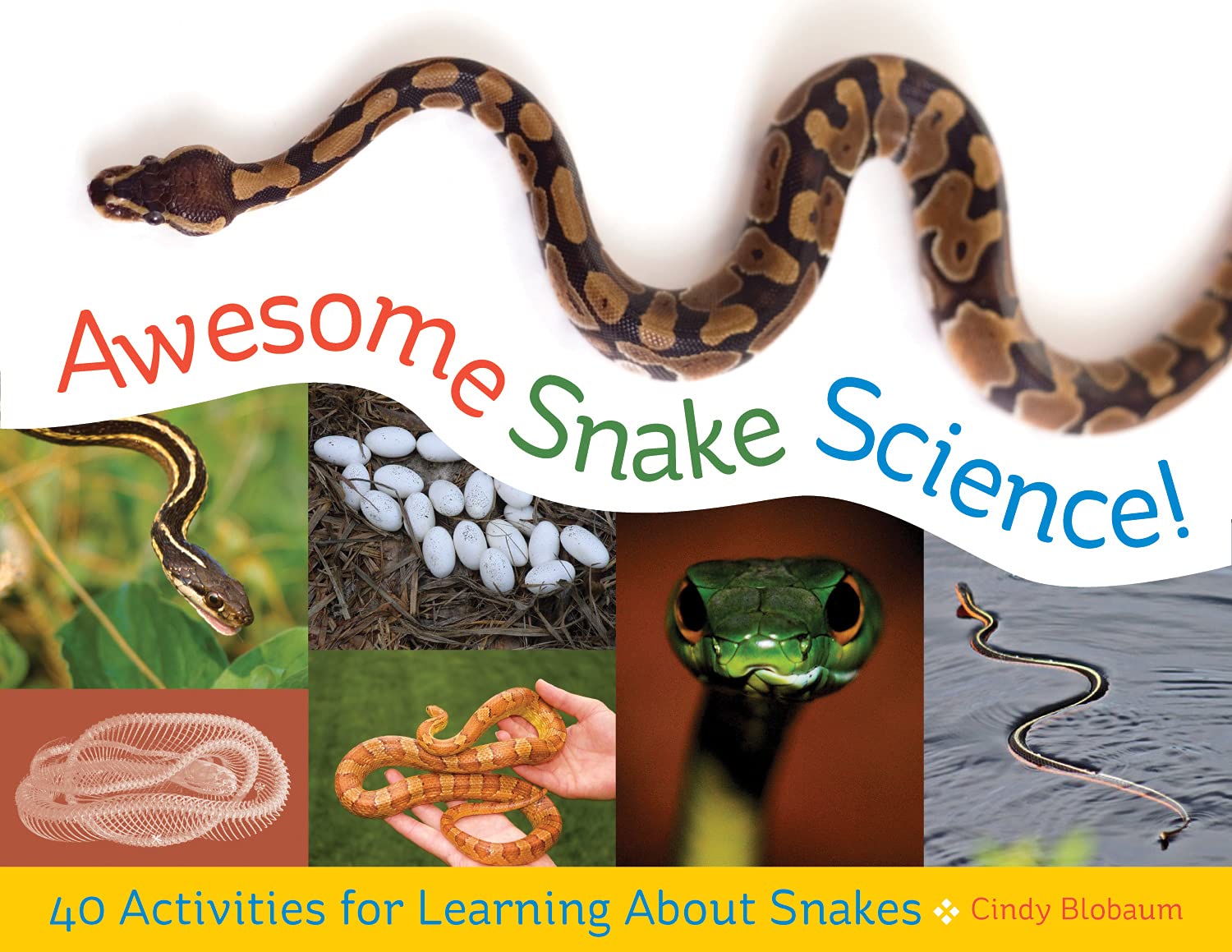
Awesome Snake Science!: 40 Activities for Learning About Snakes (2) (Young Naturalists)
$16.99
by Cindy Blobaum



From cobras and copperheads to pythons and boas, all types of snakes are covered in this book of 40 science experiments, art projects, and games that help budding herpetologists gain a greater appreciation for these slithering reptiles. Activities include making foldable fangs to learn how snakes’ teeth and jaws work together; simulating cytotoxic snake venom while making a tasty snack using an everyday enzyme found in pineapple; and mimicking the sound a rattlesnake makes using a rubber band, a paper clip, and an envelope. Engaging, simple, and safe experiments teach kids about the biology of snakes, such as how they use their tongues and nostrils to detect smells, how they are cold-blooded and sensitive to subtle changes in temperature, and how they can detect the slightest vibrations or tremors. Kids do not need a snake for any of the activities and will delight in all the strange snake facts and gross-out projects such as Snake Stink—where they create their own signature stink and test how well it repels potential predators. Did you know... Snakes do not need to be coiled to strike. They can strike from any position, even underwater! - Cobras and coachwhips are two of the few snakes that can move in a straight line forward while keeping their upper body raised off the ground - Snake venom can actually help humans too: a blood pressure medicine was developed from the venom of a Brazilian pit viper, and over 60 other treatments have been created from snake venoms "Here's a book for the real reptile lover, or just the science nut. Written very scientifically, but at an accessible level, it honors the serious nature lover. And good news for parents: no real snakes needed!" — Tales Told Tall “Elementary students may want to become ophiologists after trying out a few of the investigations in Awesome Snake Science! . . . Overall, this book would be a useful tool for teachers undertaking reptile studies or as a nice, but not mandatory, purchase for a classroom or school library.” — Green Teacher "It's exactly the kind of hands-on learning book that takes what could be dry subject matter and makes it nearly irresistible to children—really a great achievement by [author Cindy] Blobaum." — You Know, For Kids "This book is a hit in many ways, but most importantly it works because it teaches readers to think like scientists, inspiring them to seek out the true facts about snakes." — Good Reads with Ronna "The variety, originality, and ease of most of the activities assure satisfied readers and repeated use." — School Library Journal "This book goes a long way to helping the average student understand reptiles and support their interests. The simulations, models, and facts will be appreciated by both young readers and their teachers." —National Science Teachers Association "There is enough information here – and enough activity recommendation – that you could probably make an entire year’s science curriculum from this!...This might be an especially good way to engage a young boy who thinks school is 'boring!'" — Titus2Homemaker Cindy Blobaum is the author of Geology Rocks and Insectigations and a contributor to Highlights , Hopscotch for Girls , and Plays magazines. She has designed science-based programs and teacher workshops for nature organizations throughout the United States. Awesome Snake Science 40 Activities for Learning About Snakes By Cindy Blobaum Chicago Review Press Incorporated Copyright © 2012 Cindy Blobaum All rights reserved. ISBN: 978-1-56976-807-5 Contents Acknowledgments, Introduction, 1 Snake Study, 2 Body Basics, 3 Awesome Adaptations, 4 Super Senses, 5 On the Offense, 6 Definitely Defense, Glossary, Resources, Teacher's Guide, Bibliography, Index, CHAPTER 1 Snake Study Look around — you are surrounded by snakes. Where are they? On flags and signs; on bodies as tattoos; as a part of the medical symbol in pharmacies and doctors' offices; in books, movies, and games; and on exhibit in pet stores, museums, nature centers, and zoos. Unless you are in a polar region, on top of very high mountains, or on the islands of Ireland, New Zealand, or Greenland, live snakes are outside and likely not too far away. There are around 3,000 different kinds of snakes living around the world, including the sea snakes swimming in the warm waters of the Pacific and Indian oceans, the European adder living just above the Arctic Circle, and the common garter snakes and brown snakes that call many lawns, golf courses, and vacant lots home. Even more exciting, scientists believe there are snakes that have yet to be discovered! Snakes are fascinating reptiles that have long been both feared and revered by humans. People have hunted snakes, drawn snakes, written about snakes, built snake statues, and even created snake jewelry for millennia, with the oldest snake artwork being made well over 10,000 years ago. People eat snake meat, we