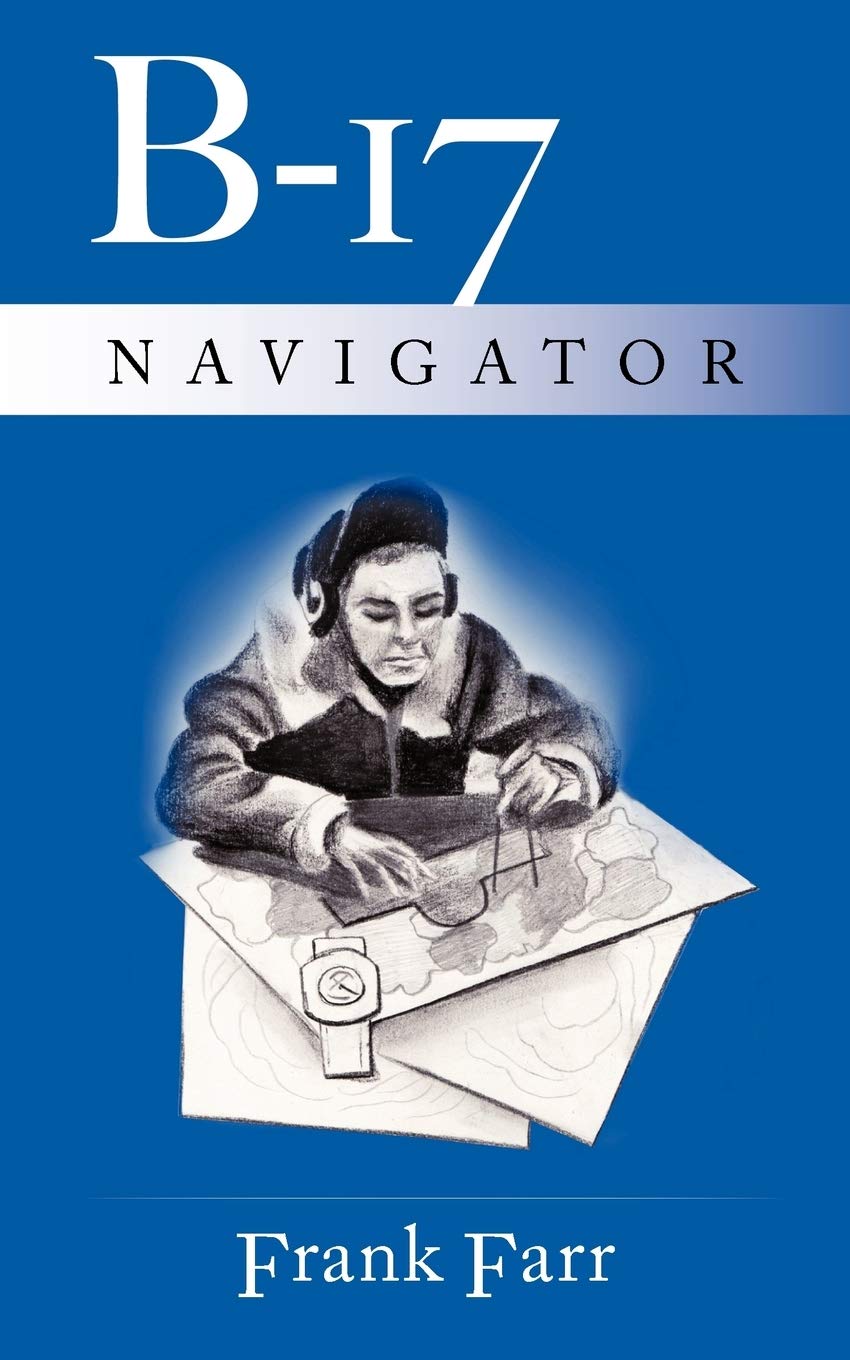



During World War II, the Army Air Corps had effective formulae for turning raw recruits, only a year or two out of high school, into flying officers-"officers and gentlemen." This is the story of one such recruit's transformation from college freshman into B-17 navigator, second lieutenant complete with silver wings and gold bars. Loving support from a nineteen-year old bride helped bring about the transformation. His adventure started at the Presidio of Monterey in California and moved through four different stops in Texas and a final three in Iowa and Nebraska before he was ready to cross the Atlantic and attack Hitler's "Festung Europa." B-17 Navigator By Frank Farr AuthorHouse Copyright © 2009 Frank Farr All right reserved. ISBN: 978-1-4490-0518-4 Chapter One In December 1941 I was a first-quarter freshman at San State College. On the seventh, when the Japanese bombed Pearl Harbor, I was enjoying a sand lot football game on the field at Campbell High School. Only minutes after I made the best block of my career, someone ran across the field, calling, "The Japs just bombed Pearl Harbor!" The world was about to become much more confused and much more complicated. The game broke up immediately, and we gathered around the radio at the home of my girl friend, Connie Dondero, just across the street from the school, whose brother Chuck had been the victim of my perfect block in the football game. The next day I was back in class again. Christmas came and went, a warm, happy Christmas like my family always had together. A couple of weeks later I parked my old '29 Model A Ford at Connie's house, and she and I, at her father's suggestion, took Chuck's 1933 Ford Coupe out instead of my car. We ran out of gas on a heavily fogged-in road about five miles later. In an indefensible example of 17-yeaar-old reasoning, I let the car roll to a stop about half on the shoulder of the road, half on the pavement. I thought it would be easier that way for someone to come along and give us a push to a gas station. I probably didn't even leave the tail lights on. Naturally, a car roared out of the fog and hit us hard. I was standing on the running board, from which position I planned to signal an oncoming driver for help. I wound up dazed on the pavement, and the Ford was probably 25 or 30 feet into an adjacent orchard. I stumbled through the dark to the car to see if Connie was OK. She was. Shortly afterward I was in a hospital, where examiners determined I wasn't hurt enough to keep; and in a few minutes Mr. Dondero came to take me and Connie back to her house. I didn't get the chewing-out I deserved for stupidity. Perhaps Mr. Dondero felt partly to blame for giving me a car that was out of gas. Anyway, the Donderos were very kind and kept me at their home for several days. Maxine Dondero was very impressed at my running to the car despite my (minor) wounds to check on Connie. "You must be very fond of Connie to have thought first of her," she said. Then she made an unnecessary apology: "You understand that I can't fix your bed in Connie's room." "Sure," I said. "I know." Besides an abrasion on the back of my head, I had painfully strained muscles in my chest. Continuing with the three part-time jobs that supported me at San Jose State was impossible. I was forced to go to the home of my parents in Oakland to recuperate. In Oakland there was much more consciousness of the war than I had felt in San Jose. Even so, I enrolled in San Francisco City College for the spring semester of 1942, took the A-Train from Oakland, and finished my first year of higher education. My father was working in the Kaiser shipyards in Oakland, which helped make the war more real for me. All around, young men were enrolling in one of the services or getting drafted into the Army. Jobs were suddenly plentiful, and I worked at several of them as 1942 wore on. I finally landed a good job at the great Montgomery Ward mail order house in Oakland-a job open because employees were going into the service. When fall came, I didn't feel like going back to school. Blackouts were real by then, and some time late in 1942 I became an air raid warden. This required that during blackouts I go to the roof of a high building in the neighborhood and scan the city for unauthorized lights. In the feared event of a Japanese bombing, I would report on the locations of fires. My immediate supervisor was a World War I veteran. I thought him very old. He may have been about 40. Rationing became a harsh reality in 1942. Most cars had an "A" sticker on their windshields, which indicated that they were limited to four gallons of gasoline per week. If you used your car on your job, you could qualify for a "C" sticker, which allowed you more gas. I had purchased a 1934 Chevrolet, which I used to deliver Western Union telegrams, so I had a "C" sticker. My driving was not very limited. My old '29 Ford had been given to the scrap metal