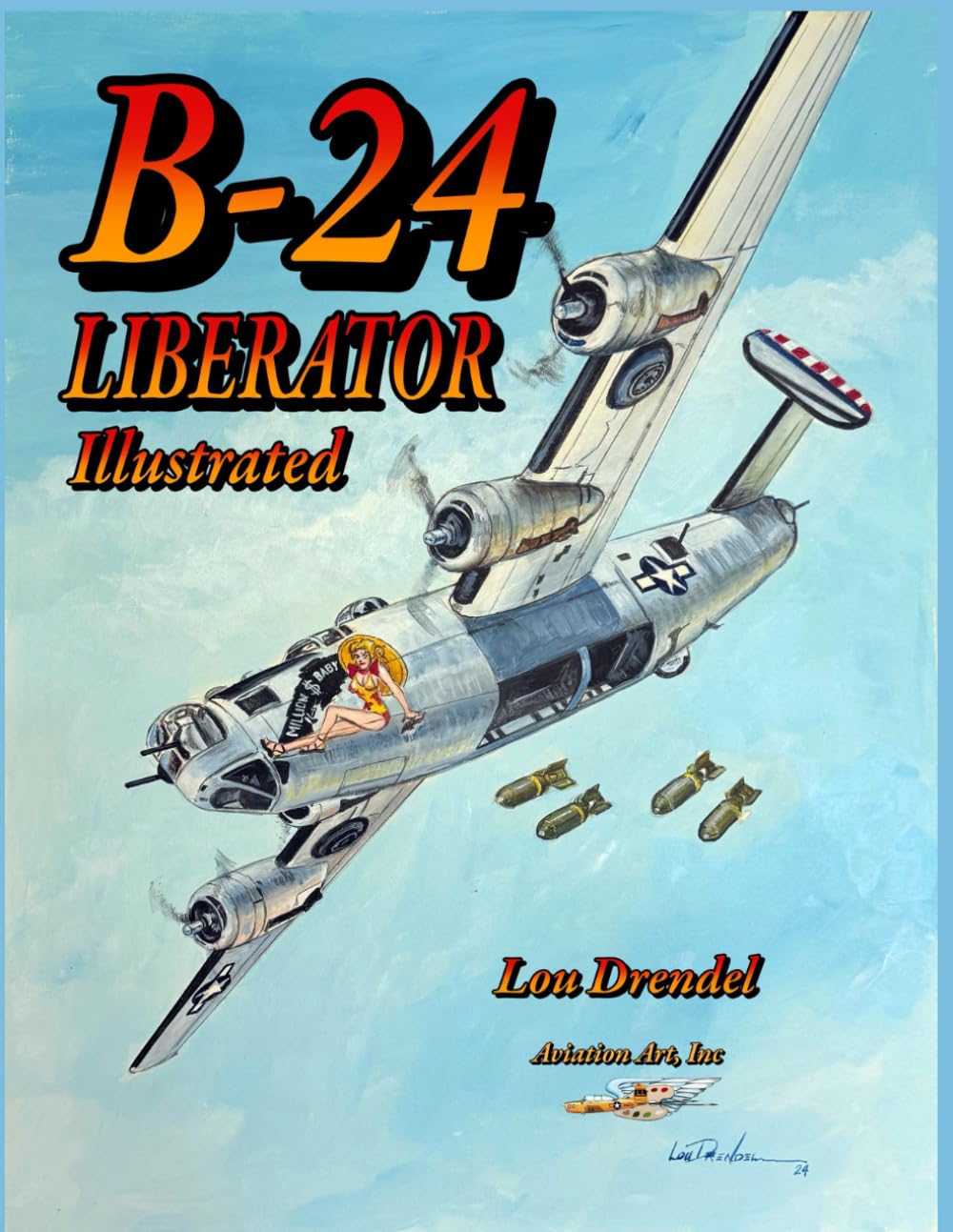



In most World War II films, the B-24 is rarely seen, taking a back seat to the more familiar B-17 Flying Fortress. The reason for that may be that more B-17s survived as flying warbirds….there were just more of them around for use in before-the-age-of-computer-generated movies. Movies like “12 O’Clock High”, “Command Decision”, and “The War Lover” could not be made with the most-produced, but most quickly scrapped and forgotten B-24 Liberator. The B-24 was designed and built by a company that had been asked to participate in the B-17 manufacturing process. They declined, saying they could build a better bomber. The could and they did. The B-24 was faster and had longer range than the B-17. It could also carry a heavier load. The high wing and slab-sided fuselage were ideal for converting the B-24 to a cargo hauler, and a great many Liberators were so converted, or manufactured as C-87s or C109s. The B-17 had been in USAAF service for four years when the war broke out, and it was axiomatic that it would therefore become the bomber used in the daylight bombing campaign in Europe. President Roosevelt had long seen the threat of Nazi Germany, and though the Japanese attack on Pearl Harbor was the catalyst for American entry into the war, it was Germany that FDR decided was the most imminent threat, and the majority of the early war effort was directed to the European Theater of Operations…..which meant more B-17s. The B-17 was thought to be the more mission-survivable of bombers because of its heavy defensive armament, which gave it the name “Flying Fortress”, and its ability to sustain heavy damage and return to base. Combat loss numbers show that the Liberator was slightly more survivable, probably because of its greater speed. The B-24 came into its own in the Pacific, where long range was a necessity, given the far-flung reaches of the Japanese Empire. B-24 missions of 2,400 mile round-trip distances were not uncommon, compared to the 1,600 mile max round trip-range of B-17s. B-24s were able to operate at lower altitudes in the Pacific, which translated to better bombing accuracy. The B-24 also became the preferred long range patrol bomber of the US Navy and was produced as the PB4Y-1 and PB4Y-2 Privateer. This is a visual history of the B-24, with dozens of period color and black and white photos. There are several pages of illustrations from the flight manual and line drawings of the various versions of the B-24 and PB4Y.