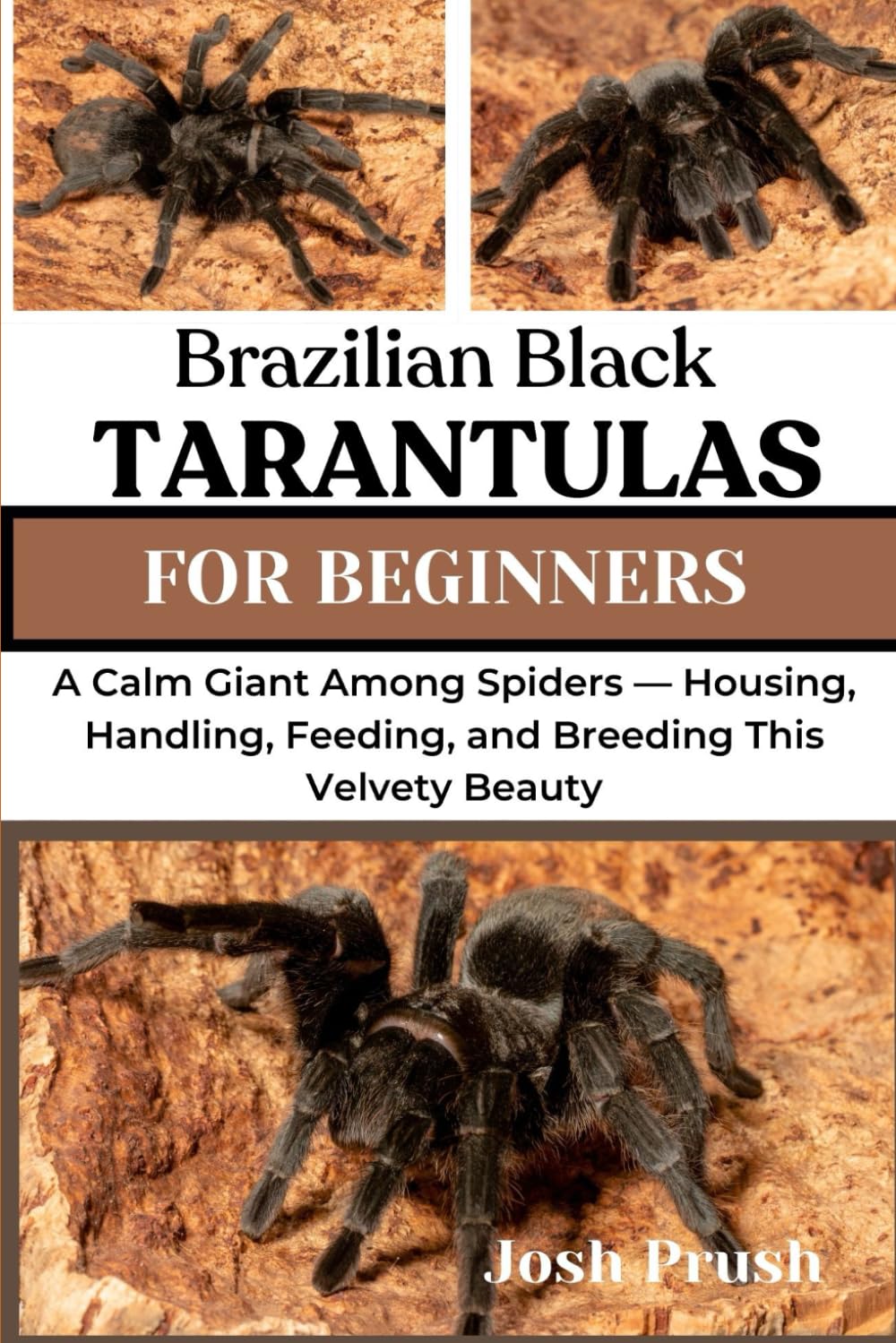
BRAZILIAN BLACK TARANTULAS: A Calm Giant Among Spiders — Housing, Handling, Feeding, and Breeding This Velvety Beauty
$15.50
by JOSH PRUSH



The taxonomy of the Brazilian Black Tarantula is a foundation that anchors all scientific, ecological, and husbandry understanding of the species. Like all tarantulas, it belongs to the class Arachnida, order Araneae, suborder Mygalomorphae, and the family Theraphosidae. The genus Grammostola , to which this species belongs, encompasses several terrestrial tarantulas native to South America, each recognized for their robustness, moderate size, and typically docile temperament. The specific epithet pulchra is Latin for "beautiful," a fitting descriptor for this visually captivating arachnid. The complete taxonomic classification is as follows: Kingdom : Animalia - Phylum : Arthropoda - Class : Arachnida - Order : Araneae - Suborder : Mygalomorphae - Family : Theraphosidae - Genus : Grammostola - Species : Grammostola pulchra This classification places the Brazilian Black Tarantula within a unique evolutionary lineage of spiders distinguished by their downward-pointing chelicerae (a hallmark of Mygalomorphs), long lifespans, and often solitary terrestrial habits. Unlike Araneomorph spiders, which comprise the majority of modern spider diversity, Mygalomorphs represent an older, more primitive group with retained ancestral traits such as simple spinning mechanisms and less efficient respiratory systems based on paired book lungs. The genus Grammostola includes other well-known species such as Grammostola rosea (the Chilean Rose Tarantula), Grammostola pulchripes (the Chaco Golden Knee), and Grammostola iheringi . G. pulchra , however, stands apart both in appearance and reputation. Despite not being the most colorful of the genus, it is often considered the most elegant due to its uniform jet-black coloration and velvet-like texture. From a phylogenetic perspective, the Grammostola genus is considered stable, with limited taxonomic confusion compared to other Theraphosid genera. The species G. pulchra was first described by Mello-Leitão in 1921, who contributed significantly to the understanding of South American tarantulas. Since its description, it has remained taxonomically consistent, with no major revisions or synonymies, which is relatively rare in the world of Theraphosid classification where reassignments are frequent. The stability of G. pulchra’s taxonomic identity aids in consistent communication among hobbyists, breeders, scientists, and conservationists. Misidentification is far less frequent than in species with polymorphic traits or extensive regional variation, making G. pulchra a reliable model species for education and research alike. Moreover, the taxonomy serves as an anchor for legal and regulatory frameworks. As exotic animals, tarantulas often fall under local or international trade restrictions. The correct taxonomic identification of Grammostola pulchra ensures compliance with legal standards under CITES and national laws in countries like the United States, Brazil, or members of the European Union, which may regulate the import and export of wildlife based on accurate classification. Understanding its taxonomy is also crucial for appropriate care and husbandry. Because many behaviors, growth rates, and environmental preferences can be inferred by comparing members within the Grammostola genus, keepers who are familiar with species like G. rosea or G. pulchripes can make informed adjustments to the needs of G. pulchra . This genus-level continuity allows for an easier transition for novice keepers moving from common tarantula species to more specific or less widely available ones.