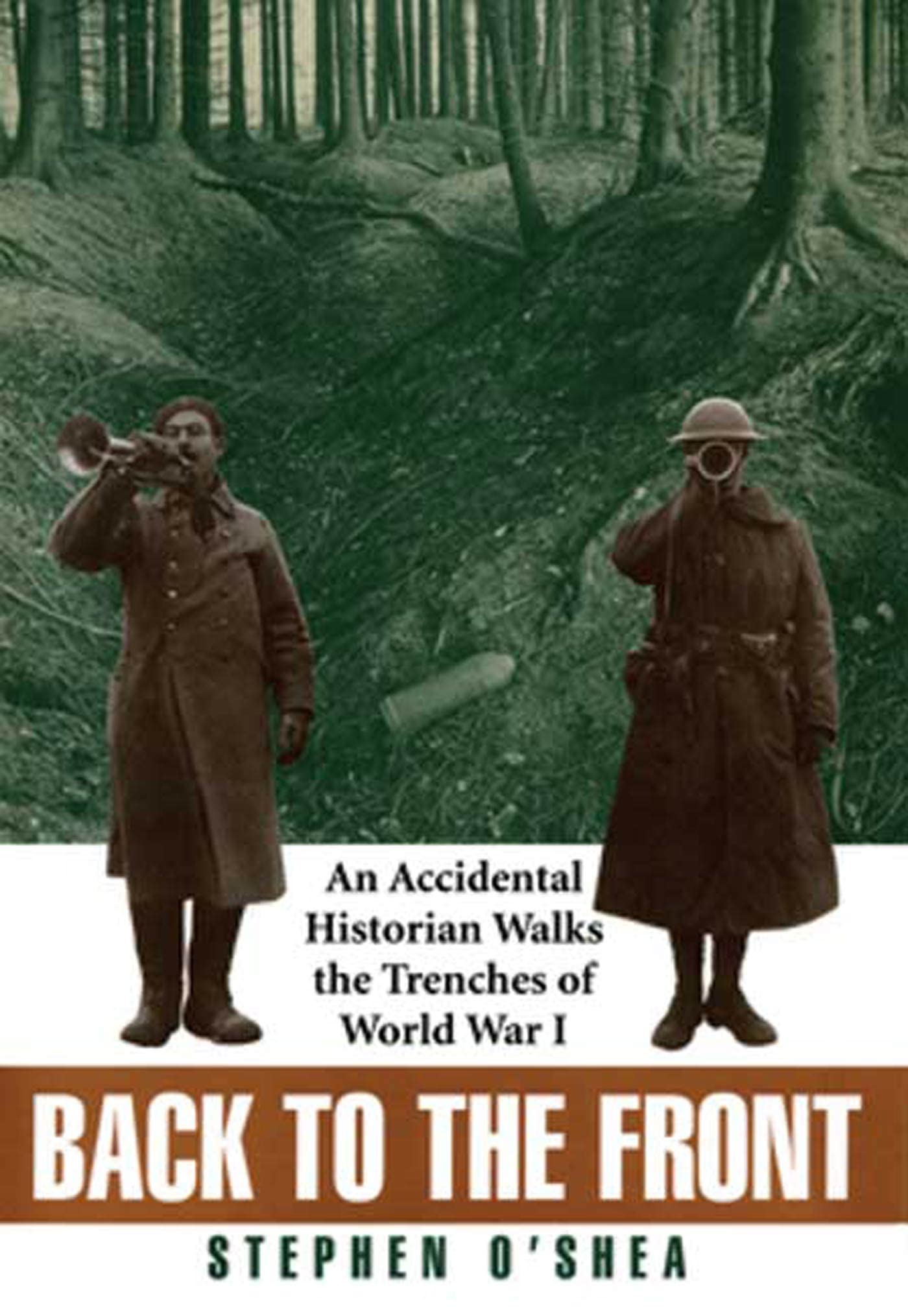
Back to the Front: An Accidental Historian Walks the Trenches of World War I
$28.48
by Stephen O'Shea



World War I is beyond the memory of almost everyone alive today. Yet it has left as deep a scar on the imaginative landscape of our century as it has on the land where it was fought. Nowhere is that more evident than on the Western Front―the sinuous, deadly line of trenches that stretched from the coast of Belgium to the border of France and Switzerland, a narrow swath of land in which so many million lives were lost. For journalist Stephen O'Shea, the legacy of the Great War is personal (both his grandfathers fought on the front lines) and cultural. Stunned by viewing the "immense wound" still visible on the battlefield of the Somme, and feeling that "history is too important to be left to the professionals," he set out to walk the entire 450 miles through no-man's-land to discover for himself and for his generation the meaning of the war. Back to the Front is a remarkable combination of vivid history and opinionated travel writing. As his walk progresses, O'Shea recreates the shocking battles of the Western Front, many now legendary―Passchendaele, the Somme, the Argonne, Verdun―and offers an impassioned perspective on the war, the state of the land, and the cultivation of memory. His consummate skill with words and details brings alive the players, famous and faceless, on that horrific stage, and makes us aware of why the Great War, indeed history itself, still matters. An evocative fusion of past and present, Back to the Front will resonate, for all who read it, as few other books on war ever have. Paris-based journalist O'Shea walked the length of the Western Front of World War I during the summers from 1986 to 1995. The journey was a personal one: both his grandfathers had fought on the front lines. O'Shea began his journey in Nieuport, Belgium, and followed the remains of the trenches some 450 miles to the border of France and Switzerland. Because the tactics of war usually consisted of massed infantry assaults against machine guns and artillery, O'Shea doesn't provide much historical context. What does emerge from his narrative is a shocking description of what happened on the battlefields. Generals often began offensives that lost some 100,000 men in one month?only to begin the same process the following month. Despite the talk of glory, the war came down to crushing personal losses. The author briskly moves the narrative along, though photographs comparing the battlefields a la William Frassanito (Early Photography at Gettysburg, Thomas, 1995) would have been helpful. An engaging and thought-provoking work; recommended for history buffs.?Mark E. Ellis, Albany State Univ., Ga. Copyright 1997 Reed Business Information, Inc. In places the Western Front still slashes across Belgium and France, visible among the cemeteries, ossuaries, and monuments as grassy, cratered terrain, zig-zagging trenches, crumbling pillboxes and forts. O'Shea, while working in publishing trenches in Paris, grew curious about the war's physical aftermath, and in several trips gathered his observations for this sensitively nuanced tour. For preparation, he steeped himself in the war's history and got reacquainted with the trench experience of his two Irish grandfathers. Both motifs contribute to the book's structure, which unfolds geographically as O'Shea hoofs it from the sea to Switzerland, encountering formerly muddy slaughterhouses euphemized as Ypres, the Somme, or Verdun. At each battle area O'Shea summarizes what generals hoped would happen and how they seemingly never learned from what did happen, a mulish obstinacy that palpably angers him. His contemporary vignettes vividly animate the trip, as do his reflections about the meaning of monument making. With this ambulant meditation and protest against militarism, O'Shea has created a high-stature addition to the classic works about the Great War. Gilbert Taylor A Canadian journalist who has walked the weary length of WW I's western front reports movingly on his experiences and more. A Paris-based correspondent for Elle, Interview, and other periodicals, O'Shea began hiking the centerpiece combat zone of the so-called Great War almost by chance during the mid-1980s. The serpentine path (to which he returned time and again) begins around Nieuport on the Belgian coast, winds through the French countryside, and ends abruptly at the frontier of neutral Switzerland. Between the two extremes, the blood-soaked track of the trenches, from which Allied and German troops rose to slaughter one another by the millions during the 52-month conflict, twists through scores of storied venues. Cases in point range from Flanders (Ypres, Passchendaele) through Artois (Armentires, Arras, Vimy Ridge), Picardy, Champagne (Chemin des Dames, Reims), and Alsace-Lorraine (St. Mihiel, Verdun, the Argonne Forest). In his commentary as a tour guide, the author is by turns informative and censorious. Interspersing his point-to-point travelogue of abandoned redoubts, burial grounds, disputed barric