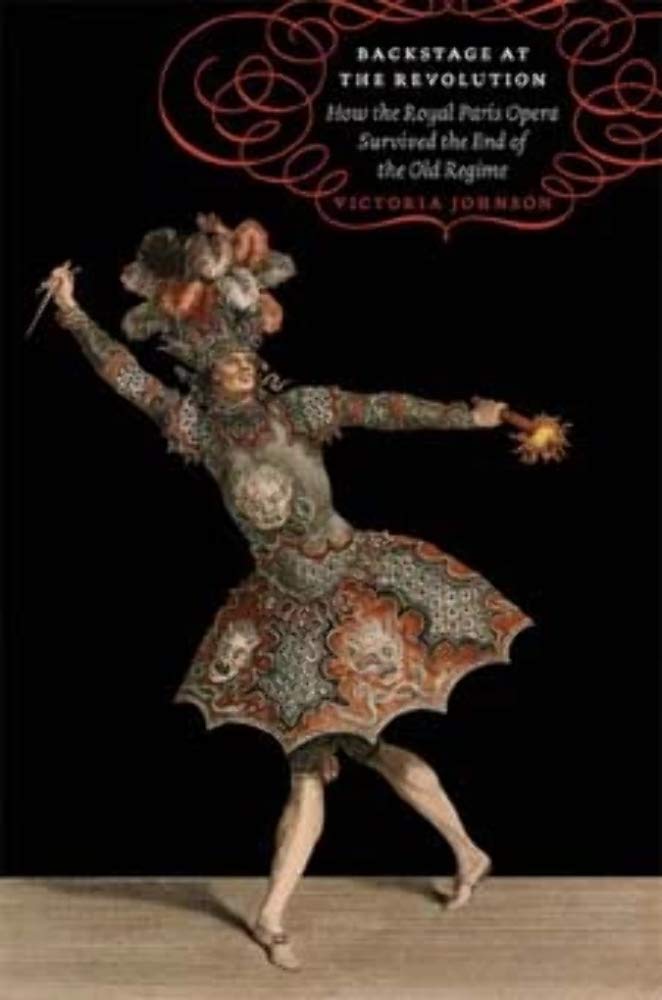
Backstage at the Revolution: How the Royal Paris Opera Survived the End of the Old Regime
$61.00
by Victoria Johnson



On July 14, 1789, a crowd of angry French citizens en route to the Bastille broke into the Paris Opera and helped themselves to any sturdy weapon they could find. Yet despite its long association with the royal court, its special privileges, and the splendor of its performances, the Opera itself was spared, even protected, by Revolutionary officials. Victoria Johnson’s Backstage at the Revolution tells the story of how this legendary opera house, despite being a lightning rod for charges of tyranny and waste, weathered the most dramatic political upheaval in European history. Sifting through royal edicts, private letters, and Revolutionary records of all kinds, Johnson uncovers the roots of the Opera’s survival in its identity as a uniquely privileged icon of French culture—an identity established by the conditions of its founding one hundred years earlier under Louis XIV. Johnson’s rich cultural history moves between both epochs, taking readers backstage to see how a motley crew of singers, dancers, royal ministers, poet entrepreneurs, shady managers, and the king of France all played a part in the creation and preservation of one of the world’s most fabled cultural institutions. “Victoria Johnson’s book sits between scholarly worlds: that of a sociologist concerned with organization theory and that of a musicologist examining a musical institution, the Paris Opera. Although parts of the book will be challenging for each world, I have never seen a better demonstration of how the intersection of two disciplines can illuminate a historical problem. Why did the Opera survive the Revolution and the Terror? How could an institution so blatantly associated with the Old Regime, with luxury, elitism, and aristocratic privilege remain intact and emerge to become a favorite institution of Napoleon? The answer lies within the organizational strategy that led to the formation of the Académie d’Opéra under Pierre Perrin during the 1660s, which allowed the Opera to prevail under the most diverse political circumstances. It is a remarkable story, and no one has told it with such flair and clarity as this brave sociologist.”—Philip Gossett, University of Chicago -- Philip Gossett, University of Chicago “ Backstage at the Revolution is one of those rare books masterfully combining historical detail with an engrossing theoretical narrative. Victoria Johnson has unearthed a prodigious amount of evidence about why the Paris Opera survived a revolution meant to eliminate any vestiges of privilege and grandeur. In terse prose, she demonstrates the power of sociology when it comes to explaining institutional persistence. A soaring achievement, one that will likely spur a new wave of historical research in organizational sociology and beyond.” -- Mauro F. Guillén, Lauder Institute, The Wharton School of the University of Pennsylvania “In her compelling and beautifully illustrated Backstage at the Revolution Victoria Johnson updates classical institutional theories of organization to answer the question: Why did revolutionaries intent on destroying realms of privilege spare the royal Paris Opera? Its founders had imprinted the opera with the mark of a national treasure. For some revolutionaries it was a unique French accomplishment to be sustained, a hybrid of royal academy and public theater that was the height of artistic achievement, rather than a symbol of the Old Regime to be destroyed. This meticulously researched and colorfully presented study challenges the old regimes in organizational analysis and political studies to see their domains differently.”--Frank Dobbin, Harvard University -- Frank Dobbin "Johnson offers a unique, insightful and colourful perspective on the French Revolution and the Paris Opera's early history." ― Times Higher Education "After reading the fascinating story told in Backstage at the Revolution , one cannot but want to read its sequel." ― Times Literary Supplement Victoria Johnson is assistant professor of organizational studies at the University of Michigan.