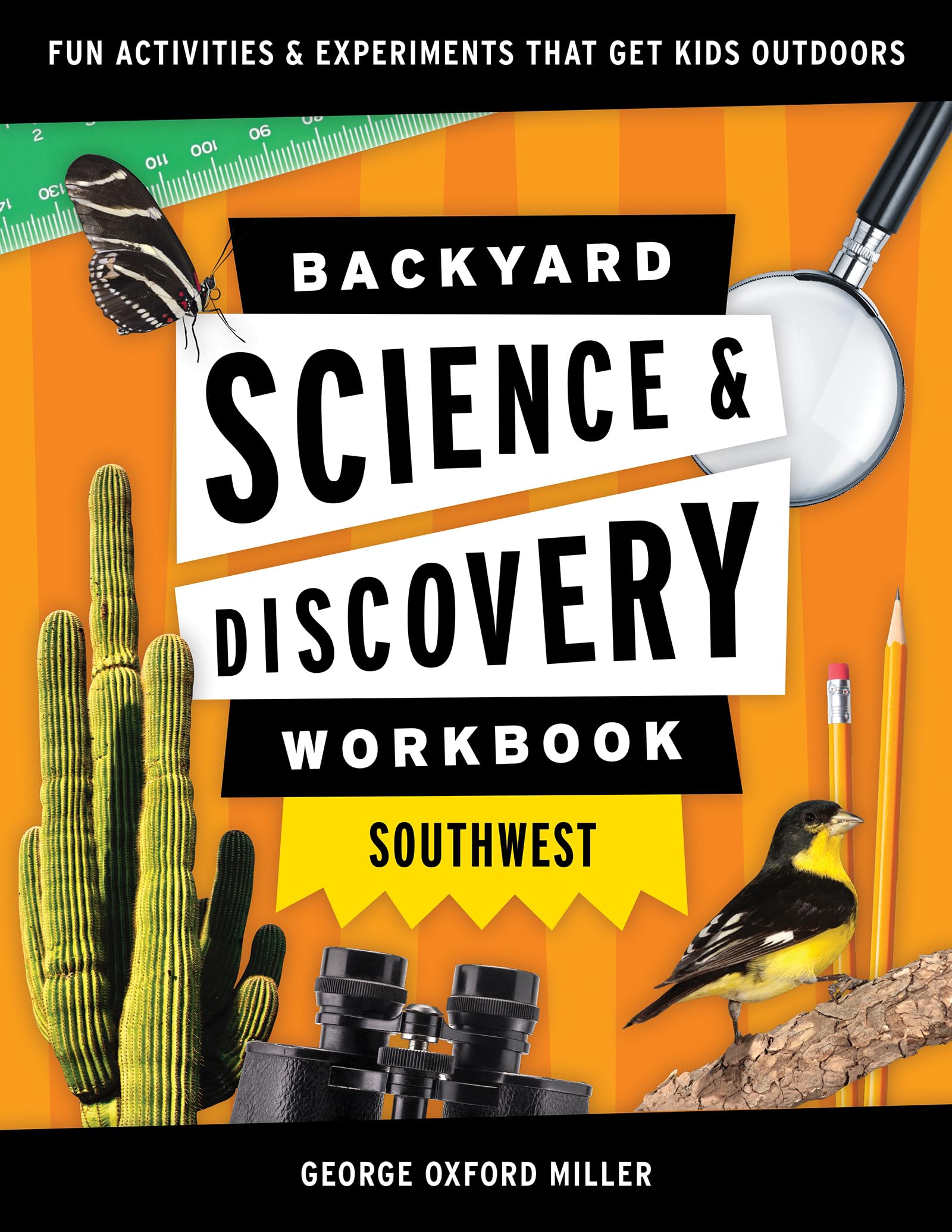
Backyard Science & Discovery Workbook: Southwest: Fun Activities & Experiments That Get Kids Outdoors (Nature Science Workbooks for Kids)
$9.80
by George Oxford Miller



Why settle for less? Utilize educational content tailor-made for your part of the country, and introduce children to nature in the Southwest. National workbooks are great—but regional content is even better! The Southwest encompasses several states. Focus on the habitats, plants, and animals found here. Written by George Oxford Miller, a botanist from the region, the Backyard Science & Discovery Workbook: Southwest does what other workbooks can’t: It gets specific about climate, geography, state symbols, weather, and especially birds, fungi, insects, minerals, trees, wildflowers, and so much more. With over 20 simple, fun introductions to scientific subjects—like astronomy and geology—it gets children excited about nature in their own backyard and teaches them to love and protect the great outdoors. More than a dozen activities help kids to make hypotheses, experiment, and observe. The 19 hands-on science projects—such as raising native caterpillars, making mushroom spore prints, and attracting moths with an ultraviolet light—put students in control of their own learning! You never know what your children will uncover in their outdoor classroom. Every day is a little treasure hunt. If they keep good records and share what they find, their observations can even help scientists learn more about nature in the states of Arizona, Nevada, New Mexico, western Oklahoma, western Texas, and southern Utah. So get the Backyard Science & Discovery Workbook: Southwest , and get started on a lifetime of discovery. Regional workbooks are better: Introduction to the Southwest’s geography, plants and animals, and biology - Activities specific to your part of the country - Fun hands-on projects that spark wonder - Regionally accurate information about agriculture, invasive species, weather records, and more Professional nature photographer and botanist George Oxford Miller is a lifelong resident of the West. He has lived in New Mexico, Arizona, and Texas, and he has written six guidebooks to the Southwest, including the best-selling trio Landscaping with Native Plants of the Southwest, Landscaping with Native Plants of Texas, and Landscaping with Native Plants of Southern California . He also wrote Wildflowers quick guides to Arizona & New Mexico, Texas, Southern California, and Colorado. He wrote a “Plant of the Month” column for New Mexico Magazine and is former president of the Albuquerque chapter of the Native Plant Society of New Mexico, where he still conducts workshops and programs on how to create your own backyard pollinator oasis. Spotting the Moon, the Planets, and Orion In winter, it can be hard to stay active outside. After all, it’s cold and it gets dark early, but for stargazers, winter is one of the best seasons around. You don’t have to stay up late for it to get dark, and some of the best constellations are visible during the winter. So if you dress up warmly, grab a lawn chair, and bust out a small telescope or binoculars, you can see the planets, the moon, even the Orion nebula and the Pleiades . What You’ll Need Warm clothes - A lawn chair - A small telescope or binoculars - A field guide and/or virtual planetarium software like Stellarium (free for PC/Mac) is helpful What to Do First, figure out what you want to see before you head out. That’s where a good field guide comes in, and virtual planetarium software, as those can show you exactly what the sky will look like wherever you are (and whenever you want). Starting with the moon is always a good idea, as it’s bright and impossible to miss. The best time to observe the moon is in the “first quarter” when only one half of the moon is lit up. It reveals a lot more detail than a full moon, when all that reflected sunlight washes out the view. If you have a small telescope, try holding a smart phone over the eyepiece and see if you can snap some pictures. This can be tricky, but if you take a bunch of pictures and fiddle with the settings, you can get some wonderful shots. (There are also phone mounts for sale online, though you have to get the right model for your phone.) After you take a look at the moon, make sure you get a chance to see Jupiter, Saturn, Mars, and Venus. You’ll need to refer to your field guide/planetarium software for when/where to look for each, as they appear to move through the sky over time. Still, it’s worth the effort, as seeing Saturn’s rings for the first time will make you gasp. One note: Don’t expect to see the rings like you would in a picture from NASA. Instead, the planets will look pretty small, but if you’re patient and you focus just right, you’ll see the planets for real. It’s an amazing experience. Even if you only have binoculars you can often spot Jupiter’s largest moons: Io, Europa, Ganymede, and Callisto. Finally, even if you only have a small telescope or binoculars, make sure to take a look at Orion. Easy to spot throughout much of the late fall and winter, it’s famous for “Orion’s Belt” a