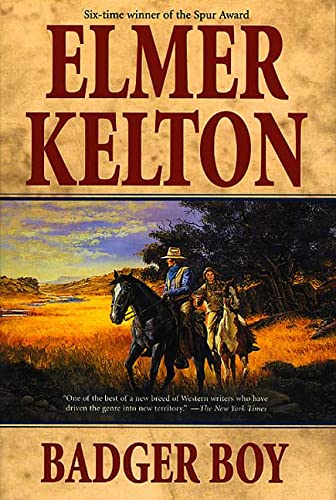



The Texas Frontier, 1865 The Civil War is over and Texas is reluctantly yielding to the Union soldiers spreading across the state, even into the dangerous Comanche country. David "Rusty" Shannon, proud member of a "ranging company" attempting to protect Texas settlers from Indian depredations, finds that the rangers are being disbanded. He makes his way home to his land on the Red River, hoping to take up the life of a farmer and the hand of the beloved girl he left behind, Geneva Monahan. But Geneva has married in Rusty's long absence and the country is filled with hostiles—not just Indians, but hate-filled Confederates, overbearing Union soldiers, and army renegades. Rusty's youth as a captive of the Comanches returns to haunt him when, in pursuit of Indian raiders, he takes as prisoner Badger Boy, a white child taken from his murdered parents by a Comanche warrior. “A terrific read.”— The Dallas Morning News “Award-winning writer Elmer Kelton—a star in the shrinking Western genre—totes you effortlessly to the post-Civil War Texas frontier, where white settlers were just learning to live with freed slaves, Comanches and each other . . . . His characters, like Shannon, make mistakes, are far from perfect and take life in stride.”— The New York Post “Kelton is a master of both plot and character development, and his Rusty Shannon is a down-to-earth, dusty cowboy whose exploits always thrill Kelton’s fans.”— Publishers Weekly (starred review) Elmer Kelton , author of more than forty novels, grew up on a ranch near Crane, Texas, and earned a journalism degree from the University of Texas. His first novel, Hot Iron , was published in 1956. For forty-two years he had a parallel career in agricultural journalism. Among his awards have been seven Spurs from Western Writers of America and four Western Heritage awards from the National Cowboy Hall of Fame. Among his best-known works have been The Time It Never Rained and The Good Old Boys , the latter made into a television film starring Tommy Lee Jones. He served in the infantry in World War II. He and his wife, Ann, a native of Austria, live in San Angelo, Texas. They have three children, four grandchildren and five great-grandchildren. Badger Boy CHAPTER 1 The Texas frontier spring, 1865. Rusty Shannon saw brown smoke rising beyond the hill and knew the rangers had arrived too late. The Indians had already struck, and by now they were probably gone. He had expected trouble, but his pulse quickened as if the smoke were a surprise. He signaled his five fellow patrol members and spurred his black horse, Alamo, into a run. He did not have to look back. The men would follow him; they always did though he had no official rank. He was a private like the rest, but they had fallen into the habit of looking to him for leadership. Nor was he noticeably older than the others. Orphaned early, he could only guess he was about twenty-five, give or take a little. A harsh outdoor life had made him look more than that. He had accepted the responsibility of leadership by default, for no one else had offered to take it. Back East, the strong nicker of the war horse was fading to a faint and painful whinny as the tired and tattered Confederacy kept struggling to its feet for one more battle and one more loss. To Rusty's independent, red-haired mannerof thinking, it was high time the Richmond government conceded defeat and let the guns fall silent. Even from his faraway vantage point at the edge of Comanche-Kiowa country he saw clearly and with pain that the war had bled both sides much too long. The Texas frontier had a war of its own to contend with, and it was far from over. Rusty Shannon was tall and rangy, some would say perpetually hungry-looking. Meals were a sometime thing when frontier rangers scouted for Indians. Often the men were too pressed to stop, and at other times they simply had nothing to eat. He considered himself a soldier of sorts, though he owned no uniform. Texas had not even provided him a badge as a symbol of ranger authority. The cuffs were raveled on his grimy homespun cotton shirt, the sleeves mended and mended again. His frayed gray trousers seemed as much patch as original woolen fabric, for the long war had made new clothing scarce and money scarcer. Red hair bristled over his ears and brushed his collar. Forced to be frugal, rangers cut each other's hair. It was often a rough job of butchery, but appearances were of little concern. Staying alive and helping others stay alive were what counted on the frontier. Riding their assigned north-south line past the western fringe of settlement, the patrol had come upon tracks of fifteen to twenty horses at dusk yesterday. By order of Texas's Confederate government in Austin, the rangers were duty-bound to locate and take into custody any deserters or conscription dodgers who might be idling out the war in the wild country beyond the settlements. Rusty knew the approx